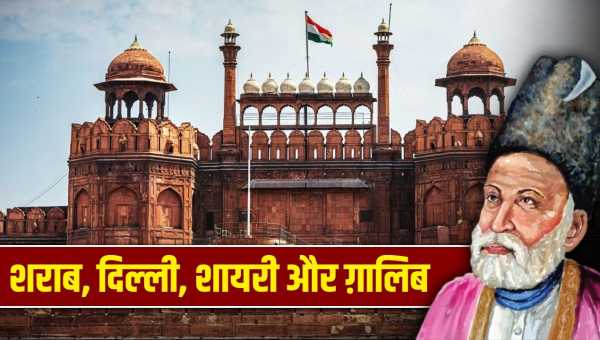
Delhi was not just a city, for Ghalib it was the treasure of his soul, his identity and his memories. Mirza Ghalib, fond of alcohol and having deep philosophy of life, also wrote many poems on Delhi. Sometimes with enthusiasm and excitement, and sometimes while mourning the decaying culture. The rebellion of 1857 and the destruction that followed shook Ghalib. The pain of Delhi is heard in a very deep tone in his poetry.
Come, on the occasion of Mirza Ghalib's birth anniversary (27th December), let us try to know some of his famous poetry related to Delhi, its context and simple meaning.
There is a lion-
Delhi, once a city, is no more.
There is only one city, Muntakhb in the world,
In which neither you nor I live, there are neither friends nor rivals.
This couplet is usually quoted to explain Ghalib's Delhi-adoration and subsequent disappointment. For Ghalib, the real Delhi was the one which was full of Urdu-Persian literature, gatherings, royal courts and intelligent people. After 1857, when the city started falling into ruins, he felt that the old Delhi was no longer Delhi.
Ghalib is saying that the real Delhi was the one where there was life, culture and friendship. Now the ruined city is Delhi in name only. The real city is the one where it has its own people, is vibrant, has a culture even with hostility; Otherwise empty buildings do not make a city.
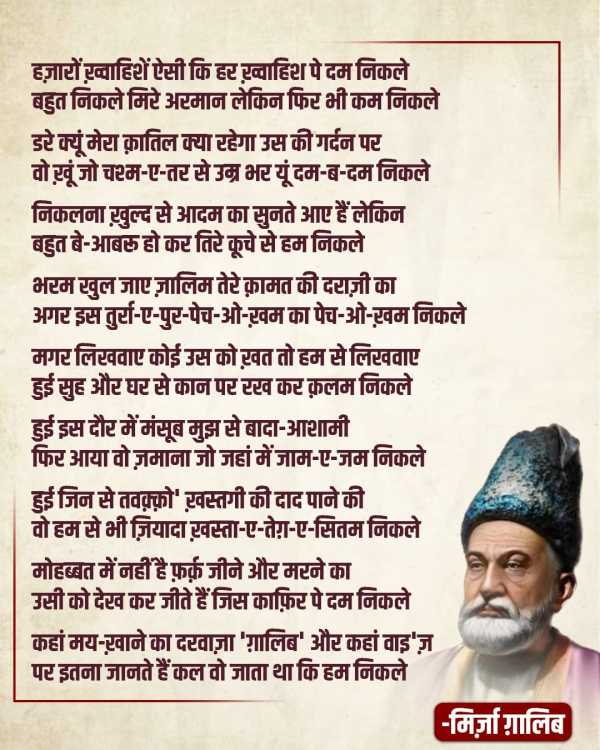
see another lion
There are other very good and happy people in this world,
It is said that Ghalib has a style of speech and
This couplet does not directly mention Delhi, but for Ghalib, his identity was due to being a Dehlavi i.e. from Delhi. He was the last strong pillar of the poetry tradition of Delhi. His style, his language, his accent, everything was derived from the Ganga-Jamuni culture of Delhi.
The meaning of this couplet can be said like this - There are many good poets in the world, but people believe that Ghalib's way of speaking, his delicacy and elegance is different from all others. This style is actually the result of the same old language and atmosphere of Delhi.
Let one more couplet be read.
Some day in my life, my heart will be in Delhi,
Memories remain in the heart in the form of pain.
This sentiment is reflected in Ghalib's letters and couplets in which he remembers Delhi even after being away from it. He was born in Agra, but his real love was for Delhi, and it remained till his last breath.
The meaning of this couplet can be said like this - If there is any good day in life, it will be the one when the heart can breathe again in the streets of Delhi. Old memories keep piercing the heart like a wound, because that old time, old Delhi is no longer the same.
see the fourth couplet
Which is called Delhi, where a dream resided,
Now that dream haunts me even after being reduced to ashes.
For Ghalib, Delhi was a dream, that is, a dream which included love, poetry, music, joys and sorrows, gatherings, debates, etc. The rebellion of 1857 and British slavery broke this dream.
Ghalib says that Delhi is not just the name of buildings; That was a complete dream. Now that that dream is broken and ruins are left, that broken dream still does not allow them to sit in peace. That is, the memory of the old world of Delhi keeps him restless every moment.
The devastation of 1857 and Ghalib's sorrow
The devastation that Delhi saw during and after Ghadar-e-Azadi (1857) was in front of Ghalib's eyes. He himself was its witness. He wrote in his letters how many cities were destroyed, how many people were killed, how many mansions were in ruins. The echo of this pain is also heard in his poetry.
look at another lion
This is the condition of ruined Delhi, Ghalib.
There was no one left to cry, no one left to laugh.
With the help of this couplet, Ghalib says that in the ruined Delhi there are no more gatherings of laughter, nor even the etiquette of crying; People scattered, houses were looted, and the city lost its charm. As if a living city had suddenly become old and silent.
Ghalib described the specialties of Delhi sometimes with humor, sometimes with sarcasm and sometimes with love. In many of his poems there is a hint of Delhi's elegance, its cunningness, its language, its grandeur.
see another lion
There is a story of love in every street of Delhi,
The color of passion is also found in the sand here.
It means that here at every turn, every street, every intersection there is a story of some love or the other. The color of madness is present even in the soil of Delhi.
Liquor, party and Delhi
Ghalib's personality seems incomplete without the mention of alcohol. For him, alcohol was not only an intoxicant but also a means of increasing worries and imagination. Alcohol, poetry, ghazals, debates, all this used to go on together in the gatherings of Delhi. Ghalib remembered both alcohol and Delhi together many times.
See how?
Those nights of Delhi, those gatherings, all those drinks,
Now the jam is in my hands, but it is not the same.
Meaning, Ghalib still has a cup of wine, but the old atmosphere is no more, neither the friends, nor the gathering, nor the same enthusiasm. The real fun was with friends, gatherings and the excitement of the city, which has now ended.
Should I also stay or should I stay in Delhi?
At one place, Ghalib also expressed his sentiment about Delhi that if Delhi is no more, then what is the point of living? The lives of both the city and the individual seem to be tied to each other.
Read the couplet-
If I live in Delhi, I also love to live.
When the heart itself is destroyed, then what is the house for?
Its meaning is something like this - Here consider Delhi not just as a city but also as the condition of the heart. Ghalib wants to say that as long as Delhi's life, its beauty and its culture are alive, I feel like living. When all that disappears, life becomes meaningless.
Ghalib's Delhi, love and mourning too
In Ghalib's poetry, Delhi never appears as just a place but as a living character. Sometimes like a friend, sometimes like a beloved, sometimes like a memory of bygone times and after 1857, like a wounded, bleeding old city.
The clarity with which Ghalib, empowered by a cup of wine, described the splendor of Delhi, its devastation, its culture and its loneliness, is unmatched in Urdu literature. In his eyes, Delhi was not just the capital, but the colony of his heart, whose destruction he bore throughout his life, and which he revived forever through his poetry.
-
US : Air Travel Disrupted by Severe Winter Storm During Holiday Rush

-
Patna: Launches Coordinated Drive to Rescue Children from Street Begging and Ensure Long-Term Rehabilitation

-
Chhapra Tragedy: Silent Winter Tragedy Claims Four Lives in Chhapra Home

-
England’s Melbourne Revival: A Landmark Test Win That Reignited the Ashes Battle

-
Kis Kisko Pyaar Karoon 2 Re-Release: Kapil Sharma’s Comedy Sequel Set for a Fresh Box Office Run in 2026