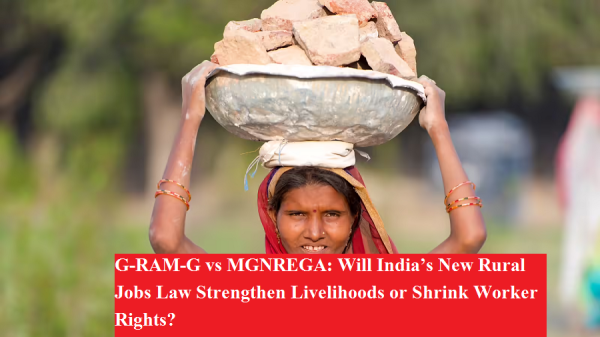
India’s rural employment landscape is undergoing a historic transformation. After nearly 20 years of supporting millions of rural households, the Mahatma Gandhi National Rural Employment Guarantee Act (MGNREGA) has officially been replaced. The new policy — Viksit Bharat Guarantee for Rozgar and Ajeevika Mission (Gramin), popularly known as VB G-RAM-G — has sparked nationwide debate on whether it will boost livelihood opportunities or restrict existing rights.
A Two-Decade Lifeline Now Discontinued
When MGNREGA was introduced in 2005, India was facing a rural crisis: farmer suicides were rising, distressed migration to cities was accelerating, and agricultural income was stagnating. The Act provided a legal right to at least 100 days of paid work every year — a revolutionary safety net for the poorest families.
Now, the country stands at another crossroads. Instead of questioning whether rural workers need support, the nation is asking:
Is the new system stronger — or simply smaller?
A Scheme Rooted in Constitutional Rights
The foundation for MGNREGA was laid when the Supreme Court ruled that the Right to Life under Article 21 must include the Right to Food and dignity. For years, the Act served as a direct attack on extreme poverty, contributing to:
✔ Poverty reduction
✔ Women’s empowerment
✔ Local infrastructure and water conservation
✔ India’s Sustainable Development Goals
Crucially, it empowered rural citizens to demand work, and if work was not provided, they could claim unemployment allowance.
What Changes Under G-RAM-G?
The government calls the new Act an upgraded, modern version of MGNREGA — increasing guaranteed work days from 100 to 125. But several major changes have raised concerns:
1️⃣ Seasonal Restrictions
A mandatory 60-day halt on public works during sowing and harvesting seasons aims to ensure farm labour availability, but it limits income for:
-
Landless labourers
-
Women workers
-
Migrants and marginal groups
2️⃣ Centralized Funding Control
The guaranteed funds shift from a demand-based system to approval by the Centre — reducing village-level autonomy.
3️⃣ Higher Financial Burden on States
Under the previous Act, the Centre paid 100% of unskilled wage cost.
Now, states must share funding at 60:40, straining fiscal capacity — particularly in poorer states.
Experts argue this could reduce the scale and reach of rural job creation.
Losing the Spirit of a Rights-Based Law?
One of MGNREGA’s biggest achievements was its impact on women’s workforce participation. Female labour force participation nearly doubled — from 24.6% in 2017-18 to 47.6% by 2023-24. For many women, the scheme provided:
-
Independent income
-
Local work opportunities
-
Social mobility
Critics warn that limiting accessibility to funds and locations weakens the universal right to work that MGNREGA provided.
What Lies Ahead for Rural Workers?
The promise of 125 days of employment looks like progress on paper. But labour pauses, tighter central control, and financial barriers for states signal a shift:
➡ From a legal entitlement
➡ To a discretionary welfare scheme
As G-RAM-G rolls out fully, millions of workers who depended on MGNREGA during the pandemic and recurring agricultural crises now face uncertainty.
The core question remains:
Will the new law empower rural India — or leave its most vulnerable citizens with fewer choices and weaker protections?
-
Jasprit Bumrah, Hardik Pandya Set To Miss IND vs NZ ODI Series: Report

-
Amit Shah To visit Assam On Monday, Inaugurate Projects Worth Over Rs 800 Crore
-
From Shubhanshu Shukla’s ISS Mission To NISAR Launch, India’s Space Push Sets Stage For Gaganyaan In 2026

-
Tripura Student Murder Case: Uttarakhand Govt Takes Strict Stand, CM Pushkar Singh Dhami Says Such Incident Is Completely Unacceptable
-
Kiran Rao Shares Health Update After Appendix Surgery, Posts Photo Of Swollen Lips Due To Allergic Reaction