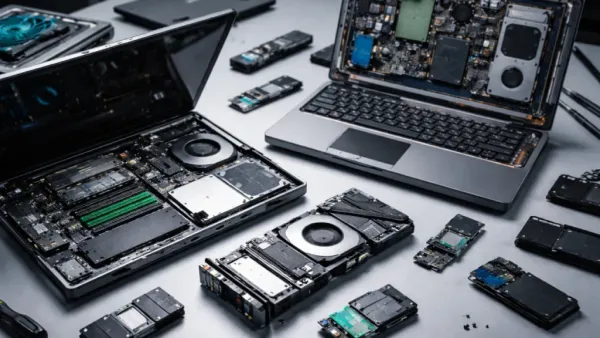
Highlights
- Framework leads modular laptops with upgradeable RAM, SSDs, and even GPU modules.
- MNT Reform emphasises open-hardware sovereignty but faces limited module ecosystem support.
- Modular laptops balance sustainability with trade-offs in cost, refinement, and market adoption.
Modularity promises to cure a perennial problem in personal computing: planned obsolescence. The idea is simple and appealing: make individual components accessible, standardised, and replaceable so a machine can evolve with a user’s needs rather than be discarded. In practice, the architectural and commercial trade-offs mean modular laptops occupy a niche between mainstream, sealed ultrabooks and fully custom desktop PCs.
This article examines the current generation of modular laptops that are actually for sale, evaluates how far they deliver on swapable RAM, storage, and CPU claims, and assesses whether they represent a long-term, sustainable alternative or a specialist hobbyist plaything.
What “modular” means in laptops today
Not all modularity is the same. For some vendors, modularity is a suite of external expansion cards or user-replaceable I/O ports; for others, it includes user-accessible memory and storage; a few push further and make the system board or processor module replaceable. The distinction matters because repairability and longevity track directly with the granularity of replaceable parts.
User-replaceable RAM and SSDs are helpful and relatively common; a truly future-proof laptop would also allow the CPU, GPU, and mainboard to be upgraded without replacing the whole chassis. The industry has seen several attempts to reach that ideal, but only a small number of companies are selling machines now that come close.
Framework: the most visible commercial effort
Framework (US) has become the reference point for modern modular laptops. Its current product line, notably the Framework Laptop 13 and the larger Framework Laptop 16, is explicitly designed so owners can open the chassis, swap memory and storage, change port modules, and even replace or upgrade the mainboard and GPU modules that Framework sells as discrete parts. Framework’s marketing and product strategy is unambiguous: sell a serviceable chassis with standard connectors and make spare parts available on a marketplace so users can upgrade over time. The company’s 2025 refreshes added AMD Ryzen AI 300-series mainboards and, for the 16-inch model, an officially supported discrete GPU module (NVIDIA RTX 5070); a significant engineering achievement for a laptop that foregrounds modularity.
From a practical standpoint, Framework’s machines allow user-replaceable DDR5 SO-DIMMs (two slots) and M.2 NVMe storage, and the company explicitly documents configurations up to very large capacities (Framework markets memory options up to 96GB in some DIY configurations, and the 16-inch design supports high storage totals across multiple SSDs). Notably, official spec pages and marketplace listings make it straightforward to buy replacement RAM, SSDs, mainboards, and other modules. That level of transparency and parts availability materially reduces the friction of mid-life upgrades.

Yet Framework does not come without its downsides. The independent examinations emphasise that the modular layout might lead to an industrially non-polished product: squeaks, not-so-rigid chassis, and slightly increased thickness compared to the thinnest luxury models have been mentioned. The performance per dollar and finish quality sometimes do not reach the level of conventional laptops in the same price category, particularly when the configurations come with discrete GPUs. To sum up, Framework prefers to give up some refinement and close integration to gain modularity and repairability; the acceptability of this trade-off is determined by the priorities of the buyer.
MNT Reform and open-hardware alternatives
If Framework aims modularity at a mainstream-enthusiast market, MNT Research takes a more radical, open-hardware route. The MNT Reform is an explicitly open-hardware laptop where the processor and other core subsystems are organised as swappable modules. It targets users who prefer architecture transparency, long-term software control (Linux), and the ability to tinker at the hardware level.
MNT’s product line, including tiny “Pocket Reform” variants and the full-sized Reform, offers processor modules that can be changed, along with clearly documented schematics and community support. These devices are not performance leaders versus mainstream x86 ultrabooks, but they excel in repairability, openness, and longevity. For those whose primary value is sovereignty over hardware and software, MNT remains compelling.
However, MNT’s approach highlights a limiting reality: module ecosystems are small. If a laptop’s CPU is modular, but there are only two processor modules ever produced, the practical benefits for future upgrades are constrained. Open-hardware models rely on strong community and third-party vendor support to expand available modules; without that, the theoretical upgrade path risks evaporation.
Real trade-offs: engineering, economic, and market dynamics
Three structural trade-offs explain why modular laptops remain rare and why the promise of “CPU swapability” is difficult to scale.
First, the problem of engineering is very complicated. The increasingly intense integration of CPUs, GPUs, and memory subsystems is being done with their tight thermal and power envelopes. It is very challenging to design a chassis and thermal system that can support a wide variety of TDPs and power profiles without increasing the weight, thus shortening the battery life. The GPU module of Framework for the 16-inch model is an engineering feat because typically, discrete laptop GPUs require custom cooling and power delivery.
Secondly, there are commercial factors. Most of the major Original Equipment Manufacturers (OEMs) gain a lot from margins that come from refresh cycles and component integration; the existence of a long-lived, easily upgradable platform draws partly from their business model. Smaller companies (Framework, MNT) can emphasise longevity as a selling point, but they have the disadvantage of being less scaled: higher manufacturing costs per unit, smaller R&D budgets, and less robust supply chains for replacement modules.

Third, standards and third-party support. For modularity to be genuinely future-proof, it needs a third-party ecosystem of compatible modules: multiple vendors producing memory, storage, and alternate mainboards. Framework has built a nascent marketplace and an enthusiastic community, but its module ecosystem is far smaller than the commodity PC market. MNT’s open approach could encourage third-party uptake, but that remains a long game.
Product evaluation
For a user who puts longevity, repairability, and being able to upgrade performance step by step instead of having to buy a new machine first, the Framework is still the most obvious commercial option today. The presence of user-replaceable DDR5 SO-DIMMs, multiple M.2 storage slots, a modular I/O card, and consumable replacement parts allows the user to do good upgrades without the help of any specialists.
The introduction of discrete GPU and mainboard upgrade modules for the 16-inch model is something that sets it apart from the market, but does so at a higher price and with some ergonomic trade-offs in comparison to not only sealed flagship notebooks but also desktop tiered ones. Buyers should be okay with a bit of a DIY approach and also be ready to face a situation where a modular machine does not have the same finish or quietness as the closed ones.
MNT Reform, on the other hand, is better for people like the scientists, developers, and users who are aware of the privacy issues and who appreciate open hardware and full documentation. It is not a top-end gaming or content creation performance machine, but it does allow for architectural experimentation and long-term maintainability in ways that a typical laptop would not. For someone who is looking for a strong device that can last for many years with easy access to repair schematics and replacement parts, Reform is a strong candidate.
Modular laptops still remain a niche for the majority of people looking for thinness, cutting-edge industrial design, the best battery life per watt, or the lowest initial price. Major computer makers such as Lenovo, Dell, and Apple still prefer to make hardware and software tightly integrated; upgrading the CPU or GPU is practically impossible on most of today’s consumer-grade machines. Such a situation will last until there is a bigger commercial case — either regulatory (right-to-repair laws) or consumer demand — for modularity.
Conclusion: sustainable alternative or overhyped niche
Modular laptops are no longer a thought experiment. Framework has shown that a commercially viable, reasonably high-performance, upgradeable laptop can be produced at scale, and MNT demonstrates the possibilities of open-hardware modularity. The fundamental promise, turning the laptop from a disposable commodity into a serviceable, upgradeable platform, is now realisable in practice. Yet important limitations remain: higher prices for equivalent raw performance, engineering compromises in chassis refinement, and the fragility of module ecosystems.

In case sustainability and long-lasting use are your main worries, a modular laptop (Framework as the practical mainstream choice; MNT for open-hardware purists) is an excellent investment in principle. If you care about getting the best performance per rupee, having the most beautiful industrial design, or an extremely light carrying weight, you will still have to rely on non-modular laptops to be your best choice for a long time. The overall success of modular laptops will be based on whether the vendors will be able to grow the ecosystems, improve the fit-and-finish, and scale the prices, or if the regulations and the consumer expectations change the economics of modular, repairable designs.
-
Patient in Mumbai Surgeon in Shanghai, India’s first cross-border robotic surgery successful at Ambani Hospital
-
Kannada-Tamil TV actress Nandini CM passes away, wave of mourning in the industry

-
Budget-friendly New Year 2026 events and parties under ₹1000 in Delhi NCR you shouldn’t miss

-
New Year 2026: Adopt these 5 small health resolutions in the New Year, you will remain fit and energetic throughout the year.

-
Attention PAN Card Holders! Check Your Credit Report Today To Stay Safe From Financial Fraud, Follow These Easy Steps