The retired retail worker was learning how to use her new metal detector when it started bleeping by the moss-covered ruins of a building. After Plumridge dug the nugget out of the shallow dirt with a plastic trowel, a guide estimated it was around 0.2 of a gram of gold, worth about A$40 ($26.58).
“But to me, it’s worth a million dollars,” said the 63-year-old, who had bought the detector only a few days before. “My heart is singing.”
Plumridge’s story is becoming more common, as hobbyists flock to Australia’s 9,600 sq km “golden triangle” in the heart of Victoria state, known as one of the world’s most prospective regions for gold nuggets.
Prospectors have been spurred on by record gold prices, social media, the success of TV show Aussie Gold Hunters, and a love for the outdoors, according to Reuters interviews with a dozen gold hunters.
Plumridge’s detector, Minelab’s Gold Monster 2000, which she bought for A$2,999, sold out across the country within weeks of its Oct. 20 launch, according to Leanne Kamp, joint owner of Lucky Strike Gold, a prospecting shop in Geelong.
“It’s a great price point and we have seen a big jump in sales this year, partly because the gold price has got everyone’s interest,” said Kamp, who has led prospecting tours since 2007.
“We get a lot of internationals. Next week we have some Germans coming. Germans love the gold. The Swiss seem to love the gold too. And we have some coming over from the U.S.,” she said.
The chance of finding nuggets on historic sites improves with each iteration of detectors, which is why there is a rush for new models as soon as they are released, she added.
World’s biggest nuggets
Hobbyists have flocked to 19th-century gold rush towns like Ballarat, which laid the foundation for Melbourne’s early wealth and helped make Australia one of the world’s top three gold producers.
The region has yielded the world’s biggest nugget, the Welcome Stranger at 72 kg, found in the 1860s, as well as the Hand of Faith, the largest nugget found with a metal detector at 27.2 kg in 1980. As recently as February 2023, an amateur prospector unearthed a 4.6 kg nugget in the region with a detector, according to the state government.
|
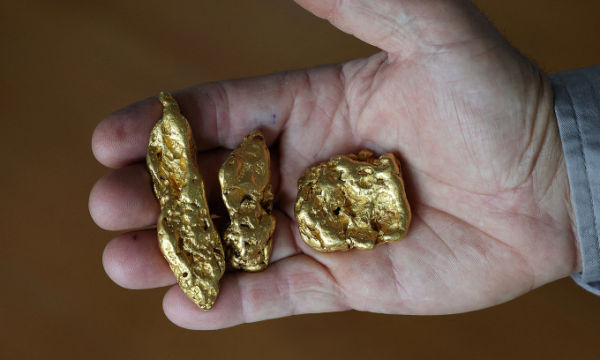
A shop worker poses holding three gold nuggets at The Gold Centre store, in Maryborough, Australia, Nov. 28, 2025. Photo by Reuters |
The lure of large nuggets is one of the draws for Damian Duke, 39, who works in construction. Duke used to go prospecting with his father who died three years ago. Now he takes his own son, Ethan.
The 11-year-old inherited his grandfather’s detector, and Duke has recently upgraded his machine, he told Reuters.
“Where prices are now, you do have the chance of striking a life-changing piece of gold,” he said.
Gold has chalked up successive records this year, surging above US$4,500 a troy ounce on Friday. Goldman Sachs expects prices will reach US$4,900 by the end of 2026, with further gains likely if private investors continue diversifying their portfolios amid geopolitical and fiscal uncertainty.
In Victoria, fossickers must buy a permit from the state government. The permit allows them to fossick using only hand tools and to keep any gold they find.
Demand for the miner’s right permits, which cost A$28.60 each and last for a decade, has hit all-time highs, at almost 16,000 by November, from nearly 11,000 last year, according to figures from Victoria’s Department of Energy, Environment and Climate Action, supplied exclusively to Reuters.
In total, there are more than 100,000 active miner’s right permits in Victoria.
A dream of riches may drive people to get out, but they stay out because of the psychological benefits that come from the focus on the hunt, being outside in nature, and connecting with others, prospectors said.
“It’s really good for your mental health, being out here. You take it all in, you can’t think about anything else – I love looking at all the wildflowers,” said Kelly Smith, a 50-year-old from the country town of Koondrook, who was prospecting with her partner on a training session organized by The Gold Centre in Maryborough.
“You’re not guaranteed to find anything. But you’re not going to find anything at all if you don’t look.”
Global phenomenon
Victoria’s latest gold rush is part of a broader phenomenon, said Ben Harvey, executive general manager of Minelab at Adelaide-headquartered Codan, which is the world’s largest maker of hand-held metal detectors.
Alongside Codan’s communications division, strong detector sales in its home market of Australia as well as in Africa and the Americas have helped double the firm’s share price this year.
In Africa, demand may be led by artisanal miners working in cooperatives to improve their standard of living, Harvey said. In Latin America, there is also recreational interest from hobbyists searching for coins and other treasure, he told Reuters in an interview.
Behind the success is a push by Codan’s team of engineers to improve technology to cut down on background noise so detectorists can focus on the gold, he said.
“What a prospector is looking for is, when they go out, they want to find gold, and they want to find more gold than they found last time,” he said.
-
Good news for railway passengers; Avail 3% discount on general tickets booked through THIS app, 6% discount for…

-
Big cat 'as tall as car bonnet' filmed prowling driveway in UK town

-
Who is Martha from the Wake Up Dead Man cast?

-
Stop using popular 'temporary' solution to clear drains that makes it 'far worse'

-
“Not Natural Exit….,” Ex-Cricketer Questions Virat Kohli & Rohit Sharma's Sudden Test Exits