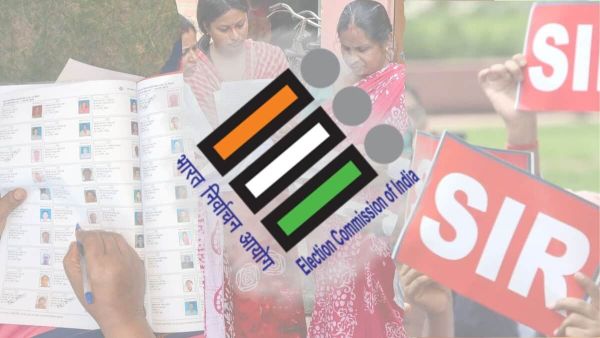
Kolkata: As West Bengal edged closer to the assembly polls due next year, 2025 unfolded as a year in which the mechanics of voting, border anxieties and sharpening communal lines eclipsed governance, turning the SIR of electoral rolls and cross-border unrest into the state’s defining political battlegrounds.
If the Lok Sabha elections verdict of 2024 fixed the poll arithmetic, the politics of 2025 fixed the mood.
A steady undercurrent through the year was the spillover from neighbouring Bangladesh. Political instability and reports of communal violence across the border, including attacks on minorities and the killing of a Hindu man, fed directly into Bengal’s political discourse.

At home, the detention and pushback of Bengali-speaking migrant labourers from BJP-ruled states like Odisha, Assam, Delhi, Maharashtra and Gujarat on suspicion of being Bangladeshis ignited a political firestorm in West Bengal.
With the 2026 polls approaching, the Mamata Banerjee-led TMC went on the offensive, sharpening its Bengali identity pitch and accusing the BJP of institutional and linguistic profiling under the guise of national security, a strategy that blunted the saffron party’s Hindutva surge in the 2021 elections.
At the heart of Bengal’s churn lay the Election Commission’s Special Intensive Revision (SIR), the first such exercise since 2002. Draft rolls published under the revision saw over 58 lakh names dropped for reasons ranging from death and migration to duplication and untraceability.
Large sections of the electorate, particularly in border districts and refugee-settled pockets of Nadia, North and South 24 Parganas, Malda and parts of north Bengal, found themselves unsettled by notices, hearings and documentation requirements.
For the Matua community, a Dalit Hindu voting bloc influencing nearly 50 Assembly seats, the revision revived long-standing anxieties over paperwork and citizenship.
The TMC framed the exercise as a threat to genuine voters, accusing the Centre of engineering disenfranchisement months ahead of the polls.
The BJP countered by backing the revision as a constitutional necessity, accusing the ruling party of shielding illegal infiltrators.
“A clean electoral roll is the foundation of democracy. Genuine voters have nothing to fear,” Leader of the Opposition Suvendu Adhikari said.
As the hearing part of the SIR progressed, the voter list, rather than governance, became the organising axis of the election narrative.
“Bengal has entered a cycle where the election debate is about the vote itself, not about schemes,” political analyst Biswanath Chakraborty said. “That alters both the emotional pitch and the risk profile of the campaign.”
In June, Sunali Khatun, a pregnant migrant resident of Birbhum, was detained by Delhi Police on suspicion of being a Bangladeshi and pushed across the border.
Following Supreme Court intervention, she was repatriated along with her minor son in December, an episode the TMC projected as emblematic of profiling and institutional excess.
Along the international border, reports of undocumented Bangladeshi nationals being pushed back through West Bengal sectors also fed competing political claims.
The BJP cited the movement as evidence of infiltration being exposed, while the TMC accused the opposition of manufacturing panic and stigmatising Bengali-speaking people.
The shadow of Bangladesh grew larger as the year progressed. BJP leaders repeatedly invoked developments across the border to flag minority rights and regional security concerns.
The TMC condemned attacks on minorities in Bangladesh and accused the BJP of exploiting regional instability to polarise people.
Communal polarisation within the state deepened after riots in parts of Murshidabad in April. Triggered by protests against the Waqf Amendment Bill, the clashes involved arson and killing of three people.
The BJP cited the violence as evidence of lawlessness and minority appeasement. The TMC alleged provocation and external interference, insisting that the administration acted decisively to restore order.
Murshidabad remained politically sensitive throughout the year, particularly after the laying of a foundation stone for a mosque said to be modelled on Ayodhya’s Babri Masjid, sharpening symbolism and rhetoric amid a charged atmosphere.
“As elections approach, symbolic acts begin to matter more than administrative outcomes,” Chakraborty said.
Institutional shocks compounded the unease. The Supreme Court verdict upholding the cancellation of nearly 26,000 school jobs linked to irregular appointments through the School Service Commission delivered a social and political jolt.
Protests by terminated candidates became a recurring feature in Kolkata, strengthening the opposition’s corruption narrative, while the state government blamed procedural failures.
Apart from these, the TMC accused the Centre of withholding nearly Rs 2 lakh crore in dues, while the BJP alleged fiscal mismanagement and governance failure.
The BJP sought to balance its infiltration and national security pitch against the risk of unsettling Hindu voters affected by SIR. The Left and Congress remained peripheral, retaining limited pockets of influence without disrupting the bipolar contest.
-
List of 13 actors who performed Umrah and Haj in 2025

-
Zia’s funeral draws dignitaries from South Asian nations
-
Indian tea industry better placed in 2025 compared to last year
-
Hyderabad: Mock fight using Allu Arjun, Jagan masks goes viral
-
Arsenal make Jurrien Timber decision for Aston Villa clash after injury blow