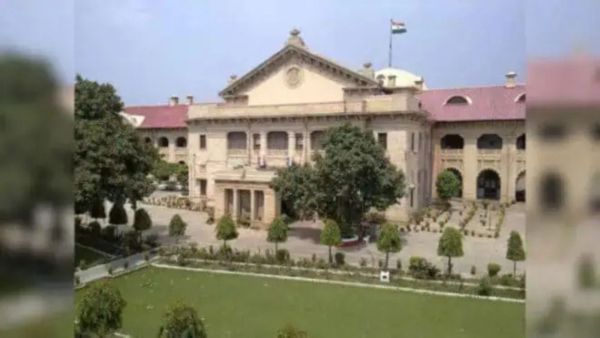
Allahabad: The Allahabad High Court has come down hard on the Uttar Pradesh Police, saying a large section of its officers are more loyal to whoever is in power than to the Constitution, and that the state’s administrative machinery has long been used as an instrument of personal dominion rather than public service.
The observations, made by Justice Vinod Diwakar, came in a matter related to the Uttar Pradesh Gangsters and Anti-Social Activities (Prevention) Act, 1986, in which an accused had approached the court challenging action taken against him under the law.
Justice Diwakar did not return a final verdict on the broader legal questions, which are pending before the Supreme Court, but used the occasion to deliver a pointed assessment of how policing functions in the state.

Transfer economy, political loyalty
The High Court said transfers, postings and promotions in the UP Police have for long served as tools of political patronage. Officers seen as loyal to the ruling establishment are rewarded with coveted urban postings, while those who show independence are packed off to inconsequential assignments.
“The vertical loyalty of officers runs not toward the Constitution but toward the ruling dispensation. Field officers, acutely conscious of the transfer-posting economy, calibrate their conduct to satisfy political superiors,” the court said.
It added that encounter killings, selective crackdowns and targeted use of the Gangsters Act against inconvenient individuals had periodically drawn judicial notice.
Process bypassed, orders defeated
The High Court was equally scathing about how procedure is treated on the ground. First information reports (FIR) are registered or suppressed for ulterior motives, arrests are made without due process and preventive detention provisions are invoked arbitrarily, it said.
“A considerable section of the officer cadre treats the rule of law not as a constitutional obligation but as an operational inconvenience… Judicial orders are complied with in form but defeated in substance,” Justice Diwakar observed.
The judgment also censured the State Home Secretary’s office, saying certain officers who rose to that position had, in practice, served as conduits for self-serving interests. Recommendations on postings, approvals of departmental proceedings and responses to court proceedings had in such instances been shaped by personal or extraneous considerations, the court said.
It directed the government to independently evaluate the suitability and effectiveness of its officers in the department.
Bikru as a case in point
The court cited the 2020 Bikru village ambush, in which eight policemen, including a Deputy Superintendent of Police, were killed during a raid to nab gangster Vikas Dubey, to illustrate the culture of impunity it was describing. The officer responsible for overseeing that operation received only a formal caution, the High Court noted.
“This Court finds it difficult to reconcile such a disproportionately lenient outcome with the gravity of the supervisory failure involved,” it said, adding that precisely this culture of unaccountability allowed the “feudal and politically patronised administrative ecosystem” to persist.
The constitutional apparatus of the state must remain answerable to the law and to the Constitution, and not to any ruling establishment, the court said.
-
Vaibhav Sooryavanshi Earns Team India Call-Up For Upcoming Tours & Asian Games Following Stellar IPL 2026 Season

-
KCET UGCET Result 2026 OUT: Female Candidates Outnumber Male Students By Over 41,000

-
Bharat Bhhagya Viddhaata First Review: Odisha Chief Minister Mohan Charan Majhi Calls Kangana Ranaut's Tireless Efforts 'Commendable'

-
Veteran Actor Salim Kumar Hospitalised In Kochi, Placed On Ventilator Support After Sudden Health Complications
-
'Shitty JioHotstar...': Bigg Boss Fame Bandagi Kalra Complains Of '100 Ads' During Dhurandhar 2 OTT Streaming