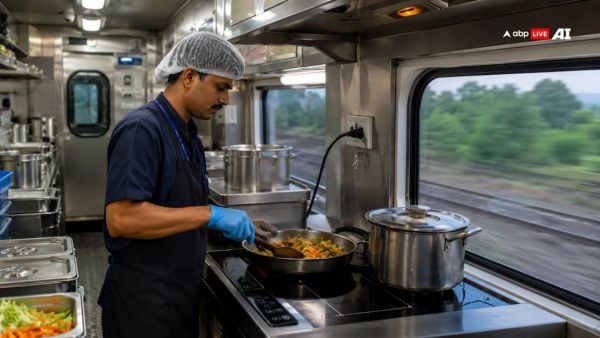
The impact of the US-Israel and Iran war has finally reached the pantry cars of Indian trains. A sharp shortage of commercial LPG cylinders has forced the Indian Railway Catering and Tourism Corporation (IRCTC) to rethink how it provides meals to its passengers.
After years of preparing food at ground-level base kitchens, the railway catering arm has returned to onboard cooking. However, cooking gas has now been replaced by electric induction stoves.
Why There Is A Shortage
The disruption traces back to the Strait of Hormuz, a narrow sea channel through which much of West Asia's oil and gas moves to the rest of the world. Conflict in the region has choked those supply lines. According to data from the PIB, India imports about 60 per cent of its LPG needs. Before the current crisis, nearly 90 per cent of that imported gas used to arrive through this single route.
The fallout has been swift and wide. On June 7, state-owned oil marketing companies announced a price hike for domestic LPG cylinders across the country. The government has also cut the number of subsidised cylinders available to Pradhan Mantri Ujjwala Yojana beneficiaries from nine to four per year. The scheme provides cooking gas at subsidised rates to low-income households. For those families, the cut is a direct hit to the monthly budget.
India's heavy dependence on imported cooking gas means its kitchens, both domestic and commercial, remain tightly linked to geopolitical events thousands of kilometres away.
What IRCTC Is Doing
IRCTC manages catering across 1,400 trains and serves around 1.7 million meals every day. Keeping that running requires roughly 1,000 commercial LPG cylinders daily, used across cluster kitchens, base kitchens, and station food counters. With supply squeezed, the corporation has had to make rapid changes.
IRCTC Chairman and Managing Director Sanjay Kumar Jain said, as reported by ET, that vendors have now been permitted to cook inside pantry cars, which already carry the necessary safety infrastructure. Most premium services, including Rajdhani, Shatabdi, Duronto, and Vande Bharat trains, run on Linke Hofmann Busch (LHB) coaches. These coaches have pantry cars that are now being used to prepare hot meals while the train is in motion, powered entirely by electricity.
Induction cooking has also been introduced at large railway stations. Jain added that IRCTC has coordinated with Indian Oil Corporation, Bharat Petroleum Corporation, and Hindustan Petroleum Corporation to secure priority LPG supply in line with government directives.
Food plazas, refreshment rooms, and Jan Ahaar outlets at stations have separately been asked to switch to induction cooktops and microwave ovens. As a result, nearly 60 per cent of food preparation in railway kitchens has now shifted to electricity-based cooking.
The Financial Hit
The LPG crunch has also squeezed IRCTC's earnings. According to Times of India, the catering business posted an operating margin of 6.3 per cent in the fourth quarter of 2025-26, down from 10.4 per cent in the same period a year earlier. Rising input costs were the primary reason cited.
The crisis has also brought an older infrastructure gap back into focus. Parliamentary data shows that 341 trains across the country still operate without any pantry service facility. For passengers travelling on those trains, an already limited situation has only grown worse.
For now, Indian Railways is relying on induction-based cooking and alternative arrangements to keep meal services running without disruption. However, the long-term sustainability of these measures will depend on how the geopolitical situation evolves, with the fragile US-Iran ceasefire and broader developments in West Asia continuing to be closely watched.
-
Man Utd set to make move for Tottenham captain Cristian Romero as next signing after Ederson deal

-
Manchester United push ahead in Mateus Fernandes pursuit as West Ham raise asking price

-
Manchester United confident of landing Elliot Anderson and overtaking City in £100m chase for England midfielder

-
France Player Ratings vs Northern Ireland: Michael Olise Proves World Cup-Ready with a Hat-Trick as Didier Deschamps’ Side Finish Warm-Ups in Style

-
Kylian Mbappe faces the same ‘superstar’ challenge at Real Madrid as Cristiano Ronaldo, says Rafael van der Vaart amid ‘arrogant’ criticism of the French striker