With a population of barely 155,000, Curacao is poised to become the smallest nation ever to take part in a World Cup this summer. FourFourTwo visited the island to learn how this Caribbean gem achieved the impossible.
The Koningin Julianabrug, a massive blue and yellow bridge that rises 185 feet above the ground, offers a breathtaking view of Willemstad, Curacao’s capital. From here, one can see why this tiny island—roughly the size of Andorra and located less than 40 miles off Venezuela’s coast—is so unique. To the south lies the vibrant town centre with its colourful buildings, floating bridge, and sparkling sea. Turning north reveals the Schottegat lagoon and the glowing flares of the oil refinery that symbolise the island’s economy. To the west, the rocky formations known as The Three Brothers cast shadows over Piscadera Bay, representing the island’s dry terrain dotted with cacti and reptiles. The aptly named ‘Road to the West’ snakes through the 171-square-mile nation, lined with bright lottery stalls and rugged paths leading to private beaches and resorts.
Massive cruise ships docking regularly show that Curacao is a popular tourist destination, attracting nearly half a million visitors annually. Yet, its resident population remains only 155,000. This summer, that small population will witness their nation become the tiniest ever to feature in a World Cup.
In Tera Kora, northwest of the island, football fields of sand and stones compete for space with mango and banana trees. Elder locals fondly recall the days when players would pick stones out of their legs after matches. Times have changed—nearby Soto recently saw £1.7 million spent to replace sandy pitches with artificial turf. In the town of Barber, a second turf layer had to be installed after the first was stolen and cut into small pieces, allegedly to patch private gardens. “The synthetic surface is safer and improves the overall football environment,” explained Ramiro Griffith, president of the Curacao Football Federation (FFK) between 2022 and 2024. “It’s vital for nurturing young players who can continue their training in the Netherlands.”
Curacao’s story is closely tied to that of the Netherlands, nearly 5,000 miles away. Initially a stopover for ailing Spanish and Portuguese sailors—legend says the Portuguese called it Ilha da Curacao, meaning ‘island of healing’—the Dutch captured it from Spain in 1634. The Dutch West India Company turned it into a hub for the Atlantic slave trade until abolition.
After World War II, Curacao became part of the Netherlands Antilles, alongside Aruba and Bonaire. The national team reached the final round of Central American qualification for the 1962 World Cup. In 2010, Curacao became an independent country and officially joined FIFA, playing its first international match in 2011. Today, Dutch influence remains strong across society, including football. On a sunny afternoon at Dr Antoine Maduro Stadium in Willemstad, an under-17 match between Jong Holland and SUBT takes place before a small crowd of parents. The players converse in Papiamento, a once-suppressed Creole language now spoken by most of the population. Among the spectators, a man named Jarrod watches his son closely.
“Training sessions here are less frequent and intense than in the Netherlands,” said the head of SUBT’s parents’ association. “All our first-division players also work or attend school.” When Jarrod’s son finishes high school, he plans to study in the Netherlands and trial with clubs, hoping to turn professional. Around 150,000 people of Curacaoan descent live in the Netherlands, nearly matching the island’s population. “In the 1970s, Surinamese migration gave rise to football stars like Patrick Kluivert, Clarence Seedorf, and Edgar Davids,” Griffith added. “By the late ’90s, many Curacaoans followed, and now their children are thriving. It’s possible that the Netherlands’ future defence could feature players of Curacaoan roots—Jurrien Timber, Jozhua Vertrouwd, and Quilindschy Hartman.” Hartman, now at Burnley, was once called up by Curacao as a youth player at Feyenoord, but the club refused to release him. He has since represented the Netherlands five times.
That call-up was part of Curacao’s wider recruitment of players with Caribbean heritage. Cuco Martina, who later played for Southampton and Everton, debuted for Curacao in their first match in 2011. Leandro Bacuna made his debut in 2016 while at Aston Villa, later joined by his brother Juninho Bacuna.
Remko Bicentini fondly remembers those early years. Initially assistant to Patrick Kluivert between 2015 and 2016, he later took charge himself. “With players from the mainland, we won the Caribbean Cup, the King’s Cup in Thailand, and twice qualified for the Gold Cup, reaching the 2019 quarter-finals,” he recalled. However, during the pandemic, just before the 2022 World Cup qualifiers, Bicentini learned from the media that Guus Hiddink would replace him. “He came in thinking he’d show us how things are done,” Bicentini said, irritated. “He ignored our culture—like cancelling the party bus where players danced and played music on the roof. That showed he didn’t understand us.”
Hiddink managed only two qualifiers before contracting Covid, after which Kluivert stepped in for four matches in June 2021. Curacao topped their group on goal difference after drawing with Guatemala but lost to Panama in the next round. A Covid outbreak forced them to withdraw from the 2021 Gold Cup, and soon after, Hiddink retired at 74.
In January 2024, 76-year-old Dick Advocaat took over, leading his eighth national team. “We always knew we had quality,” said captain Leandro Bacuna, “but Advocaat gave us belief and the determination never to give up.” Before his appointment, Dean Gorre, father of winger Kenji Gorre, served as interim coach. Veteran local Peter Kleine, who witnessed the 1969 oil workers’ protests that shook Willemstad, recalled how football later helped rebuild community ties. But by 2023, after a shock loss to St Kitts & Nevis and failure to reach the Gold Cup, several clubs—including Kleine’s CVV Willemstad—demanded the FFK board’s resignation over financial mismanagement. FIFA imposed oversight after debts caused players like Bacuna, Vurnon Anita, and Jurgen Locadia to withdraw from duty.
“In small nations like ours, big clubs dominate,” one former federation member admitted. “They got most subsidies, while others lacked facilities. Much of the federation’s money went into the national team, especially recruiting Dutch-born talent. But that team drives our sport’s growth.”
Baseball has long rivalled football in Curacao, producing the world’s highest number of Major League players per capita. “For 20 years, baseball flourished while football stagnated,” said Gilbert Martina, FFK’s new president. “But that success has inspired us. We’ve addressed governance issues, repaid 2023 debts, and are financially stable for 2024 and 2025.”
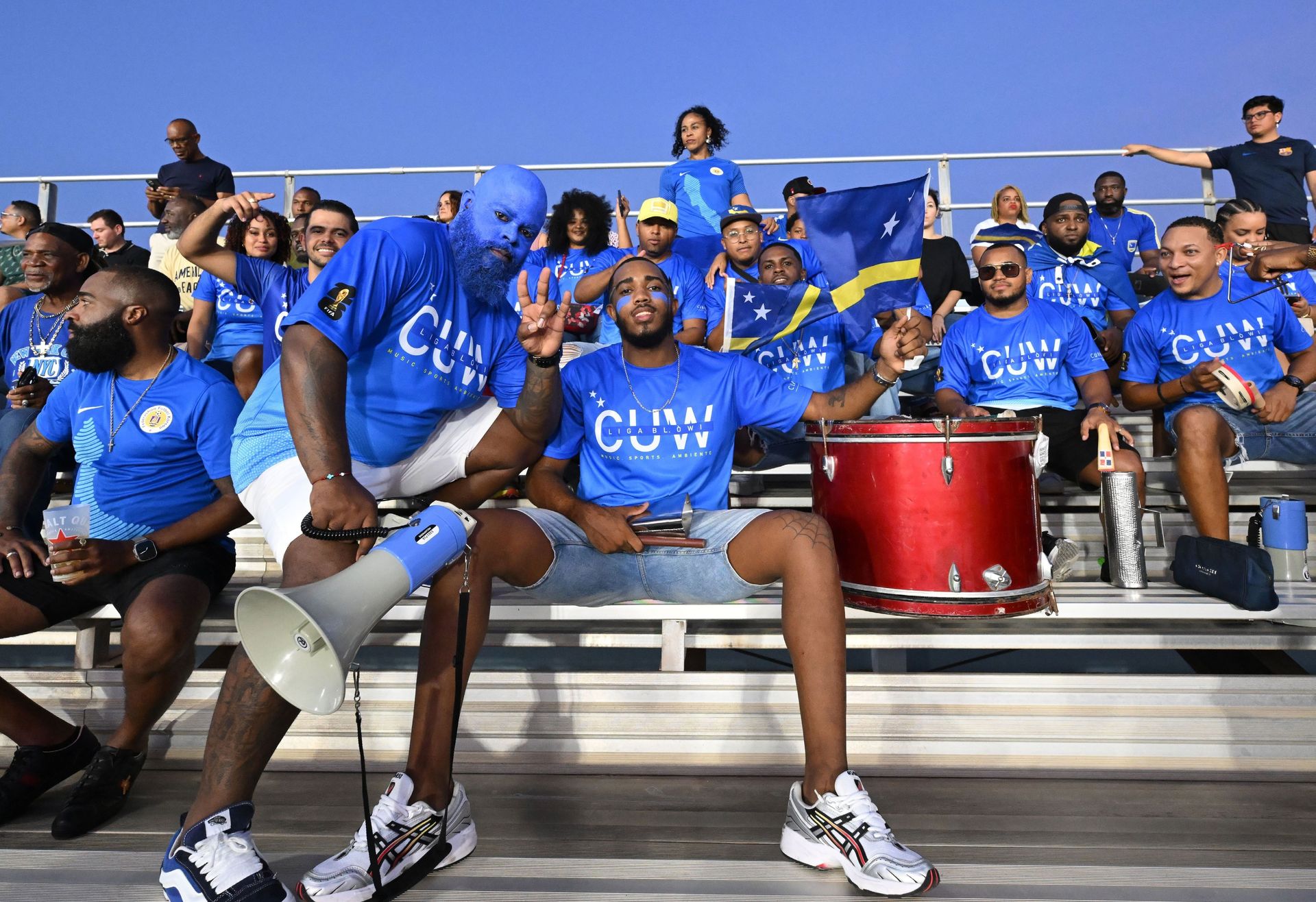
Under Advocaat, Curacao’s top players returned for World Cup qualifying in June 2024. Drawn alongside Haiti, they defied expectations, beating them 5-1 to top the group. With the USA, Mexico, and Canada already qualified as hosts, three CONCACAF spots were open. Though ranked seventh among qualifiers, Curacao advanced to the final round alongside teams such as Jamaica, Bermuda, and Trinidad & Tobago. Advocaat’s side featured former Manchester United midfielder Tahith Chong, born in Willemstad but raised in the Netherlands. At 26, now with Sheffield United, he was the only squad member born on the island. Chong scored twice on his home debut in a 3-2 win against Bermuda, earning pride from his former coach Brenton Balentien, who famously paints his face blue for every match.
Curacao’s crowning moment came in their final qualifier in Jamaica last November. After beating Jamaica 2-0 at home, drawing with Trinidad & Tobago, and thrashing Bermuda 7-0, they only needed a draw in Kingston. Two days before kickoff, Advocaat left due to family reasons, and Gorre resumed charge. “There were 180 of us among 35,000 Jamaicans,” Balentien said. “It was terrifying.” Jamaica struck the woodwork thrice and were awarded a stoppage-time penalty—then VAR overturned it. The 0-0 draw sealed Curacao’s historic qualification, making them the smallest nation ever to reach a World Cup, surpassing Iceland’s 2018 record.
“When we returned, the whole island celebrated,” Balentien recalled. “Curacao is a mix of Spaniards, Asians, Dominicans, and others, but that day, we were one family.” At 78, Advocaat will be the oldest coach in World Cup history but stepped down in February as his daughter underwent chemotherapy. Fred Rutten, formerly of PSV and Feyenoord, succeeded him. In Willemstad, locals are painting the city blue—from schools to shops—in anticipation of the tournament. Balentien will join over 2,500 fans travelling to cheer the Blue Wave against Germany, Ecuador, and Ivory Coast. “We’ll play with pride, no matter the results,” he said, smiling. For Curacao, history has already been written. In a world where seven of the ten most populous nations—including India, China, and Nigeria—missed out, this island of 155,000 stands tall. In nearly a century of the World Cup, few stories shine brighter.
-
Kuwait allows domestic worker hiring from India, nine others

-
Revanth alleges ‘seat chori’ after Congress RS nomination rejected
-
Explained: Why Bobby Deol, Anurag Kashyap’s Critically Acclaimed ‘Bandar’ Is A Box Office Flop
-
Rahul Slams Ujjwala Subsidy Cut, Says Poor Families Being Pushed Back To Firewood
-
World Leaders Congratulate Modi As He Becomes India's Longest-Serving Elected PM