A rare account from Sir Terence Clark reveals how Dubai’s founding father Sheikh Rashid bin Saeed Al Maktoum witnessed England’s historic 1966 Fifa World Cup victory and was struck by the scale of Wembley’s 97,000-strong crowd.
Long before the UAE emerged as a global hub for sport, ambition, and mega events, Dubai’s late ruler was a spectator at one of football’s most iconic nights. What stayed with him was not just England’s victory, but the sheer scale of the crowd before him.
Stay up to date with the latest news. Follow KT on WhatsApp Channels.
In the summer of 1966, Wembley Stadium in London became the stage for one of football’s most dramatic finals. England faced West Germany in front of nearly 97,000 spectators, a match that would etch itself into sporting history.
Among those in the stands was Sheikh Rashid bin Saeed Al Maktoum, the late ruler of Dubai and a key figure in shaping the foundations of the future United Arab Emirates.
The memory of that visit was later recalled by Sir Terence Clark, who served as Assistant Political Agent in Dubai between 1965 and 1968, during an interview conducted by the Al Maktoum Archives team.
“He came for a week to London. 1966 was the time of the final of the World Cup,” Clark said. “We got VIP tickets to go and watch the match. England looked unfamiliar in their red shirts.”
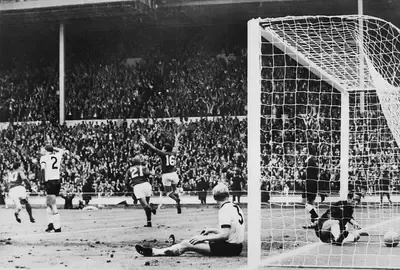
Clark described a thrilling encounter inside Wembley, where England eventually defeated West Germany 4–2 after extra time.
England players celebrate their second goal against West Germany in the 1966 World Cup final at Wembley
“A long shot gave Banks no trouble. Very exciting match, which England won,” he recalled, referring to England goalkeeper Gordon Banks.
But beyond the goals, tension, and celebration, it was a quiet moment after the final whistle that left a lasting impression.
“At the end of this game, I turned to Sheikh Rashid and said, ‘Sheikh Rashid, what are your impressions?’” Clark recounted.
“And he said, ‘You know, what has impressed me most is that there are more people in this stadium than in the whole of my country.’ And it was true.”
At the time, the Trucial States, which would later become the United Arab Emirates in 1971 had a population smaller than the crowd gathered inside Wembley Stadium.
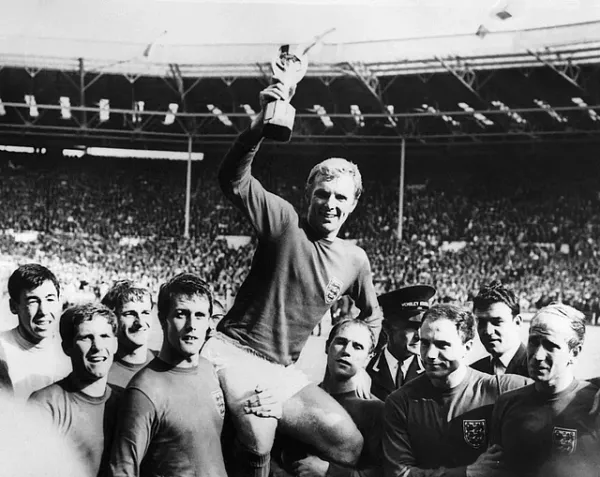
Captain Bobby Moore lifts the trophy following England's victory in the final
The remark, simple yet profound, captured a snapshot of a different era, one where Dubai and the wider region were still in the early stages of transformation, far removed from the global scale they would one day achieve.
Today, the UAE hosts some of the world’s biggest sporting spectacles, from Formula One races and international football tournaments to global boxing events and cricket championships. Stadiums across the country regularly welcome tens of thousands of fans, while Dubai itself has grown into a global city of millions.
Over karak, after Isha: Fifa talk takes over UAE's cafes, parks ahead of World Cup Play971 UAE: Full guide to access, sports wagering and restrictions How Sheikh Mohammed's hospitality helped Dubai World Cup weather 1997 storm World Sports Summit concludes, signals Dubai’s growing influence on global stage-
Deliver tenant farmers’ rights, Telangana activists warn Congress

-
Trump says Iran shot down US Apache helicopter, vows response
-
Whose roads are better? Check out viral Hyderabad-Bengaluru post
-
Woman drugged, gang raped in Karnataka’s Davanagere

-
Ballari engineering student found hanging, family cries foul