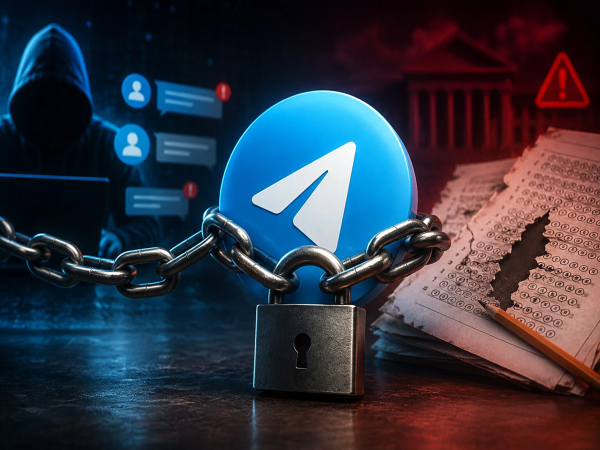
NEET Exam News, OPINION: Ahead of the re-examination for NEET-UG 2026, the central government has decided to impose a temporary ban on Telegram until June 22. Additionally, Telegram has been directed to disable the feature allowing users to edit messages already sent in India until June 30. The government and the National Testing Agency (NTA) argue that this measure will curb fake paper leaks, rumors, and organized gangs that defraud candidates; however, the major question remains: will banning Telegram alone eliminate a serious issue like paper leaks? The answer to this question is likely 'no'.
The problem isn't Telegram; it's the entire ecosystem.
Over the past few years, whenever there has been talk of paper leaks in major recruitment or entrance exams, Telegram's name has invariably surfaced. The reason for this is clear: Telegram allows for the creation of massive channels and groups that can host hundreds of thousands of members, and files, PDFs, photos, and videos can be shared rapidly. This is why exam-related rumors spread so quickly on the platform; however, assuming that paper leaks occur solely via Telegram would be akin to turning a blind eye to reality. Even if Telegram were shut down, numerous other platforms exist for disseminating information.
If Telegram shuts down, what are the alternatives?
India has emerged as the world's largest digital market, boasting numerous messaging and social platforms with user bases numbering in the millions. WhatsApp, for instance, is India's largest messaging platform. It has over 3 billion monthly active users globally, with more than 850 million users in India alone. Features such as group chats, communities, broadcast channels, and file sharing make it highly influential. Instagram, too, has evolved beyond being merely a photo and video-sharing app; its direct messaging, group chat, and 'Stories' features allow information to reach vast audiences. It is estimated to have between 390 million and 410 million users in India. Facebook Messenger also continues to be used by millions of people today. Additionally, platforms like Signal are gaining popularity for private conversations due to features such as end-to-end encryption and disappearing messages. Some student groups also use Discord. Meanwhile, Indian platforms like ShareChat and Josh have rapidly gained popularity in smaller towns and rural areas; this means that if an individual or a group intends to spread misinformation, they have several options available beyond just Telegram.
Where do paper leaks occur, and where do they go viral?
It is crucial to understand the root of the problem. A paper leak happens in two stages: first, gaining unauthorized access to the question paper or examination material; and second, disseminating that material to a large number of people. Telegram, WhatsApp, and other apps are merely mediums for conveying information or content to a vast audience. If an exam paper is secure and the system is robust, no app can cause a leak. Conversely, if the question paper escapes the secure loop—whether from the exam center, printing press, transportation chain, or an internal network—dozens of digital platforms are available to spread it. Therefore, while action against such platforms is necessary, it is not the complete solution to the problem.
Why is restricting the 'edit' feature important?
The government has not only imposed a temporary ban on Telegram but has also directed the suspension of its message-editing feature until June 30. This move is considered significant because, in several instances, old messages were edited after the exam concluded to create the impression that the question paper had been available beforehand. Such screenshots would subsequently go viral on social media, causing confusion among candidates. The NTA states that students were being misled by the fabrication of such fake evidence regarding paper leaks. In this context, restricting the edit feature could help curb the spread of rumors.
What is the government's objective?
That is not the case. The temporary restriction imposed just before the exam can be viewed as a precautionary measure. The government aims to uphold the integrity of examinations and protect students from fraudulent claims. According to the NTA, there has been a rapid spread of misinformation on social media and messaging platforms during various competitive exams in recent years. While heightened vigilance is essential during the critical period surrounding an exam, it is equally true that paper leaks cannot be prevented merely by taking action against a single app.
**The Real Battle: Exam Security**
A robust security mechanism is paramount to preventing paper leaks. Measures such as securing question papers, monitoring exam centers, tracking data, keeping a real-time watch on suspicious activities, and taking strict action against networks involved in leaks would prove far more effective. Additionally, it is crucial to raise awareness among candidates. Every year, thousands of students fall victim to fraud after being lured by claims promising "100% genuine question papers" or access to exam questions beforehand.
Disclaimer: This content has been sourced and edited from News18 Hindi. While we have made modifications for clarity and presentation, the original content belongs to its respective authors and website. We do not claim ownership of the content.
-
Virat Kohli & Anushka Sharma Spotted On Family Day Out In UK; Pics Goes Viral Across Social Media

-
Mumbai’s Seth Juggilal Poddar Academy Hosts Film Pedagogy Workshop For Teachers
-
Smita Bansal Reacts To TV Actress Sanchita Ugale’s Tragic Death: “You Have To Be Thick-Skinned To Survive This Industry” | FPJ Exclusive

-
BRS says Congress evicting 650 families from Secunderabad huts

-
Karnataka: Congress camps MLAs at resort over cross-voting fears