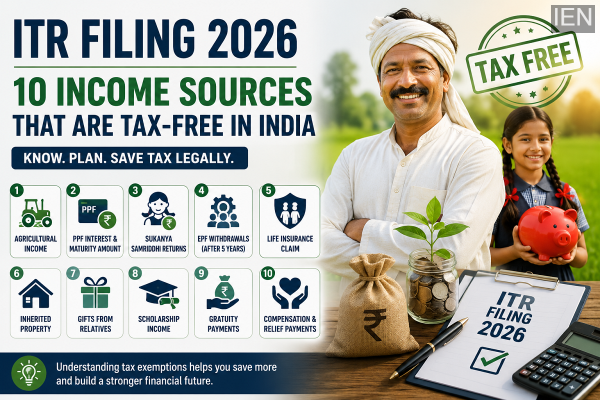
When it comes to income tax, most people assume that every rupee they earn is subject to taxation. Salaried employees pay tax on their salaries, business owners report profits, and investors often face taxes on returns from various financial instruments. However, India's tax laws provide exemptions for several types of income, helping taxpayers save money while encouraging long-term savings, education, and social welfare.
As taxpayers prepare for ITR Filing 2026, understanding which income sources are exempt from tax can help in better financial planning and legal tax optimization. Here are ten major income categories that are either fully tax-free or enjoy significant tax benefits under current income tax provisions.
1. Agricultural Income
Income earned directly from agricultural activities is generally exempt from income tax in India. This includes revenue generated from cultivating crops and farming-related operations.
However, simply owning agricultural land does not qualify for tax exemption. The income must genuinely arise from agricultural activities carried out on the land.
2. Public Provident Fund (PPF) Returns
The Public Provident Fund remains one of the most tax-efficient investment options available to Indian investors.
Not only is the interest earned on PPF investments exempt from tax, but the entire maturity amount received after the lock-in period is also tax-free. This makes PPF one of the few investments that enjoy Exempt-Exempt-Exempt (EEE) tax treatment.
3. Sukanya Samriddhi Yojana Benefits
Designed to support the financial future of girl children, the Sukanya Samriddhi Yojana offers attractive tax advantages.
The interest accumulated under the scheme is tax-free, and the final maturity proceeds are also exempt from income tax. As a result, it remains a preferred long-term savings option for parents.
4. EPF Withdrawals After Five Years
The Employees' Provident Fund (EPF) serves as a key retirement savings tool for salaried individuals.
If an employee withdraws EPF funds after completing at least five continuous years of service, the withdrawal amount is generally exempt from tax. However, different tax rules may apply in cases of premature withdrawal.
5. Life Insurance Claim Proceeds
Money received by nominees after the death of a policyholder through a life insurance claim is fully tax-exempt.
In many cases, maturity proceeds received at the end of a life insurance policy term are also tax-free, subject to certain conditions. However, specific high-premium policies may be governed by separate tax rules.
6. Inherited Property and Assets
Receiving property, cash, jewelry, or other assets through inheritance does not attract income tax in India.
Whether the inheritance comes through a will or succession, the recipient is generally not required to pay tax at the time of receiving the assets. However, capital gains tax may apply if the inherited property is sold later.
7. Gifts Received From Specified Relatives
Gifts received from close family members enjoy favorable tax treatment under Indian tax laws.
Money, property, or valuables received from parents, spouses, siblings, or other specified relatives are generally exempt from tax, regardless of the value involved. However, gifts received from non-relatives above prescribed limits may become taxable.
8. Scholarship Income
Scholarships granted to students for education, research, or academic development are fully exempt from income tax.
The exemption applies to financial assistance provided for pursuing studies in India or abroad, helping students focus on their education without additional tax burdens.
9. Gratuity Payments
Gratuity received upon retirement, resignation, or completion of service may qualify for tax exemption up to specified limits.
The exact exemption amount depends on factors such as employment category and applicable regulations. Government and private-sector employees may be subject to different rules.
10. Certain Compensation and Relief Payments
Some forms of compensation and financial assistance are exempt from tax due to their social or humanitarian nature.
These may include:
-
Compensation received by families of martyred soldiers
-
Certain government awards and honors
-
Approved disaster relief payments
-
Specific compensation linked to accidents or loss of life
The tax treatment depends on the nature of the payment and applicable legal provisions.
Not Every Income Is Tax-Free
While several income sources enjoy tax exemptions, many commonly misunderstood earnings remain taxable.
For example:
-
Fixed Deposit (FD) interest is taxable.
-
Rental income from property is taxable.
-
Freelancing earnings are taxable.
-
Income from YouTube, blogging, content creation, and influencer activities is generally taxable.
-
Business profits and professional income remain subject to applicable tax rules.
Plan Taxes Wisely
Tax-free income provisions can play an important role in wealth creation and financial planning. However, exemptions often come with specific conditions and eligibility requirements.
Before making major investments or implementing tax-saving strategies, taxpayers should carefully review the latest regulations or seek professional advice. Understanding these exemptions can help individuals make smarter financial decisions while remaining fully compliant with tax laws.
Disclaimer: Tax laws are subject to amendments and individual circumstances may vary. Taxpayers should consult a qualified tax professional before making financial or tax-related decisions.
-
Essar Group, IRH ink USD 500 mn crude sourcing, product supply deal

-
Vijay’s Jana Nayagan: What is Happening?

-
Nabha Natesh Is Unapologetically Gorgeous In This Purple Look

-
Samantha Slays Promotion Look In Mustard Drape

-
Bharat Bhhagya Viddhaata box office collection day 5: Kangana Ranaut film continues to struggle; collects ₹52 lakh