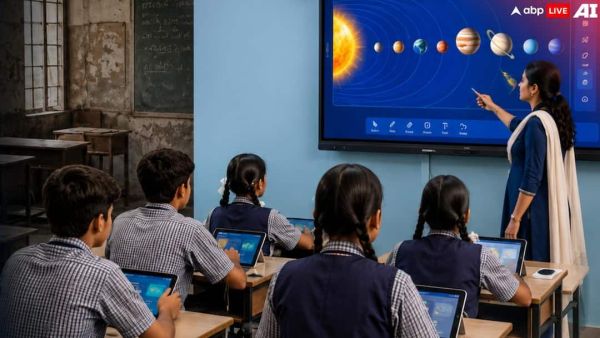
Walk into most Indian classrooms today, and the scene looks familiar. A teacher at the front. Students in rows. Notes being copied. A lesson that moves in one direction only. Now consider that this scenario is the daily reality for roughly 70% of India's schoolgoing population. These students will graduate into a workforce shaped almost entirely by digital fluency, collaborative thinking, and comfort with technology. The mismatch between where learning happens and where it needs to go is not a future problem.
It is already here, visible in data.
The NITI Aayog report on School Education, published in May 2026 and drawing on UDISE+ data, documents that only 30.6% of schools had functional digital classrooms in 2024-25, up from 14.9% in 2021-22. The report defines digital classrooms as teaching spaces that digitally enable and incorporate interactive whiteboards, audio-visual content, and electronic resources. This integration aims to enhance the interactivity of learning experiences and focus on competency-driven education. Growth is real. But nearly seven out of ten schools still operate without any of it.
Pedagogy Gap Behind The Infrastructure Gap
The same NITI Aayog report identifies what it calls a fundamental misalignment between pedagogy, curriculum, and learning outcomes in the existing school system. It explicitly calls for a shift away from rote instruction toward competency-based, student-centred learning. These are not minor adjustments. They are architectural changes in how education is designed and delivered.
Interactive technology is central to making that shift real. When students engage through touch, visual manipulation, and real-time collaboration on interactive displays rather than copying from a board, they are building reasoning and problem-solving capacities the report directly links to future readiness. Research on interactive flat panel environments consistently shows better recall weeks after instruction compared to traditional methods.
The report also recommends that schools harness AI for pedagogical innovation, with AI-powered adaptive tools used for formative assessment and personalised feedback. Its long-term goal is universal access to AI-enabled digital infrastructure with focused attention on underserved regions. The technology gap is, in effect, an outcomes gap in disguise.
Sharp Disparities The National Average Conceals
The NITI Aayog report reveals that digital classroom adoption varies dramatically across states. Tamil Nadu moved from zero coverage to 60.8% in four years. Maharashtra went from 17.3% to 63.6%. Against this, West Bengal sits at 5.7%, Bihar at 14.9%, and Meghalaya at 4.3%. Geography and governance capacity are determining which students receive a 21st-century learning experience and which do not. This disparity is an equity question as much as a technology question.
State-level evidence reinforces the case for investment. According to the report, Gujarat's Gyankunj programme has deployed smart boards and internet connectivity in 1,609 schools, benefiting over 285,000 students and improving engagement and subject clarity. Uttarakhand's Rupantaran initiative, which gave schools smart TVs and audio-visual infrastructure, saw a three- to fourfold increase in enrollment. For students from economically weaker households, a school that makes learning worth showing up for changes the daily calculus around attendance in ways that statistics alone cannot capture.
A Generation In The Balance
The NITI Aayog report frames the urgency in terms of what it calls 21st-century competencies, the skills students need in a digital economy. It recommends introducing AI literacy from the upper-primary stage and sets a medium-term goal of at least one functional digital classroom with an interactive display in every secondary school.
The students in classrooms today will enter the workforce around 2035. The roles waiting for them demand fluency with digital tools, comfort with data, and the ability to collaborate across platforms. These capacities are built over years, in classrooms, starting early. A student who spends over a decade in an environment that fails to develop these habits is unprepared for the workforce.
India's trajectory on digital classroom adoption is moving in the right direction. The pace needs to match what is actually at stake.
Seven out of ten schools are still waiting. The learning outcomes of a generation are waiting with them.
(The author is CEO, Solitaire Brand Business; Director, Prointek Global Innovations (Manufacturing Division of Supertron Electronics))
Disclaimer: The opinions, beliefs, and views expressed by the various authors and forum participants on this website are personal and do not reflect the opinions, beliefs, and views of ABP Network Pvt. Ltd.
-
FIFA World Cup 2026: Kit Reveals, Player Insights, and Historical Records

-
Rice Follows Strict Clothing Ritual Before Every Game and Fears 'We Won't Win' Without It

-
DSSSB Recruitment 2026: Apply for TGT and Technical Assistant Positions

-
Effective Strategies to Secure a Government Job Within a Year

-
Uttar Pradesh B.Ed. Entrance Exam 2026 Results Announced: Vandana Singh Tops the List