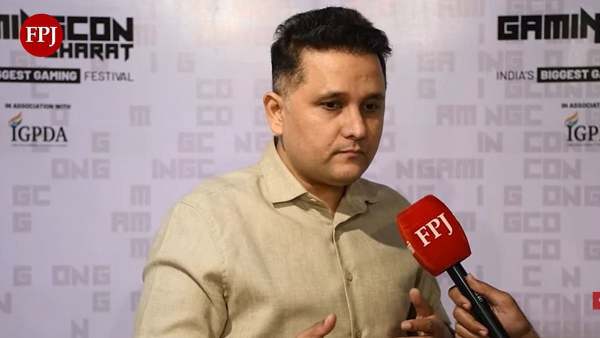
In an exclusive conversation with the Free Press Journal (FPJ) at this year’s GamingCon, celebrated author Amish Tripathi shared his bold vision for the future of the Indian gaming industry. Tripathi, who is also the co-founder of The Age of Bharat, stated that India possesses a distinct and powerful advantage that will allow it to disrupt the global video game industry: its 'living traditions.'
Mumbai: GamingCon Bharat 2025, one of India’s premier conventions celebrating video game development, technology, and culture, served as the backdrop for major announcements and industry insights this year. The event gathered developers, investors and creative talents, signalling a period of aggressive growth and ambition within the Indian gaming ecosystem.
In an exclusive conversation with the Free Press Journal (FPJ) at this year’s GamingCon, celebrated author Amish Tripathi shared his bold vision for the future of the Indian gaming industry. Tripathi, who is also the co-founder of the upcoming gaming studio, 'The Age of Bharat,' stated that India possesses a distinct and powerful advantage that will allow it to disrupt the global video game industry: its 'living traditions.'
Tripathi, best known for his mythological fiction like the Shiva Trilogy, explained that Western AAA titles like God of War or Assassin’s Creed Valhalla are fundamentally built on dead cultures or museum cultures, referencing Greek, Norse or Roman myths.
The 'Living Tradition' Advantage
“Our epics are still living traditions,” Tripathi emphasised during the interview. “We still believe in Lord Ram and Lord Shiva. Imagine if you could build a game on our epic traditions that are really exciting,” he said. He pointed to the recent global success of the Chinese title Black Myth: Wukong as the required model for Indian developers. “We need our own Black Myth: Wukong,” he stated, showing his intent to create a high-quality, narrative-driven game that successfully leverages ancient culture.
Inside 'The Age of Bharat'
Discussing the debut project from his studio, Tripathi, who is focused on the narrative element, promised a deep narrative experience. The game will prioritise world-building and immersion over simply making the player overpowered.
He detailed the player's potential role: "If Lord Ram and Ravan are fighting at the meta-narrative level, you might be a forest warden fighting minor Rakshasas." He noted that while these antagonists are minor to the gods, "for you, that Rakshasa is very powerful." The project is described as a high-investment production utilising motion capture and aiming for international AAA quality standards.
The Economic Forecast
Addressing the challenges of the Indian market, which is currently dominated by mobile gaming, Tripathi presented a forward-looking strategy. He noted that the shift is an economic one; as per capita income rises, there is a natural gravitation toward high-fidelity PC and console gaming.
Using a hockey analogy, he advised developers to "run to where the ball is going to be, not where it is." Since game development is a multi-year process, he stressed that teams must build for the mature market that will exist when the game launches, not the mobile-first market of today.
Finally, Tripathi urged the public to distinguish between 'Video Gaming' (a creative medium) and 'Real Money Gaming' (gambling), arguing that clearing up this perception is crucial for parental and institutional support of the burgeoning narrative gaming sector.
-
Bigg Boss 19 finale: Mid-week eviction announced; expected top 5

-
Malti Chahar exits Bigg Boss 19? Grand finale promo leaks finalists

-
Samantha Ruth Prabhu gets married for second time: Reports

-
Dermatologist explains why using Phitkari on face can be harmful

-
7 ways to ease arthritic joint pain during colder months, as per an orthopaedic surgeon