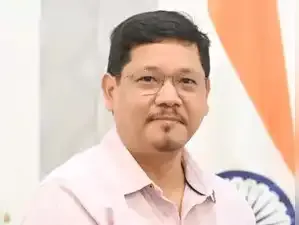
Guwahati: Meghalaya chief minister Conrad K Sangma said that in 2018, Meghalaya had 3 to 4% of women in Self Help Groups; today, 95% of women in rural areas are part of this network.
The 1st Northeast India Organic Week and the 4th World IFOAM Organic Youth Summit concluded on Monday, marking a significant moment for the region and the global organic sector.
The three-day convergence, which brought together agricultural pioneers, policy experts, and a global assembly of young changemakers across 13 countries.
Sangma articulated a clear and impassioned vision for the state, declaring that his government’s entire policy framework is centred on one singular agenda, to help and to uplift the farmers of our state.
He defined organic farming as an intrinsic part of Meghalaya’s identity, stating, “It is about our forefathers, it is about our traditions, and about how our people have been farming for centuries.”
He announced major infrastructure upgrades, including the extension of the Shillong airport runway to handle large aircraft by 2027. He placed special emphasis on the “UN International Year of the Woman Farmer” next year, revealing a massive transformation in the state's institutional structure. He reiterated, “In 2018, we had 3 to 4% of women in Self Help Groups; today, 95% of women in rural areas are part of this network.” He concluded by calling for a powerful convergence of agriculture and tourism, supported by an ambitious scheme targeting 3,000 new homestays with a “75% subsidy” thereby ensuring that economic growth reaches the grassroots level.
Vinita Sudhanshu, General Manager, APEDA, praised Meghalaya for setting a remarkable example of community driven, bottom-up approach to agriculture.
She added, “We are planning to take the two progressive Farmer Producer Organisations from Meghalaya to Gulfood event where they will get an opportunity to interact with the people, to focus their product and to understand the requirement of the importing country”.
Jennifer Chang, Executive Director, IFOAM Asia, lauded Meghalaya as a potential global model for holistic organic development, where agriculture, tourism, and community life seamlessly integrate.
Reflecting on her visits to local orchards, she commended the state’s farmers for working in harmony with nature, where crops grow without artificial interference. She also proposed future collaborations, urging the state to champion the upcoming UN International Year of the Woman Farmer, noting that “if you teach a woman, you are raising a nation”. Praising the efficiency of the state government, she encouraged the delegates to build lasting bridges with Northeast India.
Isawanda Laloo, Secretary, Agriculture and Farmers’ Welfare, emphasised that the state remains naturally organic by heritage, geography, and practice.
She detailed the state's strategic partnership with APEDA, which has already facilitated the export of over 50 metric tons of premium produce, including Khasi Mandarin, pineapples, and ginger, to Gulf nations. Outlining a bold vision for the future, supported by an investment of Rs 250 crore to build a globally competitive organic ecosystem.
The 1st Northeast India Organic Week and the 4th World IFOAM Organic Youth Summit concluded on Monday, marking a significant moment for the region and the global organic sector.
The three-day convergence, which brought together agricultural pioneers, policy experts, and a global assembly of young changemakers across 13 countries.
Sangma articulated a clear and impassioned vision for the state, declaring that his government’s entire policy framework is centred on one singular agenda, to help and to uplift the farmers of our state.
He defined organic farming as an intrinsic part of Meghalaya’s identity, stating, “It is about our forefathers, it is about our traditions, and about how our people have been farming for centuries.”
He announced major infrastructure upgrades, including the extension of the Shillong airport runway to handle large aircraft by 2027. He placed special emphasis on the “UN International Year of the Woman Farmer” next year, revealing a massive transformation in the state's institutional structure. He reiterated, “In 2018, we had 3 to 4% of women in Self Help Groups; today, 95% of women in rural areas are part of this network.” He concluded by calling for a powerful convergence of agriculture and tourism, supported by an ambitious scheme targeting 3,000 new homestays with a “75% subsidy” thereby ensuring that economic growth reaches the grassroots level.
Vinita Sudhanshu, General Manager, APEDA, praised Meghalaya for setting a remarkable example of community driven, bottom-up approach to agriculture.
She added, “We are planning to take the two progressive Farmer Producer Organisations from Meghalaya to Gulfood event where they will get an opportunity to interact with the people, to focus their product and to understand the requirement of the importing country”.
Jennifer Chang, Executive Director, IFOAM Asia, lauded Meghalaya as a potential global model for holistic organic development, where agriculture, tourism, and community life seamlessly integrate.
Reflecting on her visits to local orchards, she commended the state’s farmers for working in harmony with nature, where crops grow without artificial interference. She also proposed future collaborations, urging the state to champion the upcoming UN International Year of the Woman Farmer, noting that “if you teach a woman, you are raising a nation”. Praising the efficiency of the state government, she encouraged the delegates to build lasting bridges with Northeast India.
Isawanda Laloo, Secretary, Agriculture and Farmers’ Welfare, emphasised that the state remains naturally organic by heritage, geography, and practice.
She detailed the state's strategic partnership with APEDA, which has already facilitated the export of over 50 metric tons of premium produce, including Khasi Mandarin, pineapples, and ginger, to Gulf nations. Outlining a bold vision for the future, supported by an investment of Rs 250 crore to build a globally competitive organic ecosystem.