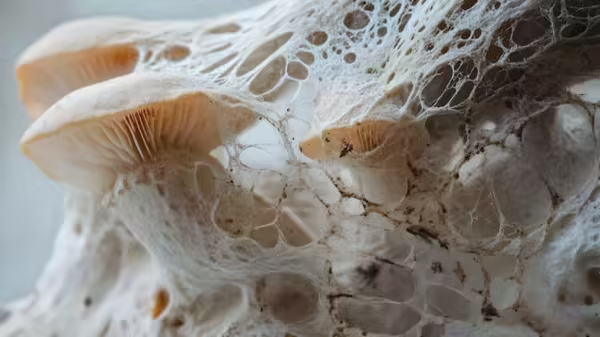
Chernobyl Fungus Appears to Have Evolved: Nearly four decades after the catastrophic explosion at the Chernobyl Nuclear Power Plant, the exclusion zone remains one of the most dangerous places on the planet. While humans cannot survive prolonged exposure here, certain organisms have done more than just endure, they have adapted, evolved, and in some cases, thrived in extreme radiation. Among them is a bizarre black fungus that scientists believe may be doing something extraordinary: using radiation as a source of energy.
Life Thriving in a Forbidden Zone
When researchers first entered the Chernobyl reactor’s surrounding structures in the late 1990s, they expected to find a lifeless environment.
Instead, a team led by microbiologist Nelli Zhdanova discovered an entire community of fungi — 37 species living on walls saturated with radiation levels that would be lethal to humans.
Add Zee News as a Preferred Source
Most of these fungi were dark or black, rich in the pigment melanin, the same pigment that protects human skin from UV radiation.
But one species stood out: Cladosporium sphaerospermum, which appeared to dominate the contaminated samples.
The Fungus That Flourished Under Radiation
What stunned scientists even more was what happened next. A research team led by radiopharmacologist Ekaterina Dadachova and immunologist Arturo Casadevall exposed C. sphaerospermum to intense ionizing radiation, the type that normally destroys DNA and kills living cells.
Instead of dying, the fungus grew faster.
Ionizing radiation is powerful enough to knock electrons off atoms, rip apart molecules, and shred genetic material. It’s used in cancer treatment because it is so effective at destroying cells. Yet this fungus not only tolerated it, it appeared to thrive.
A Radical Theory: Could the Fungus Be “Eating” Radiation?
In 2008, Dadachova and Casadevall proposed a bold theory: the fungus might be performing something similar to photosynthesis — but instead of using light, it may be using radiation.
They called this idea radiosynthesis.
Here’s the logic:
- Melanin in the fungus absorbs radiation.
- Radiation seems to alter the physical properties of melanin.
- This change might help the fungus convert radiation into usable chemical energy.
- This would make melanin act like a protective shield and a potential energy-harvesting pigment — similar to how chlorophyll works in plants.
It sounded like science fiction, yet experiments kept adding fuel to the mystery.
Space Experiments Deepen the Mystery
In 2022, a team strapped C. sphaerospermum to the exterior of the International Space Station, exposing it to harsh cosmic radiation. Sensors placed beneath the fungal layer recorded lower radiation levels compared to control samples.
This didn’t prove radiosynthesis, but it did show that the fungus can act as a remarkably effective radiation shield.
Scientists even began considering whether melanized fungi could be used to protect astronauts on deep-space missions.
Still, the core mystery remained unresolved.
Radiosynthesis: Brilliant Theory, Unproven Reality
Despite years of research, no one has been able to conclusively demonstrate that the fungus actually converts radiation into energy.
Scientists have not yet observed:
- radiation-driven carbon fixation,
- measurable metabolic gain from radiation, or
- a clear energy-producing pathway.
As Nils Averesch of Stanford University notes, the idea is fascinating, but unconfirmed.
The fungus is doing something unusual with radiation, but the exact mechanism remains hidden.
Not All Melanized Fungi Behave the Same
The mystery deepens further when compared to other fungi:
- Wangiella dermatitidis grows better under ionizing radiation.
- Cladosporium cladosporioides produces more melanin but doesn’t grow faster.
- Only C. sphaerospermum shows this particular combination of resilience and possible radiation-driven benefits.
This inconsistency suggests one of two possibilities: Either the fungus has evolved a unique adaptation to radiation, or its unusual behavior is simply a stress response helping it survive in extreme conditions.
A Survivor in a Place Where Humans Cannot Tread
Whatever the explanation, one thing is clear: this velvety black fungus has developed a remarkable strategy to survive in one of the most hostile environments known to humans.
Chernobyl remains too dangerous for people, yet this humble organism clings effortlessly to radioactive walls, thriving in conditions that should be fatal. Whether through radiosynthesis or another unknown mechanism, it continues to challenge our understanding of life and resilience.
In the words of many scientists studying it: life always finds a way, sometimes in the most unexpected form imaginable.
-
'Excellent Overall Health': White House Releases Trump's MRI Scan Results

-
What Is 'Sanchar Saathi'? App Centre Mandated To Be Pre-Installed On All Smartphones In 90 Days

-
How Microsoft Excel went from office software to e-sports arena

-
Tripura CM calls for early detection efforts to curb HIV/AIDS

-
Listing pairs with most century partnerships in ODI cricket