Kolkata | Bangalore: Padmaja Reddy, who has built her formidable reputation in microlending, has decided on a gradual exit from unsecured business by the end of this fiscal to focus instead on gold loans-the mainstay of India's financing for the past few quarters.
Reddy has already transitioned Keertana Finserv, her second entrepreneurial venture after being forced out from Spandana Sphoorty Financial in November 2021, into a firm with 94% secured portfolio from merely 58% over the past 14 months amid the lingering stress in the microfinance sector.
"I have no hope left in microfinance," Reddy told ET.
"Every crisis we faced in microfinance from 2010, borrowers came back to repay their loans. But the situation is vastly different now," she said. "Everyone chased the same borrower and, therefore, the discipline that was once a hallmark in microfinance was lost. The borrowers are not in a position to repay, making it a structural crisis."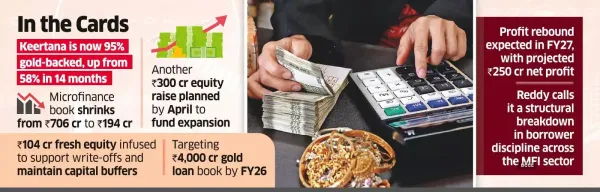
Keertana aims to be a fully secured lender by the end of the fiscal, with gold loans contributing about 95% of the assets under management. It is disbursing ₹250-300 crore loans against jewellery every month. The target is to become a ₹4,200 crore company by FY26, with a gold loan portfolio of ₹4,000 crore, Reddy said.
The promoter with 99.5% ownership infused ₹104 crore into the company last week, taking her total equity to ₹600 crore, Keertana chief financial officer Revan Saahith said in a note to lenders.
"We want to maintain capital adequacy at 22-24% and that's why I infused capital. Besides supporting growth, capital was also used for writing off microfinance loans," Reddy said.
Discussions are also underway for infusing another ₹300 crore equity from new investors by April next year to support growth.
The company started running down the microfinance business ever since the asset quality crisis broke out. Its microfinance portfolio has shrunk to ₹194 crore from ₹706 crore as of September last year.
The microfinance sector as a whole saw gross loan portfolio contract to ₹3.46 lakh crore at the end of September from a peak of ₹4.34 lakh crore seen at the end of March 2024.
In the same note, Saahith said that the company is "expecting a clean-up year in FY26 with strong profitability from FY27" and projected a ₹250 crore net profit in FY27 driven by gold loans.
The business update was shared with one of the lenders of the company, seeking a waiver in relation to covenant breach in terms of some lending conditions arising due to the stress in the microfinance book.
"Gold loans have zero risk. Once we reach the ₹5,000 crore portfolio, we will start exploring public listing," Reddy said.
India's gold loan market grew 36% year-on-year to ₹14.5 lakh crore, data from Crif High Mark showed. It is driven by strong originations, primarily supported by robust asset valuations, the credit bureau said in a report published last week.
Reddy has already transitioned Keertana Finserv, her second entrepreneurial venture after being forced out from Spandana Sphoorty Financial in November 2021, into a firm with 94% secured portfolio from merely 58% over the past 14 months amid the lingering stress in the microfinance sector.
"I have no hope left in microfinance," Reddy told ET.
"Every crisis we faced in microfinance from 2010, borrowers came back to repay their loans. But the situation is vastly different now," she said. "Everyone chased the same borrower and, therefore, the discipline that was once a hallmark in microfinance was lost. The borrowers are not in a position to repay, making it a structural crisis."
Strategic Move Spandana’s ousted founder repositions new co into 94% gold-backed book amid ‘structural crisis’ in sector
Keertana aims to be a fully secured lender by the end of the fiscal, with gold loans contributing about 95% of the assets under management. It is disbursing ₹250-300 crore loans against jewellery every month. The target is to become a ₹4,200 crore company by FY26, with a gold loan portfolio of ₹4,000 crore, Reddy said.
The promoter with 99.5% ownership infused ₹104 crore into the company last week, taking her total equity to ₹600 crore, Keertana chief financial officer Revan Saahith said in a note to lenders.
"We want to maintain capital adequacy at 22-24% and that's why I infused capital. Besides supporting growth, capital was also used for writing off microfinance loans," Reddy said.
Discussions are also underway for infusing another ₹300 crore equity from new investors by April next year to support growth.
The company started running down the microfinance business ever since the asset quality crisis broke out. Its microfinance portfolio has shrunk to ₹194 crore from ₹706 crore as of September last year.
The microfinance sector as a whole saw gross loan portfolio contract to ₹3.46 lakh crore at the end of September from a peak of ₹4.34 lakh crore seen at the end of March 2024.
In the same note, Saahith said that the company is "expecting a clean-up year in FY26 with strong profitability from FY27" and projected a ₹250 crore net profit in FY27 driven by gold loans.
The business update was shared with one of the lenders of the company, seeking a waiver in relation to covenant breach in terms of some lending conditions arising due to the stress in the microfinance book.
"Gold loans have zero risk. Once we reach the ₹5,000 crore portfolio, we will start exploring public listing," Reddy said.
India's gold loan market grew 36% year-on-year to ₹14.5 lakh crore, data from Crif High Mark showed. It is driven by strong originations, primarily supported by robust asset valuations, the credit bureau said in a report published last week.