
Listen to this article in summarized format
Loading...
××
Subscribe to

Unlock AI Briefing and Premium Content
Subscribe NowWhat's Included
- Exclusive Stories
- Daily ePaper Access
- Smart Market Tools
- Curated Investment Ideas
- Ad-lite Experience
Subscription


Tata-owned Air India operated, on multiple occasions, an aircraft that was not airworthy, potentially risking the safety of passengers.
A 164-seater Airbus A320 with an expired airworthiness licence flew eight times on November 24-25 before an engineer discovered the lapse and the plane was taken out of service, said people with knowledge of the matter. This has prompted an investigation by the regulator, Directorate General of Civil Aviation (DGCA), they said.
Since the Dreamliner crash of June 12 that left 260 people dead, the troubled airline has been seeking to convince flyers that it takes their safety seriously.
The Certificate of Airworthiness is issued by the DGCA, and is renewed every year after ensuring a plane has undergone periodic maintenance and is in a safe condition for flight. Operating an aircraft without valid licences and certificates is considered a serious offence and Air India is likely to face hefty penalties, including suspension of top officials, a government official said.
The A320 remains grounded pending DGCA investigation.
The airline may also be in trouble with lessors, as flying with an expired licence can lead to invalidation of insurance coverage. “By operating an aircraft which was not certified to be airworthy, the carrier has risked flight safety and (that of) all the passengers. This is a serious violation and not expected from a mainline carrier like Air India,” said a government official.
While DGCA inspectors make periodic spot checks, the operator is responsible for maintaining aircraft in a state of airworthiness.
An Air India spokesperson said, “As soon as this came to our notice, it was duly reported to DGCA. We have initiated a comprehensive internal investigation.”
“An airline typically starts the work of renewal of its certificates at least three months before the due date so it is renewed before time,” said a DGCA inspector. “After the end of daily operations, when the aircraft is parked for night halt, an engineer checks whether all documents and approvals are in line. That the plane flew eight times with an expired licence raises a lot of questions about Air India’s safety culture.”
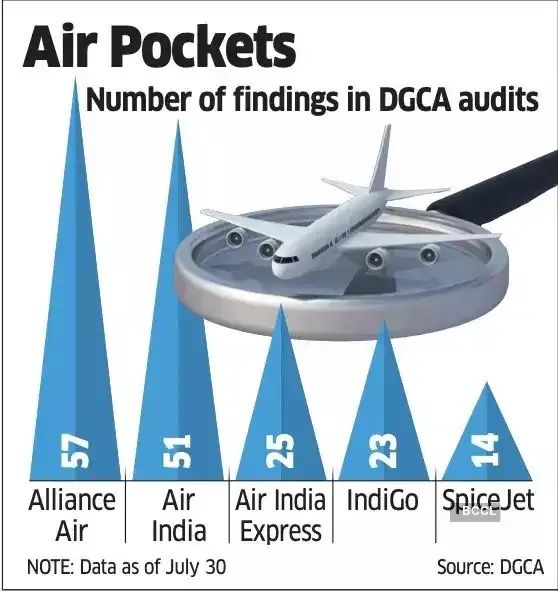
The incident is likely to be categorised as a Level 1 violation by DGCA — one that was critical to flight safety — and is the latest in a series of lapses that have plagued Air India’s flight operations.
The airline’s top officials, including chief executive Campbell Wilson, were earlier sent show-cause notices for operating multiple components fitted in aircraft that had exceeded their life span.
A few months ago, the regulator suspended the airline’s head of the engineering quality department, which is responsible for audits to ensure the airline is adhering to all norms.
The series of hiccups point to Tata group’s continuing struggle to improve the airline’s reputation almost four years after privatisation.
The airline is now leaning on Singapore Airlines (SIA), which owns 25.1% of the company, to streamline its engineering operations. Jeremy Yew, a senior vice president of Singapore Airlines Engineering Services, has been deputed to the carrier, a senior Air India executive said. More officials from SIA will be coming on board.
A 164-seater Airbus A320 with an expired airworthiness licence flew eight times on November 24-25 before an engineer discovered the lapse and the plane was taken out of service, said people with knowledge of the matter. This has prompted an investigation by the regulator, Directorate General of Civil Aviation (DGCA), they said.
Since the Dreamliner crash of June 12 that left 260 people dead, the troubled airline has been seeking to convince flyers that it takes their safety seriously.
The Certificate of Airworthiness is issued by the DGCA, and is renewed every year after ensuring a plane has undergone periodic maintenance and is in a safe condition for flight. Operating an aircraft without valid licences and certificates is considered a serious offence and Air India is likely to face hefty penalties, including suspension of top officials, a government official said.
Insurance Trouble Too
The carrier said it has already suspended all those who were involved with the decision to release the aircraft without a valid licence.The A320 remains grounded pending DGCA investigation.
The airline may also be in trouble with lessors, as flying with an expired licence can lead to invalidation of insurance coverage. “By operating an aircraft which was not certified to be airworthy, the carrier has risked flight safety and (that of) all the passengers. This is a serious violation and not expected from a mainline carrier like Air India,” said a government official.
While DGCA inspectors make periodic spot checks, the operator is responsible for maintaining aircraft in a state of airworthiness.
An Air India spokesperson said, “As soon as this came to our notice, it was duly reported to DGCA. We have initiated a comprehensive internal investigation.”
Not the First Time
Senior aircraft engineers said that with modern software, it’s very hard to miss scheduled tasks such as licence renewal or maintenance. Air India has an inhouse Continuing Airworthiness Management Organisation (CAMO), the responsible unit for the task.“An airline typically starts the work of renewal of its certificates at least three months before the due date so it is renewed before time,” said a DGCA inspector. “After the end of daily operations, when the aircraft is parked for night halt, an engineer checks whether all documents and approvals are in line. That the plane flew eight times with an expired licence raises a lot of questions about Air India’s safety culture.”
The incident is likely to be categorised as a Level 1 violation by DGCA — one that was critical to flight safety — and is the latest in a series of lapses that have plagued Air India’s flight operations.
The airline’s top officials, including chief executive Campbell Wilson, were earlier sent show-cause notices for operating multiple components fitted in aircraft that had exceeded their life span.
A few months ago, the regulator suspended the airline’s head of the engineering quality department, which is responsible for audits to ensure the airline is adhering to all norms.
The series of hiccups point to Tata group’s continuing struggle to improve the airline’s reputation almost four years after privatisation.
The airline is now leaning on Singapore Airlines (SIA), which owns 25.1% of the company, to streamline its engineering operations. Jeremy Yew, a senior vice president of Singapore Airlines Engineering Services, has been deputed to the carrier, a senior Air India executive said. More officials from SIA will be coming on board.