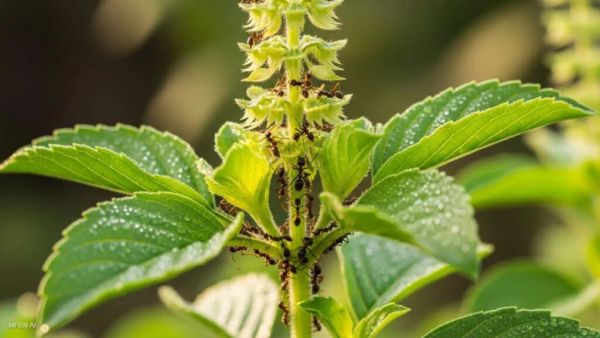
The Tulsi plant kept in the courtyard or balcony of the house is not just a part of the greenery, but is also associated with our emotions, traditions and everyday worship. But sometimes when the weather changes or the moisture in the soil increases, ants flock to this plant. Initially this seems to be a minor thing, but gradually the ants start damaging the roots and leaves of the plant, due to which the plant becomes weak and starts drying up. This is the reason why people immediately start searching for treatment, but often do not understand what to use which will not harm the plant.
In such times, home and natural remedies are the safest option. Especially Neem and Cinnamon, two such things which themselves act as strong insecticides in nature. Many horticulturists also believe that if Tulsi is attacked by ants, then using a solution of these two is most effective and safe. In this article, we will understand why ants climb the basil plant, how to make neem and cinnamon spray, how many hours it takes to show effect and how often it should be repeated.
Why do ants climb the basil plant?
The Tulsi plant is extremely sensitive, and if there is even a slight disturbance in its soil, the ants immediately convert it into their colony. Many times we water the Tulsi plant every day and worship it, but we do not see any movement of ants. Actually, there are four main reasons behind this: moisture, sweet insects, fallen sugar, and weak soil.
Ants often visit areas where aphids are present, as these aphids suck plant sap and release a sweet liquid, which ants love. This is the reason why ants are seen climbing the basil stem in a line. Apart from this, even if the soil of the pot remains wet for a long time, ants create their colony there. This whole process goes on silently, and by the time we notice, the plant has become weak. In such a situation, the solution of neem and cinnamon becomes a natural repellent for ants. It not only drives away ants, but also does not allow other insects to come near.
Neem and Cinnamon
Neem leaves are naturally filled with anti-bacterial, anti-fungal and insecticidal properties. For centuries, Neem has been used in India from agriculture to gardens to protect it from insects. Ants do not like its pungent smell and within a few hours they completely move away from that place. Cinnamon i.e. cinnamon powder contains an element called cinnamaldehyde, whose smell and pungency spoils the navigation system of ants. Ants create a line of scent to reach each other and cinnamon completely breaks this line. Therefore, both cinnamon water or powder drive away ants immediately. The spray made by mixing Neem and cinnamon becomes a natural powerful insecticide which does not cause any harm to the plant.
How to make Neem and Cinnamon solution? Very easy home recipe
The process of making the solution is quite simple and takes just 10 minutes to prepare. This natural spray is considered absolutely safe for the basil plant. First of all, take 10–12 fresh neem leaves and crush them lightly so that their juice comes out. After this, heat a cup of water and put the leaves in it and boil for 5 minutes. This prepares natural extract of Neem. Now let it cool down.
On the other hand, take one teaspoon of cinnamon powder and mix it in half a glass of lukewarm water. When both the mixtures cool down, add neem extract and cinnamon water in a spray bottle and mix well. This mixture will not only drive away ants but will also remove light insects present on basil leaves. Always use the spray in the evening or morning, when the sunlight is not strong.
How long does it take for the effects to be visible on ants?
According to horticulture experts, the mixture of Neem and cinnamon is considered to be one of the fastest effective home remedies. Ants usually leave their sites within 2–3 hours of the first spraying. Over the next 24 hours the effect becomes more intense, and the entire line of ants breaks up.
The reason behind this is that the smell of cinnamon confuses their path and the neem extract keeps them away from the plant. Many people also say that after 2-3 days of continuous use, the ants disappear completely and do not come back again. If there are a lot of ants, the spray can be applied in the morning and evening for two consecutive days. Keep in mind that after spraying, do not let the soil of the pot get too wet, because this attracts the ants again.
How to protect basil plant from ants again? necessary precautions
As important as it is to remove ants, it is equally important to prevent them from coming back. If you always keep the soil too wet or if sugar falls near the pot, the ants may return. First of all, water basil only when the soil is slightly dry. Especially during the rainy season, take care that water does not accumulate in the pot.
Apart from this, immediately clean any kind of sweet things or spilled sugar around the pot. If you feel that an ant colony has already formed in the soil, sprinkle some cinnamon powder. This method blocks the path of ants without any chemical. Neem spray can be done lightly on the plant once a week, this keeps the basil strong and no small insects come near it.
Is this method safe? What do gardening experts say?
The mixture of neem and cinnamon is completely natural, hence it does not give any side effects to the plant. Many gardening experts believe that chemicals should never be sprayed on the Tulsi plant because it is used in worship. Home remedies are always better for this. Not only this, people who have small children or pets at home also find this solution safer because its smell is not harmful. This is the reason why these days this solution is being suggested a lot in gardening videos on social media and YouTube.
-
Now Sanchar Saathi app is included in all smartphones, know its benefits

-
OpenAI took a big decision, image making users will be troubled Gujarati

-
Now ‘Sanchar Sathi’ app will be mandatory in all new mobile phones in India, fake devices and cyber fraud will be curbed.

-
The guidance I didn’t get, can I help others get it? | By Anthony Andrews

-
From water therapy to medals: Read swimmer Pratyasa Ray’s inspiring journey