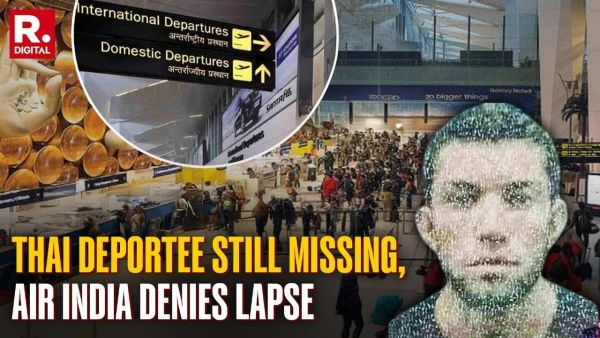
New Delhi: More than a month after a British national mysteriously slipped out of Delhi’s Indira Gandhi International Airport (IGIA) by breaching multiple layers of aviation security, the passenger remains untraceable even as Air India, in its detailed response to the Bureau of Civil Aviation Security (BCAS), has said that the airline bears no responsibility for the lapse.
In a letter to the BCAS Regional Office dated November 28, Air India said it had fully complied with all aviation security, transit handling and international guidelines in its handling of Jordan Joseph Peter Fitzpatrick, a British national who arrived in Delhi on October 28, 2025, after being deported from Bangkok for “drunk and disorderly trespassing”.
Deportee Was Not Violent, Fit To Travel Without Escort: Air India
Citing official documents received from Thai immigration, Air India said the “risk assessment form” clearly stated that the passenger had no criminal background, did not pose a threat and was fit to travel without an escort. He was categorised as a DEPU (deportee unaccompanied) with valid travel documents for onward travel to London within 24 hours and was therefore to be treated as a normal transit passenger under IATA’s Travel Without Visa (TWOV) guidelines.
The airline emphasised that Fitzpatrick was a paying customer with a commercial ticket and not a passenger handed over under custodial escort. “No violent conduct, risk of harm or criminal background… was indicated,” the airline said.
Missed First Flight, Refused Second & Then Vanished
Air India said the passenger was escorted to the international transit area upon arrival and monitored periodically “as a precaution”, though he was cooperative and displayed no unruly behaviour.
He was scheduled to fly out to London on AI-BER 2017 at 14:10 hrs on October 28, but missed the flight, claiming he was unwell. The airline rebooked him on AI 161 at 01:40 hrs on October 29, incurring financial loss but doing so “on humanitarian grounds” since he had to be returned to his port of embarkation in London.
However, when boarding began for the second flight, Fitzpatrick refused to travel to London and demanded to be flown to Spain instead. Air India said it declined the request and tried to “pacify the situation”, but the passenger continued to resist boarding.
‘Passenger Exited Airport Breaching Multiple Security Points
The airline said that before the 24-hour TWOV window elapsed, during which he was allowed to remain in the transit zone, Fitzpatrick managed to exit the airport by breaching multiple layers of security.
“He breached security protocols of the I2I transit area, made it to the arrival area and thereafter also managed to breach the immigration area and exited through the international arrival hall,” the airline wrote, adding that these highly restricted zones fall exclusively under CISF and immigration control, not under the airline’s authority.
At 07:30 hrs on October 29, Air India staff found him missing from the transit area and immediately searched adjoining zones. When it became clear he had exited the airport, the airline notified Immigration, Customs, CISF, Delhi International Airport Ltd (DIAL) and BCAS. An FIR was later registered by the Delhi Police under the Immigration and Foreigner Act.
‘Security Breach Outside Air India's Control’
In a point-by-point rebuttal to the BCAS show-cause notice, Air India said:
- Circulars dealing with deportees or intoxicated passengers did not apply, as Fitzpatrick was neither violent nor refused entry into India.
- TWOV guidelines were fully complied with, since he had confirmed onward tickets within 24 hours.
- The airline cannot use force on passengers to make them board flights.
- Continuous escort was not required under any guidelines and Thai authorities explicitly stated no escort was needed.
- “Air India denies that any security breach has occurred due to shortcomings in Air India’s handling of the passenger… The breach occurred outside Air India’s area of responsibility,” the airline said.
- It added that it had fulfilled its duty by repeatedly arranging onward travel to London and by promptly informing authorities once the passenger was found missing.

British Passenger Still Untraceable
More than five weeks since the incident, the Delhi Police and central agencies have not been able to trace Fitzpatrick, raising concerns about serious vulnerabilities in airport security systems, particularly the ease with which an international passenger crossed multiple restricted areas and exited untreated.
As the investigation continues, BCAS is assessing Air India’s response while security agencies face mounting questions about how a deportee with no intention of entering India walked out of one of the country’s most secure terminals and vanished.
-
The growing popularity of digital magazines; Huge increase in online subscriptions

-
‘Dhurandhar’ got relief, Censor Board put a stop to the news of army review

-
December 2025 Gaming Releases: Spider-Man, Samus Aran, Oscar, Katja — Every Big Title Arriving This Month

-
A new era in cancer treatment technology, Elekta launches Evo in India

-
India is bringing Israeli ‘Heron MK-II’ drone, surveillance will be done from 35,000 feet height, China-Pakistan will lose sleep