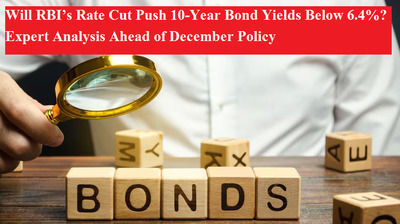
As the Reserve Bank of India (RBI) prepares to announce its monetary policy on 5 December, the financial markets are buzzing with one big question—will bond yields fall further if the central bank cuts interest rates? India’s economic indicators have shown surprising strength, and this has made investors even more curious about the RBI’s next move.
The Monetary Policy Committee (MPC) meeting comes at a time when the latest GDP data has exceeded expectations. The central bank has already reduced policy rates by 100 basis points in three rounds earlier this year, bringing the repo rate down to 5.5%. Meanwhile, retail inflation has eased to a 13-year low, and quarterly GDP growth has surged to 8.2%. With such strong fundamentals, the market is keen to know whether the RBI will opt for another rate cut.
How RBI’s Policy Could Impact Bond YieldsMarket experts believe that even if the RBI does not immediately cut the repo rate, a dovish tone or soft policy stance will still influence government bond yields.
Analysts say that if the RBI either:
-
Cuts the repo rate by 25 basis points, or
-
Provides clear guidance about future rate cuts
…then the yield on the 10-year government bond could slip below 6.4%. A drop in yield would translate into strong mark-to-market gains for bond investors.
Why Do Bond Yields Fall When Rates Are Cut?When interest rates go down, existing bonds with higher coupon rates become more attractive. As demand for these bonds rises, their prices increase, and when prices rise, yields naturally fall—because bond prices and yields move in opposite directions.
Thus, any sign of policy easing—either through an actual rate cut or through softer forward guidance—can strengthen sentiment in the bond market.
RBI Governor’s Remarks Strengthen Market ExpectationsGlobally, major central banks—including the U.S.—are shifting toward softer monetary policies. Recently, RBI Governor Sanjay Malhotra hinted at the possibility of more rate cuts in the future, which immediately influenced the bond market’s movement.
If the RBI signals a continued dovish stance on 5 December, yields may decline further. A rate cut also reduces banks’ funding costs, often resulting in lower loan rates, which boosts consumption and investment.
Why RBI May Still Wait Before Cutting RatesDespite strong growth and low inflation indicating an ideal “Goldilocks” economy, the RBI may still exercise caution.
Experts point out that:
-
CPI inflation is stable
-
GDP growth is high
-
The economy is in a sweet spot
This creates a situation where the RBI may choose to delay a rate cut to avoid disrupting the stable growth–inflation balance.
Two Possible Scenarios for Investors 1. If RBI Cuts Rates or Signals Future Easing-
Prices of government and corporate bonds may rise
-
Yields will likely fall further
-
Long-duration bond holders will see significant mark-to-market gains
This is especially favorable for investors who have already invested in long-term bonds.
2. If RBI Maintains Status Quo-
Yields may stay near current levels
-
Investors seeking stable and predictable income will benefit
-
Short- to medium-duration bonds will remain steady
The 10-year government bond is considered the benchmark for India’s debt market. A move below 6.4% would signal strong investor confidence and expectations of future rate cuts. It would also translate into capital gains for those holding long-term securities.
Bottom LineWhether or not the RBI cuts the repo rate on 5 December, the bond market is preparing for major movements. A single soft signal from the central bank could push the benchmark 10-year yield below 6.4%, creating opportunities for long-term bond investors.
However, if the RBI chooses caution and keeps rates unchanged, yields are expected to remain stable—offering comfort to those who prefer steady income.
Investors should keep a close eye on the policy statement, as even subtle hints from the RBI could shape bond market trends in the months ahead.
-
Pakistan accuses India of Hindering Sri Lanka relief efforts
-
OpenAI declares ‘code red’ to improve ChatGPT amid rising competition in AI chatbots

-
Virat Kohli To Play In Vijay Hazare Trophy For First Time Since 2010
-
Air India Check-In System Restored After Disruption; Glitch Delays Multiple Flights

-
'Perfect' gangster series based on 'fascinating' book returns with spin-off