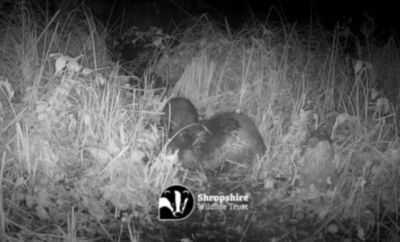
They are one of the most thrilling sights in nature and can help tackle flooding - now a UK county's recorded the first evidence of Eurasian beavers breeding in 400 years. And it's all thanks to the release into the wild of the kit's parents, named Bertie and Beryl in a competition, at a 32-acre (8.5 hectare) wildlife area in the north of Shrewsbury, in Shropshire, in February this year.
Beavers were hunted to extinction in Britain during the 16th Century for their fur, meat, and scent glands, but the release took place in a wild, wetland area with fences to keep in the new arrivals, but with a pedestrian walkway across the site so visitors could spot them in their new habitat. Now hidden cameras confirm Bertie and Beryl have had a kit - making it the first recorded beaver breeding in Shropshire in 400 years, according to the county's wildlife trust and Shrewsbury Town Council.
The site is already showing indicators of a boost in biodiversity, such as an increase in insect activity and improved wetland vegetation. Amphibian activity has also been observed within the beaver habitat.
With their ability to create and maintain resilient wetland habitat, beavers are crucial to the restoration of a healthy living landscape in the area.
Thrilled Tom Freeland, head of nature reserves at Shropshire Wildlife Trust, said: "We're delighted that Beryl and Bertie have been able to raise a kit in their first year at the Old River Bed.
"It's testament to the hard work carried out by the partners in setting up the enclosure in ideal beaver habitat, and to the consideration of visitors and local residents who have quietly welcomed the beavers and made them feel at home.
"We look forward to monitoring what happens next as the whole family get to work on the trees and waterways of this amazing site."
Beavers have been introduced to the Old River Bed, owned by Shrewsbury Town Council, as part of a five-year trial to assess the impact of this species on an existing wetland site.
Since their return to the Site of Special Scientific Interest (SSSI), the pair of 'ecosystem engineers' have been busy transforming the 8.5-hectare wetland habitat. They have already begun to restore the natural flow of water by creating small dams and rebuilding riverbanks.
These changes will improve the site's ability to store water, which in turn improves water quality, reduces downstream flood risk, and prevents stored carbon from being released.
Jim Goldsmith, Countryside and Greenspace Manager at Shrewsbury Town Council, said: "We are proud to welcome the first beaver kit born in Shropshire.
"There has been a lot of hard work, patience and partnership behind this project. Seeing Beryl and Bertie settle in so successfully and now raise a kit shows just how powerful nature can be when we create the right conditions."
Alicia Leow-Dyke, Welsh Beaver Project Officer at North Wales Wildlife Trust, said: "It is incredibly exciting to see the very first beaver kit born at the Old River Bed!
"Beryl and Bertie arrived in February, and the new addition is a testament to how well both beavers have settled into their new home.
"It has been a privilege working on this project and we look forward to seeing the kit grow and helping out with managing the habitat at the Old River Bed."
The Shropshire Wildlife Trust said the Shropshire Beaver Project has been made possible by experts and funders to whom Shropshire Wildlife Trust and Shrewsbury Town Council are extremely grateful.
They added: "To ensure the beaver kit can continue to explore their new home undisturbed, members of the public using the boardwalk and woodland footpath adjoining the enclosure are urged to be quiet and considerate, making sure dogs are on-lead and kept under control.
"England is one of the world's most nature-depleted countries and beavers offer a chance to reverse the dramatic decline in our wildlife by allowing nature to restore itself.
"Release projects, into both enclosures and the wild, are already underway in several locations across Scotland, England and Wales. They have proved to be hugely successful in managing wetlands more sensitively, enabling nature solutions to many environmental issues."
-
2nd ODI: South Africa wary of Rohit-Kohli storm after whirlwind series opener

-
Hardik Pandya Back for SA T20Is; Major Doubt Over Shubman Gill's Fitness

-
Rajrup Sarkar stars in India's qualification for AFC Under-17 Asian Cup 2026

-
Kyren Wilson opens up on wife's worrying health battle ahead of UK Championship

-
Robin Smith's team-mate slammed over 'unnecessary' remark after England legend dies at 62