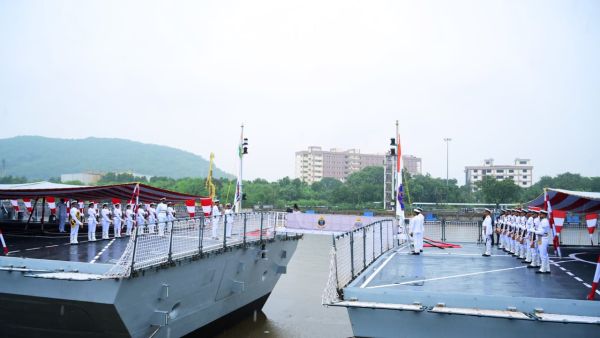
India’s Navy accelerates shipbuilding, boosts global deployments and intensifies pressure on Pakistan under Operation Sindoor, safeguarding trade routes and shaping a new maritime era.
New Delhi: Standing before the national and foreign press ahead of Navy Day, Chief of Naval Staff Admiral Dinesh K Tripathi wasn’t merely listing achievements. He was outlining a moment—one where India’s maritime power finds itself transformed, more confident than ever, and more deeply embedded in the currents shaping the Indian Ocean and beyond.

Since December 2024, the Indian Navy has secured Acceptance of Necessity for 94 capital acquisition cases, worth nearly Rs 1.27 lakh crore. These approvals cover 247 ships and 120 fast interceptor craft—a massive reinforcement of India’s sea power. In addition, the Navy has signed contracts for 83 capital cases valued at about Rs 84,762 crore, including 46 emergency procurement cases worth around Rs 7,000 crore.
Senior officers described this stage as a decisive leap in India’s maritime evolution—powered by domestic shipbuilding, new partnerships and unmatched operational momentum.
A Year of Inductions & Force Expansion
The past 12 months have rewritten India’s naval order of battle. Admiral Tripathi noted that 12 new warships and a submarine have joined active service since the previous Navy Day. Among them, INS Udaygiri stands out—the 100th indigenous warship conceived by the Navy’s own Warship Design Bureau.
Even more significant was the commissioning of the first privately designed Indian warship, underscoring how private shipyards and design firms are increasingly becoming part of India’s strategic backbone.
Anti-Piracy & Red Sea Crisis Response
On the operational front, India’s naval footprint has been everywhere—quietly steady, and often life-saving.
Over the past year, the Navy has clocked almost 11,000 ship-days and 50,000 flying hours across waters stretching from the Atlantic to the Pacific. Its anti-piracy deployment in the Gulf of Aden, running non-stop since 2008, has now involved 138 ships and ensured the safe passage of over 3,700 merchant vessels.
Then came the Red Sea crisis.
With instability rising sharply since November 2023, the Navy deployed more than 40 platforms at different moments to protect global trade routes. These missions safeguarded over 152 lakh metric tonnes of cargo aboard around 376 vessels — cargo valued over USD 6.5 billion. During this period, Indian warships responded to over 30 distress incidents and saved more than 500 lives at sea.
Humanitarian Missions Strengthen Regional Leadership
Indian sailors have also stood guard during disasters that struck the neighbourhood.
They evacuated medical emergencies in the Maldives, rushed 500 tonnes of earthquake relief material within 48 hours under Operation Brahma, and intervened in several high-risk rescue operations across the Arabian Sea.
This is the soft side of sea power—one that wins hearts long before headlines.
Partnerships have grown too: 21 bilateral, nine multilateral and 34 additional exercises have broadened India’s ties with African and Indian Ocean littoral states. The Navy’s Deep Submergence Rescue Vessel worked with submarines from three nations during Exercise Pacific Reach, sharpening confidence under the most dangerous underwater conditions.
Innovation, Tech & A Changing Force
Inside the force, transformation is underway.
Admiral Tripathi emphasised investment in AI-based systems, cutting-edge innovation, gender-neutral recruitment and a more diverse workforce—a Navy reflecting the future it sails toward.
Operation Sindoor,: ,Pakistan, Kept in Check
The most pointed remarks came when questions turned to Pakistan and Operation Sindoor.
“Our aggressive posturing and maritime domain awareness ensured that Pakistan Navy never came out,” he declared. “We are maintaining the operational tempo and we are ensuring that our maritime domain awareness is complete. We exactly know where the Pakistani naval units are deployed and maritime domain awareness in maritime warfare is the first step so I think we are quite happy with what we are able to do.”
On disrupting hostile plans, he added:
“As far as the maritime domain awareness is concerned, we are also ensuring that their units do not do anything inimical to our interests and we are being successful with that.”
The impact wasn’t only military.
Regarding the economic effect on Pakistan during Operation Sindoor, he said that by some estimates, there was a drop of at least 10-15 percent in the trade, which had an economic effect on Pakistan.
The Course Ahead
India’s naval story today is not one of silent ambition—it is visible, assertive and anchored in democratic maritime principles. With more ships, more deployability and more regional trust, the Navy has stepped into a new leadership role.
In a world of shifting currents—from piracy to geopolitics—India’s message is clear: Its sea lanes will remain open. Its partners will remain protected. And its adversaries will remain watched.
-
Spencer sisters turn red carpet into runway magic with Gaurav Gupta's couture

-
Bharti Singh celebrates 8 years of marital bliss with Haarsh Limbachiyaa

-
Shahid Kapoor on how instinct has played a crucial role in shaping his career

-
It's a victory for Ilaiyaraaja in the copyright case; Madras HC dismisses 'Good Bad Ugly' makers' plea, and the ban continues

-
Shilpa Shetty, Raj Kundra Request Travel Clearance To London Amid 60 Crore Fraud Probe