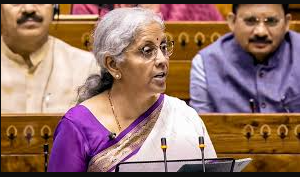
NEW DELHI, Dec 3: The Lok Sabha on Wednesday passed a law to levy a higher excise duty on tobacco and products once the GST compensation cess ends.
The Central Excise (Amendment) Bill, 2025, was passed by a voice vote in the lower house. The Bill, once enacted, will give the government the fiscal space to increase the rate of central excise duty on tobacco and products after GST compensation cess, which is currently levied on all tobacco products like cigarettes, chewing tobacco, cigars, hookah, zarda, and scented tobacco, ceases to exist.
Currently, a 28% Goods and Services Tax (GST) plus cess at a varied rate is levied on tobacco and products. The bill proposes to levy an excise duty of 60-70% on unmanufactured tobacco. Excise on cigars and cheroots is proposed at 25% or ₹5,000 per 1,000 sticks, whichever is higher.
Cigarettes, depending on length and filter, are proposed to be taxed in the range of ₹2,700-₹11,000 per 1,000 sticks, while chewing tobacco is taxed at ₹100 per kg. The Bill seeks to substitute the table containing the tariff rates of tobacco and tobacco products in Section IV of the Fourth Schedule to the Central Excise Act, 1944.
When GST was introduced on July 1, 2017, the rates of Central Excise duties on tobacco and such products were reduced significantly to allow for the levy of compensation cess without a large impact on their tax incidence. Compensation cess levied on tobacco and tobacco products will be discontinued once interest payment obligations and loan liabilities under the compensation cess account are completely discharged.”
Delivering her reply to the debate on the Bill in the Lok Sabha, the Finance Minister Nirmala Sitharaman pointed out that the duty on cigarettes had been higher in the pre-Goods and Services Tax (GST) regime. It was then reduced to a “nominal” rate under GST, as cigarettes also attracted a compensation cess.
With that compensation cess set to be withdrawn soon, once the government repays the interest on loans it had taken to compensate States during the COVID-19 pandemic period, the Center has introduced this Bill to increase the base excise duty on cigarettes so that the tax incidence on them does not fall.
“This is not a new law, this is not an additional tax or something that the Center is taking away,” Ms Sitharaman said. “Many MPs here observed that this is a cess. This is not a cess; this is excise duty. Excise duty existed before GST. The amount will be redistributed to the States as per the Finance Commission’s recommendations.”
The Finance Minister also sought to address some MPs’ concerns that the new tax would increase the price of beedis and thereby harm the lakhs of beedi workers in the country. “There is no change in the tax incidence on beedi,” Ms Sitharaman clarified. “Not even a single paisa of tax has been increased.”
The Finance Minister also spoke about how tax rates on tobacco were increased annually in the pre-GST period, and how tobacco farmers needed to move away from growing tobacco. “Efforts have been made in the past and continue to be made to raise awareness among farmers about the harms of tobacco farming,” she explained.
“Under the National Agricultural Development Scheme, the crop diversification program has been covering 10 major tobacco-producing States—Andhra Pradesh, Bihar, Gujarat, Karnataka, Maharashtra, Odisha, Tamil Nadu, Telangana, Uttar Pradesh, and West Bengal—since 2015, and other efforts have been ongoing for decades.” She said that, between 2018 and 2021-22, more than 1.12 lakh acres of land were shifted away from tobacco cultivation to other crops.
At the time of the introduction of the GST on July 1, 2017, a compensation cess mechanism was put in place for five years till June 30, 2022, to make up for the revenue loss suffered by states on account of GST implementation. The levy of compensation cess was later extended by four years till March 31, 2026, and the collection is being used to repay the ₹2.69 lakh crore loan that the Center took to compensate states for the GST revenue loss during the Covid period.
(Rohit Kumar)
-
IPPB Announces Gramin Dak Sevak Exam Results for 2025

-
Bribery Scandal Unfolds at ITAT: Assistant Registrar KC Meena Arrested
-
The role of education in securing the UAE's bright tomorrow

-
Nifty likely to hit 29,000 in 2026 as earnings drive market gains
-
Future-ready school set to solve real-world challenges