
Bengaluru: Indian companies are becoming more serious about succession planning to safeguard themselves against the fallout from any sudden leadership gaps.
Around four in five (78%) organisations now have a formal succession process in place, up from 72% last year, according to the Deloitte 2025-26 Talent Readiness Study. Companies reported a 51% success rate in their succession planning efforts (elevation of executives in line with the succession plan), almost double compared with 27% reported in the previous survey.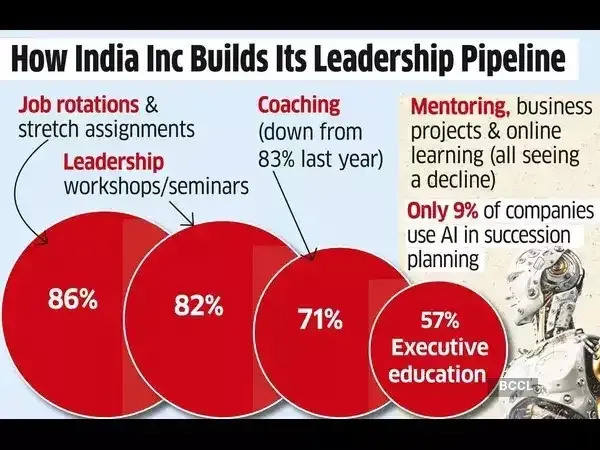
"Succession management maturity is rising, with one in every two CXOs now internal promotions," said Neelesh Gupta, partner, Deloitte India. "Nearly all organisations are strengthening assessment (62%) and development (87%) frameworks, up from 60% and 80%, respectively, the previous year. Effectiveness is becoming a priority, reflected in a sharp increase in reported success rates and more organisations measuring outcomes."
Around 63% of organisations reported that they measure the effectiveness of their succession management process, compared with 43% in the survey last year.
The survey profiled 156 companies across manufacturing, services and life sciences. The services sector took the lead with 84% surveyed companies having a formal succession process in place, followed by 80% in life sciences and 75% in manufacturing.
While only 9% of organisations have started using artificial intelligence within their succession planning process, 89% of organisations actively develop individuals identified for succession management. Family businesses are witnessing a wave of early succession, with most next-generation leaders entering young, and nearly half stepping in directly at director-level roles.
Companies are approaching succession planning with clear objectives in mind, said Gupta. While 40% are looking at identifying and developing potential successors for key leadership roles, 37% want to build a talent pipeline to ensure a smooth transition in critical positions, while 22% want to implement a structured process either as part of a board mandate or to prepare employees for future advancement opportunities.
About 86% of organisations-compared with 76% last year-use job rotations and stretch assignments to strengthen succession pipelines, which has been found to be the most effective development mechanism, according to the survey. As much as 82% put future leaders through leadership workshops/seminars, compared with 77% last year, while 57% opt for executive education (50% last year). Though 83% identified coaching as the most effective tool last year, that has dropped to 71% this year. Mentoring programmes, business projects and online learning platforms/e-learning modules have also shown a decline in terms of effectiveness since the previous survey.
The survey found that 72% of organisations annually update their succession plans in line with strategic objectives, though only 22% engage in benchmarking practices annually. "While organisations are placing strategic importance on succession planning, there's a lack of external orientation," said Gupta.
Around four in five (78%) organisations now have a formal succession process in place, up from 72% last year, according to the Deloitte 2025-26 Talent Readiness Study. Companies reported a 51% success rate in their succession planning efforts (elevation of executives in line with the succession plan), almost double compared with 27% reported in the previous survey.
"Succession management maturity is rising, with one in every two CXOs now internal promotions," said Neelesh Gupta, partner, Deloitte India. "Nearly all organisations are strengthening assessment (62%) and development (87%) frameworks, up from 60% and 80%, respectively, the previous year. Effectiveness is becoming a priority, reflected in a sharp increase in reported success rates and more organisations measuring outcomes."
Around 63% of organisations reported that they measure the effectiveness of their succession management process, compared with 43% in the survey last year.
The survey profiled 156 companies across manufacturing, services and life sciences. The services sector took the lead with 84% surveyed companies having a formal succession process in place, followed by 80% in life sciences and 75% in manufacturing.
While only 9% of organisations have started using artificial intelligence within their succession planning process, 89% of organisations actively develop individuals identified for succession management. Family businesses are witnessing a wave of early succession, with most next-generation leaders entering young, and nearly half stepping in directly at director-level roles.
Companies are approaching succession planning with clear objectives in mind, said Gupta. While 40% are looking at identifying and developing potential successors for key leadership roles, 37% want to build a talent pipeline to ensure a smooth transition in critical positions, while 22% want to implement a structured process either as part of a board mandate or to prepare employees for future advancement opportunities.
About 86% of organisations-compared with 76% last year-use job rotations and stretch assignments to strengthen succession pipelines, which has been found to be the most effective development mechanism, according to the survey. As much as 82% put future leaders through leadership workshops/seminars, compared with 77% last year, while 57% opt for executive education (50% last year). Though 83% identified coaching as the most effective tool last year, that has dropped to 71% this year. Mentoring programmes, business projects and online learning platforms/e-learning modules have also shown a decline in terms of effectiveness since the previous survey.
The survey found that 72% of organisations annually update their succession plans in line with strategic objectives, though only 22% engage in benchmarking practices annually. "While organisations are placing strategic importance on succession planning, there's a lack of external orientation," said Gupta.