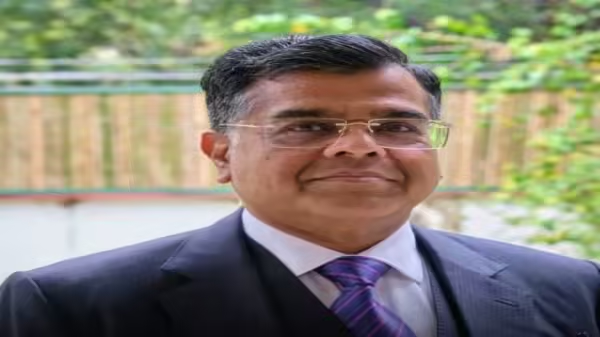
India’s Most Powerful Bureaucrat: In India’s administrative hierarchy, the office of the Cabinet secretary holds unique weight. It is the senior-most civil service position, entrusted with the coordination of the entire governmental machinery. The person occupying this post directly advises the prime minister on critical matters, ensures smooth functioning across ministries and plays a central role in influencing policy outcomes.
The headquarters of the Cabinet Secretariat sits in New Delhi’s South Block, a few steps away from the Prime Minister’s Office. Despite the simplicity of the name, the importance of the institution becomes clear when one sees its scope and influence.
The Secretariat operates across three wings: civil, military and intelligence – with the civil wing holding the most prominence, as it supports the central Cabinet, advises on policy and ensures coordination between ministries.
Add Zee News as a Preferred Source
During national crises or emergency situations, the Cabinet secretary becomes the central coordinator between ministries. Furthermore, the Secretariat is also responsible for sending monthly consolidated reports to the president, vice-president and Union ministers about departmental activities across the government.
This office has played a critical role in some of India’s most consequential decisions. For example, during the historic revocation of Article 370 and the reorganization of Jammu and Kashmir into two union territories, the Cabinet Secretariat coordinated closely with intelligence agencies and various ministries to manage the complex transition. The Secretariat’s role in that process highlighted not only its operational importance but also its strategic significance behind major policy moves.
Meet The Incumbent Office-Holder: TV Somanathan
Dr. T. V. Somanathan, a 1987-batch IAS officer, took over as India’s Cabinet secretary on August 30, 2024. The Appointments Committee of the Cabinet approved his appointment for a two-year term.
He brings a long and varied career to the post. Before this appointment, he served as the finance secretary and secretary in the Department of Expenditure. His earlier roles include joint secretary and additional secretary in the Prime Minister’s Office, joint secretary at the Ministry of Corporate Affairs and even a stint as director of corporate affairs at the World Bank in Washington DC.
In his home cadre of Tamil Nadu, he has held several senior positions, including the managing director of the Chennai Metro Rail Corporation, the commissioner of commercial taxes during the rollout of Goods and Services Tax (GST) and secretary to the chief minister.
With a Ph.D. in economics from the Calcutta University and further qualifications as a chartered accountant and company secretary, Somanathan is among the most academically and administratively equipped officers to hold the top bureaucratic position in the country.
What The Cabinet Secretary Actually Does
The Cabinet secretary acts as the chief coordinator of the entire central administration. Officially, this role includes chairing the Civil Services Board, overseeing senior appointments to key posts and heading the Committee of Secretaries on Administration, which resolves inter-ministry differences and helps forge consensus on major policy issues.
Apart from policy coordination, the Cabinet secretary ensures effective management of national crises and leads administrative continuity when governments change or during emergencies. They also prepare the Cabinet’s agenda, ensure implementation of Cabinet decisions and periodically brief the President, the Vice-President and Union ministers about government operations.
In many ways, the Cabinet secretary functions as the anchor of governance, enabling the machinery that makes national policy and decides government actions.
Why The Post Remains The Govt’s Backbone
Given the vast diversity of ministries, departments, policies and politics in India, the position of Cabinet secretary gains strength from being an institution rather than an individual.
By coordinating between ministries, feeding intelligence and analysis to the prime minister, recommending senior appointments and managing emergencies, the office keeps the core of governance steady.
With Dr. With Somanathan at the helm, many in Delhi view the move as a consolidation of experience and administrative heft. His record across finance, corporate affairs, state-level governance and international exposure at the World Bank suggests that he brings both breadth and depth to the role.
As long as the Cabinet Secretariat retains its centrality, the person occupying the post remains, in effect, the nation’s most powerful executive official outside the political leadership.
In short, the Cabinet Secretary, often called the prime minister’s right hand, remains the force that decides how India is governed, bridging politics and administration and ensuring that public policy becomes action.
-
Solar storm triggers biggest radiation surge in 20 years

-
India's exports rebound stronger in November

-
Small kitchen and grocery tweaks that can reset your health faster than any diet

-
1st Test: Shai Hope, Chanderpaul shine with fifties against NZ

-
India finish with highest medal haul at FEI Asian Equestrian Championship 2025