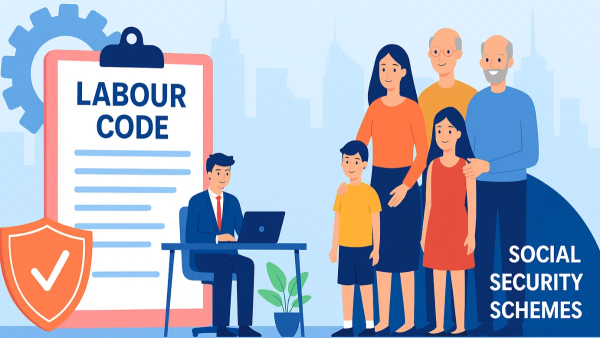
New Labour Code to Be Fully Implemented from 1 April: Major Changes in Work Hours, Overtime and Social Security
A major phase of labour reforms is set to begin next year as all four Labour Codes are expected to be fully enforced from 1 April 2026. The central government has initiated the final process of notifying rules under these codes, and draft rules will soon be released for public feedback. Once implemented, these four codes will replace 29 existing labour laws, bringing uniformity, transparency, and stronger protection for employees and workers across sectors.
According to senior officials from the Ministry of Labour and Employment, the new framework aims to enhance social security, ensure equal treatment in the workplace, and provide clearer guidelines for work hours, overtime, and employment conditions. Labour Minister Mansukh Mandaviya, speaking at the CII IndiaEdge 2025 event, confirmed that draft rules under all four codes will soon be pre-published for comments.
45-Day Public Feedback Window Before Final Notification
As per an ET report, the rules will be open for public comments for a 45-day period before they are finalised. The government’s target is to roll out the fully notified rules from the beginning of the next financial year — 1 April 2026.
Once enforced, these four Labour Codes will consolidate the country’s labour laws into a simplified system covering wages, industrial relations, social security, and occupational health and safety.
Key Benefits and Changes for Employees
1. Work Hours and Overtime Flexibility
Under the new Labour Codes, the standard daily working hours will remain 8 hours. However, employees will benefit from an added flexibility:
-
The weekly cap of 48 hours stays intact
-
Employers may offer flexible working arrangements
-
Additional overtime options will be available based on weekly work-hour management
This flexibility allows industries and employees to balance workloads more efficiently while ensuring compliance with labour protections.
2. Stronger Equality and Workplace Protection
The New Labour Codes mandate several measures to protect employees’ rights and ensure equal opportunities:
-
Issuing an appointment letter will be mandatory for all employees.
-
Equal pay for equal work will apply across gender and designation levels.
-
Workers aged 40 years or above will be entitled to free annual health check-ups.
-
Women employees will be allowed to work in different shifts with equal safety provisions.
These changes aim to create a more transparent and safe working environment for the entire workforce.
3. Increased Scope of Social Security
The government aims to significantly expand the coverage of social security schemes.
-
The target is to include 100 crore workers under social security by March 2026.
-
The current coverage has already increased from 19% in 2015 to over 64% in 2025.
This expanded coverage will include workers from unorganised sectors, gig and platform workers, and self-employed individuals.
Role of Centre and States in Implementation
Since labour falls under the Concurrent List, both the central and state governments must notify the rules for the codes to be enforced nationwide. While the centre prepares the model rules, each state must frame and approve its own rules within its jurisdiction.
Smooth implementation will therefore depend on how quickly states complete their respective procedures.
What This Means for the Workforce
With the New Labour Codes expected to be fully operational from 1 April 2026, employees can look forward to:
-
Clearer work-hour guidelines
-
Overtime flexibility
-
Stronger workplace equality
-
Mandatory appointment letters
-
Wider access to social security
-
Improved health and safety provisions
The new framework aims to modernise India’s labour system, ensure economic fairness, and strengthen worker protection across industries.
-
LoP Sidestepped? Only 4 Foreign Leaders Have Met Rahul Gandhi Since 2024
-
Mizoram Governor General Vijay Kumar Singh (Retd) Highlights Tech As Key To Northeast's Climate Resilience & Security

-
IIM Indore Student Alleges Sexual Harassment By Placement Panel Member; ICC Removes Accused And Begins Probe
-
SSC CHSL Tier 1 Result 2025 Expected Soon At ssc.gov.in; Here’s How To View Your Score
-
Chile Passes Landmark Bill Banning Smartphones In Elementary And Middle School Classes To Curb Distractions