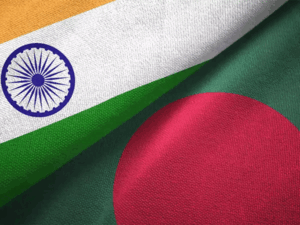
Bangladesh is looking to leverage film festivals and tourism exchanges to "break the ice" and re-energise bilateral ties with India in the post-Sheikh Hasina phase, even as overall economic engagement between the two neighbours is estimated to exceed USD 35 billion, Bangladeshi High Commissioner to India M Riaz Hamidullah said on Wednesday.
During an interaction with members of the Merchant Chamber of Commerce, Hamidullah said he hopes that cultural and people-centric exchanges will play a pivotal role in refreshing the relationship at a time when both sides are assessing the next phase of engagement.
He said talks are underway to organise a Bengali film festival in Delhi, though he did not share further details.
The envoy added that during his interactions with industry chambers, he has consistently encouraged increased tourist movement to Bangladesh.
Hamidullah, who has been posted in Delhi for the last eight months, underlined that the India-Bangladesh partnership is fundamentally an "organic relationship" rooted in shared ecology, civilisational ties and similar social moods shaped over generations.
"One should not try to find more meaning in the comment about its organic nature," he said, without elaborating.
He argued that the economic relationship is widely underestimated because commonly cited figures account only for merchandise trade.
"While goods trade stands at USD 12 billion or more, he said the true engagement is far higher once medical tourism, Indian professionals employed in Bangladesh, and the thousands of Bangladeshi students in India are included. It should be over USD 25 billion, if not somewhere in the region of USD 35 to 38 billion," he said.
On the broader strategic outlook, the high commissioner said both countries must work toward articulating a genuine "shared future", acknowledging it is "easier said than done" but certainly achievable.
He stressed the need to recognise differences and sensitivities, saying failing to do so would mean "not doing justice to the relationship".
Hamidullah also highlighted the growing importance of logistics readiness, pointing to Bangladesh's ongoing expansion of port capacity as a critical indicator of future cooperation potential.
Responding to a query on reports regarding the transit of goods to Bhutan via India, he confirmed that discussions are underway between the governments but declined to elaborate, saying the venue was not appropriate for detailed clarifications.
With Dhaka increasingly leaning on cultural diplomacy, tourism facilitation and deeper economic integration, the envoy said Bangladesh is signalling a clear intent to widen the scope of engagement as both countries navigate a sensitive phase in their bilateral ties.
On Sunday, Bangladeshi foreign affairs adviser Md Touhid Hossain reportedly said the issue of the extradition of former prime minister Sheikh Hasina would not affect the broader relationship between Dhaka and New Delhi.
During an interaction with members of the Merchant Chamber of Commerce, Hamidullah said he hopes that cultural and people-centric exchanges will play a pivotal role in refreshing the relationship at a time when both sides are assessing the next phase of engagement.
He said talks are underway to organise a Bengali film festival in Delhi, though he did not share further details.
The envoy added that during his interactions with industry chambers, he has consistently encouraged increased tourist movement to Bangladesh.
Hamidullah, who has been posted in Delhi for the last eight months, underlined that the India-Bangladesh partnership is fundamentally an "organic relationship" rooted in shared ecology, civilisational ties and similar social moods shaped over generations.
"One should not try to find more meaning in the comment about its organic nature," he said, without elaborating.
He argued that the economic relationship is widely underestimated because commonly cited figures account only for merchandise trade.
"While goods trade stands at USD 12 billion or more, he said the true engagement is far higher once medical tourism, Indian professionals employed in Bangladesh, and the thousands of Bangladeshi students in India are included. It should be over USD 25 billion, if not somewhere in the region of USD 35 to 38 billion," he said.
On the broader strategic outlook, the high commissioner said both countries must work toward articulating a genuine "shared future", acknowledging it is "easier said than done" but certainly achievable.
He stressed the need to recognise differences and sensitivities, saying failing to do so would mean "not doing justice to the relationship".
Hamidullah also highlighted the growing importance of logistics readiness, pointing to Bangladesh's ongoing expansion of port capacity as a critical indicator of future cooperation potential.
Responding to a query on reports regarding the transit of goods to Bhutan via India, he confirmed that discussions are underway between the governments but declined to elaborate, saying the venue was not appropriate for detailed clarifications.
With Dhaka increasingly leaning on cultural diplomacy, tourism facilitation and deeper economic integration, the envoy said Bangladesh is signalling a clear intent to widen the scope of engagement as both countries navigate a sensitive phase in their bilateral ties.
On Sunday, Bangladeshi foreign affairs adviser Md Touhid Hossain reportedly said the issue of the extradition of former prime minister Sheikh Hasina would not affect the broader relationship between Dhaka and New Delhi.