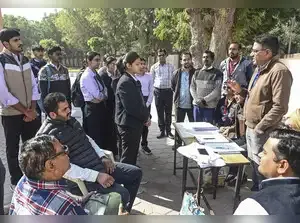
Taking note of a plea alleging extreme work pressure faced by the booth level officers (BLOs) engaged in the time-bound special revision of the electoral rolls, the Supreme Court directed the states on Thursday to consider deputing additional employees for reducing their working hours, reported PTI.
The court was hearing an application filed by actor Vijay's party, Tamilaga Vetri Kazhagam (TVK), seeking a direction to the Election Commission (EC) not to take coercive actions under the Representation of the People (RP) Act against the BLOs for not performing the duty in a time-bound manner and pointing out that many of them have committed suicide due to the work pressure.
A bench of Chief Justice Surya Kant and Justice Joymalya Bagchi took note of the submissions made by senior advocate Gopal Sankaranarayanan, who appeared in the matter for the TVK, that some instructions are needed to be issued as many BLOs, who are either teachers or anganwadi workers, have died due to the extreme pressure exerted on them by EC officials.
Sankaranarayanan said moreover, the EC officials are also getting FIRs lodged against the BLOs if they fail to perform their duties.
The CJI said the states may consider deploying additional staff, so that the work pressure is eased.
"In case they are facing hardships, including being overburdened with their routine duties as well as the additional duties assigned by the Election Commission, the state government can obviate such hardships," the bench noted.
The states may consider the "desirability of deputing additional staff at the disposal of the EC, so that the working hours can be proportionately reduced", an order issued by the court said.
The bench said if any employee has any "specific reason" for seeking exemption from the SIR duty, the competent officer of the state can consider such requests on a case-to-case basis and replace such an employee with another.
"However, it shall not be construed or understood as if they can withdraw the employees who have been assigned the duty if their substitutes are not provided," it added.
The court further said the states where the Special Intensive Revision (SIR) of the electoral rolls is underway, "shall be obligated to deploy the requisite workforce at the disposal of the EC, though the strength of such employees can be increased as explained above".
The bench disposed of the plea, saying the other prayers like seeking ex-gratia compensation for the BLOs who died during SIR duties can be revived later, either by the aggrieved persons or the petitioner, by filing another application at a later stage.
During the hearing, Sankaranarayanan said FIRs under section 32 of the RP Act have been filed by the poll panel against BLOs.
Section 32 of the Act deals with a breach of official duty by electoral officers, making it punishable with imprisonment and fines for neglecting their duties related to the electoral rolls.
The senior lawyer said BLOs are not equipped to perform the SIR duties in such a short span of time and moreover, there are internet-related issues. He said the teachers and anganwadi workers have to go for SIR duties early morning or late at night, before or after their regular work.
He said a youngster, who had to go on leave for his wedding, was denied leave and suspended.
"He committed suicide.... When you are doing this, at least show the human side. Criminal action is harsh, it should not be initiated," the lawyer said.
The bench said the state governments cannot run away from their obligation.
"If there is a difficulty being experienced, then on a case-to-case basis, the state government can exempt employees and provide an alternative," the CJI said.
"Why should the Election Commission register FIRs?" Sankaranarayanan asked.
"It is not for the first time, earlier also they have been registering it," the CJI said.
Senior advocate Kapil Sibal said the pressure on the BLOs is a "harsh reality".
Citing the example of Uttar Pradesh, the CJI said the election in the state is due in 2027, yet the BLOs are asked to complete the exercise in a time-bound manner.
The bench said no state has so far approached the court citing difficulties.
Senior advocates Rakesh Dwivedi and Maninder Singh, appearing in the matter for the EC, said in Tamil Nadu, more than 90 per cent of the enumeration forms have been supplied.
Dwivedi said the poll panel resorted to criminal proceedings only when the BLOs showed reluctance to perform their duties. He said such arguments are used to create a particular kind of political narrative.
On November 30, the EC extended the entire schedule for the ongoing SIR exercise in nine states and three Union territories by a week, amid allegations by opposition parties that the "tight timelines" were causing problems for people and ground-level poll officials.
The EC announced the SIR in the nine states and three Union territories on October 27. Nearly 51 crore electors will be covered in the massive voter-list cleanup exercise.
These states and Union territories are -- the Andaman and Nicobar Islands, Lakshadweep, Chhattisgarh, Goa, Gujarat, Kerala, Madhya Pradesh, Puducherry, Rajasthan, Tamil Nadu, Uttar Pradesh and West Bengal.
Among these, Tamil Nadu, Puducherry, Kerala and West Bengal are scheduled go to polls in 2026.
For Assam, where polls are also due in 2026, the revision of the electoral rolls was announced separately.
(With inputs from PTI)
The court was hearing an application filed by actor Vijay's party, Tamilaga Vetri Kazhagam (TVK), seeking a direction to the Election Commission (EC) not to take coercive actions under the Representation of the People (RP) Act against the BLOs for not performing the duty in a time-bound manner and pointing out that many of them have committed suicide due to the work pressure.
A bench of Chief Justice Surya Kant and Justice Joymalya Bagchi took note of the submissions made by senior advocate Gopal Sankaranarayanan, who appeared in the matter for the TVK, that some instructions are needed to be issued as many BLOs, who are either teachers or anganwadi workers, have died due to the extreme pressure exerted on them by EC officials.
Sankaranarayanan said moreover, the EC officials are also getting FIRs lodged against the BLOs if they fail to perform their duties.
The CJI said the states may consider deploying additional staff, so that the work pressure is eased.
"In case they are facing hardships, including being overburdened with their routine duties as well as the additional duties assigned by the Election Commission, the state government can obviate such hardships," the bench noted.
The states may consider the "desirability of deputing additional staff at the disposal of the EC, so that the working hours can be proportionately reduced", an order issued by the court said.
The bench said if any employee has any "specific reason" for seeking exemption from the SIR duty, the competent officer of the state can consider such requests on a case-to-case basis and replace such an employee with another.
"However, it shall not be construed or understood as if they can withdraw the employees who have been assigned the duty if their substitutes are not provided," it added.
The court further said the states where the Special Intensive Revision (SIR) of the electoral rolls is underway, "shall be obligated to deploy the requisite workforce at the disposal of the EC, though the strength of such employees can be increased as explained above".
The bench disposed of the plea, saying the other prayers like seeking ex-gratia compensation for the BLOs who died during SIR duties can be revived later, either by the aggrieved persons or the petitioner, by filing another application at a later stage.
During the hearing, Sankaranarayanan said FIRs under section 32 of the RP Act have been filed by the poll panel against BLOs.
Section 32 of the Act deals with a breach of official duty by electoral officers, making it punishable with imprisonment and fines for neglecting their duties related to the electoral rolls.
The senior lawyer said BLOs are not equipped to perform the SIR duties in such a short span of time and moreover, there are internet-related issues. He said the teachers and anganwadi workers have to go for SIR duties early morning or late at night, before or after their regular work.
He said a youngster, who had to go on leave for his wedding, was denied leave and suspended.
"He committed suicide.... When you are doing this, at least show the human side. Criminal action is harsh, it should not be initiated," the lawyer said.
The bench said the state governments cannot run away from their obligation.
"If there is a difficulty being experienced, then on a case-to-case basis, the state government can exempt employees and provide an alternative," the CJI said.
"Why should the Election Commission register FIRs?" Sankaranarayanan asked.
"It is not for the first time, earlier also they have been registering it," the CJI said.
Senior advocate Kapil Sibal said the pressure on the BLOs is a "harsh reality".
Citing the example of Uttar Pradesh, the CJI said the election in the state is due in 2027, yet the BLOs are asked to complete the exercise in a time-bound manner.
The bench said no state has so far approached the court citing difficulties.
Senior advocates Rakesh Dwivedi and Maninder Singh, appearing in the matter for the EC, said in Tamil Nadu, more than 90 per cent of the enumeration forms have been supplied.
Dwivedi said the poll panel resorted to criminal proceedings only when the BLOs showed reluctance to perform their duties. He said such arguments are used to create a particular kind of political narrative.
On November 30, the EC extended the entire schedule for the ongoing SIR exercise in nine states and three Union territories by a week, amid allegations by opposition parties that the "tight timelines" were causing problems for people and ground-level poll officials.
The EC announced the SIR in the nine states and three Union territories on October 27. Nearly 51 crore electors will be covered in the massive voter-list cleanup exercise.
These states and Union territories are -- the Andaman and Nicobar Islands, Lakshadweep, Chhattisgarh, Goa, Gujarat, Kerala, Madhya Pradesh, Puducherry, Rajasthan, Tamil Nadu, Uttar Pradesh and West Bengal.
Among these, Tamil Nadu, Puducherry, Kerala and West Bengal are scheduled go to polls in 2026.
For Assam, where polls are also due in 2026, the revision of the electoral rolls was announced separately.
(With inputs from PTI)