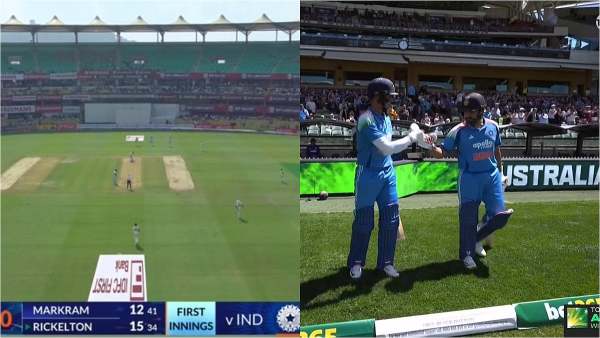
The main issue raised by the X user "@ragav_x" is that while Australia invests heavily in state-of-the-art equipment and skilled crews, India relies on older systems that limit picture clarity, motion smoothness and overall viewing quality.
Mumbai, December 04: An internet user has exposed the shocking quality gap between the BCCI's broadcast standards and Cricket Australia's production setup. The netizen has highlighted why Indian cricket telecasts often look outdated despite the country being one of the world's biggest cricket market.
The main issue raised by the X user "@ragav_x" is that while Australia invests heavily in state-of-the-art equipment and skilled crews, India relies on older systems that limit picture clarity, motion smoothness and overall viewing quality.
According to the points shared, Cricket Australia (CA) broadcasts every home game in native 4K HDR, offering sharper visuals, richer colours and smooth 50p progressive motion.
In contrast, BCCI still transmits India’s home matches in older 1080i HD, which uses interlaced video that often appears soft, shaky and less detailed.
CA’s outside broadcast trucks run on modern 12G-SDI and IP infrastructure designed for high-resolution workflows, while BCCI is said to depend on decade-old HD flypacks.
Camera technology also shows a clear gap. Australia uses Sony HDC-4300 and 5500 true-4K cameras, high-speed slow-motion gear up to 300 fps and even 600 fps ultra-motion cameras. Meanwhile, many BCCI productions reportedly use older HD cameras with fewer capabilities and slower frame rates.
This affects not just visuals but also ball-tracking and replay analysis. CA uses a six-camera high-speed system for seam and swing tracking and even deploys 100-camera 360-degree replay setups, whereas India often relies on basic HD angles with limited sampling, leading to flat-looking ball-tracking and fewer replay perspectives.
Broadcast quality is also influenced by manpower. CA employs larger, specialised teams for camera operations, replay, shading and engineering, ensuring consistent colour grading and high-quality footage. BCCI’s smaller crews struggle to match this standard, especially in fast-moving match situations.
CA produces everything in HDR, maintaining clean colours and natural lighting. BCCI still works in SDR, which can crush shadow details and blow out highlights. Even before reaching TV channels or apps, BCCI’s compressed 1080i feed reportedly loses detail.
One of the strongest arguments made is the difference seen during the ICC Cricket World Cup 2023 - also held in India. When ICC handled the production using its own teams and equipment, the same stadiums suddenly looked sharper and more professional, proving the issue is not the venues but the production quality.
Despite earning massive revenue - 40% of ICC earnings, $720 million from home media rights and over $6 billion from IPL rights - the criticism claims BCCI invests very little in upgrading broadcast infrastructure. The tweet concludes that Indian fans, who contribute hugely to global cricket viewership, deserve far better production quality.
In short, Cricket Australia’s superior investment in technology and expertise creates world-class broadcasts, while BCCI’s reluctance to modernise leaves India’s cricket telecasts looking outdated - despite having the resources to deliver the best viewing experience in the world.
He further stated, "Indian fans and Indian cricket deserve much better than this..!"
-
Liquor smuggler arrested in New Delhi, 71 boxes of illicit beer seized

-
Liquor smuggler arrested in New Delhi, 71 boxes of illicit beer seized

-
Madhya Pradesh Launches Shikara Rides to Boost Tourism at Upper Lake

-
Gardeners' World's Monty Don flooded with support as he pays emotional tribute

-
Women in this state will receive 12 days of period leave per year. Find out until what age they can avail themselves of this benefit.