Policing in India: Reform promised, but delivery delayed
Sanjeev Kumar | December 6, 2025 5:21 PM CST
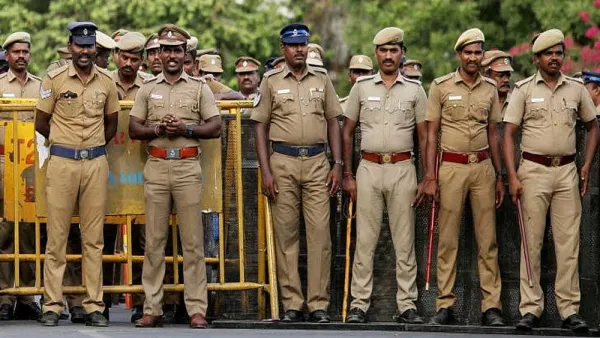
The Conference of Directors General of Police brings together India's highest political leadership and top brass of the police, intelligence, and security agencies.
The agenda of the most important gathering of the country's internal security apparatus has been wide: police modernisation, technology adoption, forensics, left-wing extremism, counter-radicalisation, cybersecurity, coastal security, narcotics control, terrorism, border management, and more. The conference allows police chiefs to exchange best practices and sets general directional themes for the upcoming year. This year, the conference took place in Raipur on November 29 and 30.
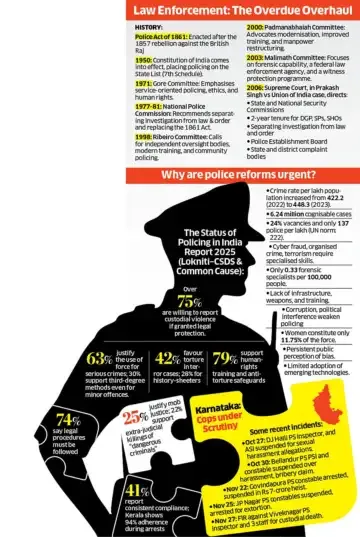
However, for decades, this apex forum has failed to engage seriously with the systemic distortions that afflict Indian policing. The core reforms identified by the National Police Commission, subsequently mandated by the Supreme Court in the 2006 Prakash Singh judgment, and reiterated by every major expert commission (headed by Ribeiro, Padmanabhaiah, Soli Sorabjee, Malimath), have never driven the conference's agenda. Instead, the discussions remain focused on operational matters that, though important, do not constitute "police reform". The conference's tone has always been about threats, preparedness, and law-and-order management. As a result, despite its prestige and visibility, the conference has not delivered the long-overdue systemic reforms that Indian policing urgently needs.
Missing from serious deliberation are crucial structural reforms: political neutrality and insulation from interference, citizen-centred service delivery, rebuilding trust, professional leadership, behavioural and cultural transformation, and internal accountability, with independent oversight through State Security Commissions. Even when mentioned, these themes do not translate into time-bound roadmaps or measurable outcomes.
India's real policing crisis arises not from technology gaps, but from deficits in sensitivity, accessibility, fairness and trust. Citizens still fear approaching the police; excessive force and custodial violence remain widespread. Investigations are frequently influenced by political pressure or biases. Severely overburdened personnel, limited transparency, and weak accountability mechanisms further erode confidence. Without addressing these structural and behavioural issues, any improvements will remain cosmetic.
 To be fair, policing in India has seen gradual progress; better infrastructure and technology adoption, and many dedicated officers across ranks working hard to deliver better services. However, these achievements cannot offset the deeper problems of accountability and political interference. Too often, police leaders allow themselves to be used to serve partisan agendas, seriously undermining the rule of law.
The most striking weakness of the DGPs' Conference is the absence of follow-up. In 2014, in his first address to the conference, Prime Minister Narendra Modi articulated his vision of a SMART Police - Strict, Sensitive, Modern, Mobile, Alert, Accountable, Reliable, and Responsive. It generated enormous optimism and a sense that long-pending reforms might finally gain momentum. Yet, nothing substantive followed. Neither the Ministry of Home Affairs, nor the police leadership, nor even the prime minister's office pushed the vision forward. There has been no roadmap, no timelines, no monitoring mechanism, and no accountability for implementation. The idea remained on posters and conference banners, never translated into action. This pattern has persisted. Each year, grand themes and ambitious visions are announced, yet no institutional mechanism exists to ensure follow-through; there is no continuity of agenda across years.
To be fair, policing in India has seen gradual progress; better infrastructure and technology adoption, and many dedicated officers across ranks working hard to deliver better services. However, these achievements cannot offset the deeper problems of accountability and political interference. Too often, police leaders allow themselves to be used to serve partisan agendas, seriously undermining the rule of law.
The most striking weakness of the DGPs' Conference is the absence of follow-up. In 2014, in his first address to the conference, Prime Minister Narendra Modi articulated his vision of a SMART Police - Strict, Sensitive, Modern, Mobile, Alert, Accountable, Reliable, and Responsive. It generated enormous optimism and a sense that long-pending reforms might finally gain momentum. Yet, nothing substantive followed. Neither the Ministry of Home Affairs, nor the police leadership, nor even the prime minister's office pushed the vision forward. There has been no roadmap, no timelines, no monitoring mechanism, and no accountability for implementation. The idea remained on posters and conference banners, never translated into action. This pattern has persisted. Each year, grand themes and ambitious visions are announced, yet no institutional mechanism exists to ensure follow-through; there is no continuity of agenda across years.
To be fair, policing in India has seen gradual progress; better infrastructure and technology adoption, and many dedicated officers across ranks working hard to deliver better services. However, these achievements cannot offset the deeper problems of accountability and political interference. Too often, police leaders allow themselves to be used to serve partisan agendas, seriously undermining the rule of law.
The most striking weakness of the DGPs' Conference is the absence of follow-up. In 2014, in his first address to the conference, Prime Minister Narendra Modi articulated his vision of a SMART Police - Strict, Sensitive, Modern, Mobile, Alert, Accountable, Reliable, and Responsive. It generated enormous optimism and a sense that long-pending reforms might finally gain momentum. Yet, nothing substantive followed. Neither the Ministry of Home Affairs, nor the police leadership, nor even the prime minister's office pushed the vision forward. There has been no roadmap, no timelines, no monitoring mechanism, and no accountability for implementation. The idea remained on posters and conference banners, never translated into action. This pattern has persisted. Each year, grand themes and ambitious visions are announced, yet no institutional mechanism exists to ensure follow-through; there is no continuity of agenda across years.
READ NEXT
-
Best Indoor Plants for Clean Air – Simple Green Choices to Protect Your Home From Rising Pollution

-
After taking five kasli of water on the body, skin disease must be cured, ‘This’ well in Konkan is very special.

-
1080 crore fine on Elon Musk’s

-
1080 crore fine on Elon Musk’s

-
What Is Cloudflare? Global Outage Disrupts Zerodha, Groww, Instagram And LinkedIn; Services Now Restored; Check Services It Offers | Technology News
