The 34-year-old says that at 4:30 a.m. daily the metallic screech of the court’s rolling gates jolts the entire street awake, and what follows is a relentless mix of sharp “pop, pop” sounds made by balls and rackets and loud shouting by players.
“The worst are the quiet nights when at 1 or 2 a.m. shouts echo through my house like someone screaming right next to me,” she says. “It’s rare for the courts to stop before 11 p.m.”
For the three generations living in her household, she says the constant noise has become a form of psychological strain, creating the sense of living in a disorderly marketplace. Often the household only sleeps out of sheer exhaustion.
“My children almost never sleep before 11 p.m. My husband and I are constantly on edge after long workdays, only to come home and battle late-night noise.”
No action has been taken despite complaining to local authorities, she says.
|
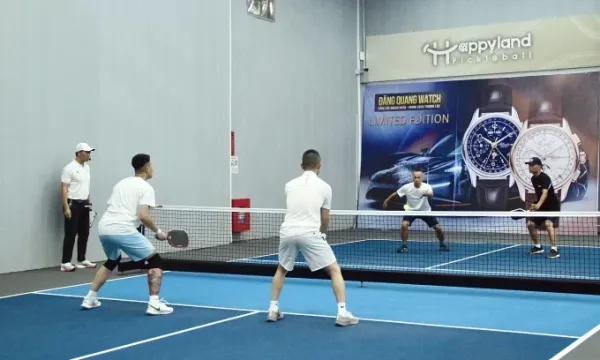
Players compete in a pickleball match in Hanoi, Nov. 13, 2025. Photo by Read/Phan Duong |
Similar accounts are emerging across Hanoi. Lien, who lives on the ninth floor of an apartment in the Viet Hung Urban Area in Phuc Loi Ward, says she feels powerless.
There are eight pickleball courts, converted from four old tennis courts, just three meters from her building. With the wind channeling sounds directly toward her home, she says her balcony has effectively become an “amplifier,” funneling noise into her child’s study room.
“Many times, out of frustration, I have shouted down from the ninth floor asking for quiet, but the only response was laughter.”
These grievances have contributed to a surge of urban noise complaints. The city’s iHanoi app has received hundreds of submissions about noise pollution, more than half of which concern pickleball courts. Hotspots include Hoang Ngan Street, where courts reportedly operate past midnight, sometimes until 2 a.m.
In Cau Giay Ward, people say the noise continues until midnight despite keeping windows closed. On Tran Duy Hung Street in Yen Hoa Ward, repeated complaints about courts running from 6 a.m. until late night have been ignored.
A resident on Dinh Cong Street says: “I am never able to sleep before midnight.”
The noise not only disrupts rest but also interferes with children’s studies. People in Phuc Loi Ward say their children cannot focus due to the continuous pounding and shouting.
This issue is not confined to Hanoi. Authorities in Ha Tinh, Da Nang and Ho Chi Minh City have intervened after complaints about serious disruptions linked to pickleball courts.
Globally, pickleball noise has become a contentious topic. In the U.S. and Canada, lawsuits and petitions have sought to shut down courts near residential areas.
Experts describe pickleball as a “new acoustic hazard” of the 21st century. At the Noise-Con 2023 conference, pickleball noise was identified as the “topic of the year.”
According to U.S. noise consultant Bob Unetich, a pickleball strike can reach 70 dBA at a distance of 30 meters, significantly louder than typical residential background noise of 55 dBA.
Research by Tennis Warehouse University indicates a single hit can reach up to 90 dBA, a level considered hazardous and capable of causing stress and hearing damage if exposure exceeds one hour.
Experts note the problem is not only due to just the volume but also the sound’s pitch and pattern: The hard paddle striking a plastic ball produces a high-frequency, piercing noise that triggers stronger neural stress responses than the low thud of tennis.
Irregular, impulsive sounds like these make it difficult for the brain to adapt, contributing to psychological strain.
Vietnam’s new National Technical Regulation on Noise, now in effect, sets stricter limits: residential areas must not exceed 55 dBA during the day and must stay below 45 dBA at night (10 p.m.–6 a.m.). Violations are subject to penalties based on actual sound measurements.
But enforcement remains a challenge.
Manh Seven, a pickleball coach in Ho Chi Minh City, says many courts are located in small premises in residential areas.
“With high player density and no soundproofing, exceeding 45 dBA at night is inevitable,” he says.
Most operators have responded by promising reduced playing hours. But for residents like Lan and Lien, meaningful relief will require technical solutions such as proper soundproofing, without which a peaceful night is unlikely.
In early November Anh of Hanoi’s Van Mieu–Quoc Tu Giam Ward submitted multiple complaints about noise from nearby pickleball courts.
Authorities intervened on Nov. 12, ordering changes to operating hours. But by early December the violations resumed, with the sounds of balls hitting racket and shouting continuing past curfew time, rendering earlier commitments ineffective.
“My greatest wish is for courts in residential areas to install proper soundproof walls, or be relocated if that isn’t feasible,” Anh says.
-
Squash World Cup: India became world champion for the first time in 29 years, these players together hoisted the flag

-
Rajya Sabha erupts over anti-PM slogans; Nadda seeks Sonia’s apology

-
Oh My God! Is it a share or a money printing machine, gave 1,000% return in 11 months

-
Nandamuri Balakrishna’s movie Akhanda 2 Meaning: What is the meaning of the word ‘Akhanda’, the film which collected Rs. 80 crores in three days?

-
Who is Sai Jadhav? IMA passout first female officer, became lieutenant at the age of 23. Sai Jadhav Ima First Woman Officer Territorial Army Lieutenant Success Story
