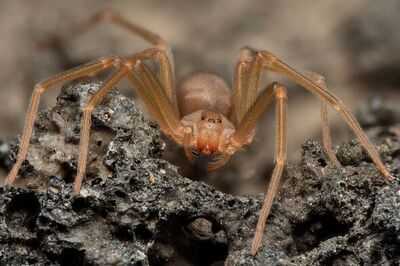
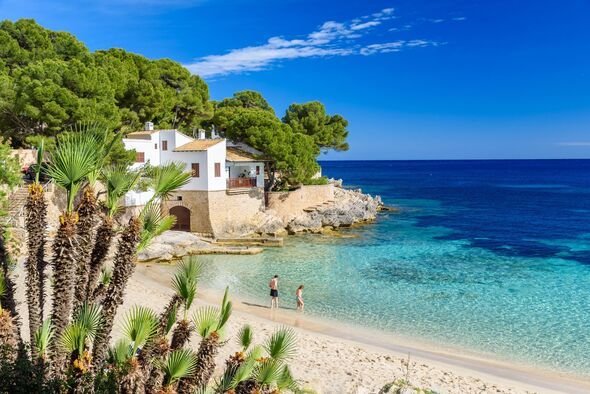
Brits heading to one of Europe's most popular holiday hotspots have been warned to stay alert after several locals were hospitalised after being bitten by a dangerous species of spider. Last September, a 60-year-old woman from s'Arenal d'en Castell, Menorca, was bitten by the arachnid on her arm, causing swelling and severe pain, to the point that she could not sleep.
The woman rushed herself to a local health centre, claiming that he had possibly been bitten by a Mediterranean recluse spider (Loxosceles rufescens). "That's impossible, there aren't any here," the doctor is said to have replied. One of the most serious incidents occurred in nearby Ibiza in 2024, when a 32-year-old woman almost lost her leg after being bitten. The spider's venom is known to cause tissue necrosis - premature and irreversible cell death - but luckily, she was treated in time, and surgeons saved her limb after multiple surgeries and skin grafts.
"These bites can happen anywhere. In Ibiza, there was a case in a car, while a Catalan tourist walking in flip-flops in Cabrera was stung on the side of his foot. It is a very common species that can be found anywhere, especially in cavities or under rocks; I even have a documented case that occurred in a bathroom at the University of the Balearics," said spider biologist Guillem Pons, who has compiled an article in which he criticises the lack of training among many doctors in the Balearics.
He warned that quick action is vital after being bitten to prevent the victim's condition from worsening.
"These are cases that should be known about. The treatment is simple, but prompt attention is required to avoid complications," he added, before urging the Regional Ministry of Health to promote an information campaign in health centres so that both staff and the public can easily recognise the bite of this species of spider.

Most cases are medically insignificant. However, in some instances, pain - more severe than that of a wasp - may occur two to eight hours after a bite, followed by a burning sensation. Areas near the bite often become red and painful, and a blister may form, which often changes to a dark blue colour with a sunken centre over the next few days. In rare cases, hemolysis (the breakdown of red blood cells), intravascular coagulation (overactive blood clotting) and thrombocytopenia (platelet deficiency) can occur, leading to renal failure.
In 2024, the species was blamed for the deaths of two people in Italy: a 52-year-old policeman from Palermo, according to a local paper and a 23-year-old male, who died more than a month after being bitten, according to ANSA news agency.
The Mediterranean recluse spider is a cave-dwelling spider that is very similar in appearance to the brown recluse spider (Loxosceles reclusa). They can be identified by three pairs of two eyes organised in the shape of a triangle, with a violin-shaped pattern on their cephalothorax. Both males and females grow to approximately 7-7.5mm in length.
This species is listed as one of the most invasive species in the world. It is native to the Mediterranean and western Asia, including parts of Europe and Northern Africa. Its distribution across the world has increased thanks to human travel and the increased transportation of goods.
-
5 Herbal Teas That Naturally Boost Your Immune System

-
Swedish study reveals when fitness and strength begin to fade
-
Priyanka Chopra Jonas, Alia Bhatt to Triptii Dimri: 8 Actresses Who Went De-Glam to Serve Best Portrayals

-
Govinda BREAKS silence on marriage crisis: 'Sunita THROWN as opening batsman in evil plot'

-
Juhi Parmar & daughter enjoy croissants & breads in Paris all day long