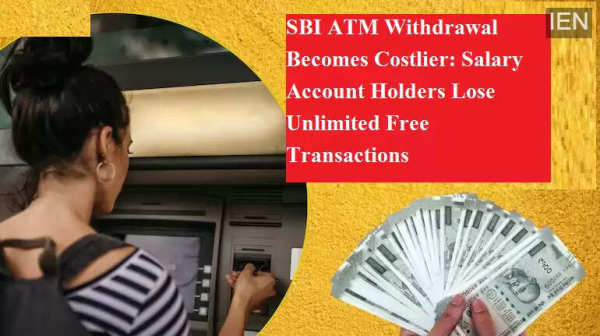
State Bank of India (SBI), the country’s largest public sector bank, has implemented revised ATM transaction charges, making cash withdrawals from other banks’ ATMs more expensive for many customers. The new charges affect savings, salary, and current account holders, while some categories continue to enjoy exemptions. One of the biggest changes comes as a setback for salary account customers, who will no longer get unlimited free ATM transactions.
These revised charges have come into effect from December 1, 2025, and customers are now required to be more cautious about their monthly free transaction limits to avoid paying extra fees.
What Has Changed in SBI ATM Charges?
Under the updated structure, SBI debit card holders using other banks’ ATMs will have to pay higher charges once they exhaust their free transaction quota. The increase applies to both cash withdrawals and non-financial transactions such as balance inquiries and mini statements.
While SBI customers can still use SBI ATMs as per existing rules, transactions at non-SBI ATMs will now attract higher costs beyond the free limit.
Accounts Affected by the New Charges
The revised ATM charges apply to the following account types:
-
Savings accounts
-
Salary package savings accounts
-
Current accounts
However, Kisan Credit Card (KCC) holders and Basic Savings Bank Deposit (BSBD) account holders have been kept outside the scope of these changes. These customers will continue to enjoy existing benefits without any additional ATM charges.
New Rules for Savings Account Holders
SBI savings account customers will continue to receive five free transactions per month at other banks’ ATMs, regardless of the city or location. There is no change in the free transaction limit for this category.
Once the free limit is exhausted:
-
Cash withdrawal will cost ₹23 + GST per transaction (earlier ₹21 + GST)
-
Non-financial transactions such as balance check or mini statement will cost ₹11 + GST per transaction (earlier ₹10 + GST)
This increase may seem small per transaction, but frequent ATM users could see a noticeable rise in monthly banking expenses.
Major Impact on Salary Account Holders
Salary account holders are the most affected by this revision. Earlier, SBI salary package savings account customers enjoyed unlimited free transactions at other banks’ ATMs. This benefit has now been withdrawn.
Under the new rules:
-
Salary account holders will get only 10 free ATM transactions per month
-
After crossing this limit:
-
Cash withdrawal: ₹23 + GST per transaction
-
Non-financial transaction: ₹11 + GST per transaction
-
For customers who rely heavily on non-SBI ATMs, this change could significantly increase monthly banking costs.
No Relief for Current Account Holders
For SBI current account holders, the rules remain largely unchanged. Just like before:
-
There are no free ATM transactions at other banks’ ATMs
-
Every transaction will attract charges:
-
Cash withdrawal: ₹23 + GST
-
Non-financial transaction: ₹11 + GST
-
Thus, current account customers should plan ATM usage carefully to avoid repeated charges.
Summary of Revised Charges at Other Banks’ ATMs
-
Savings Accounts
-
Free transactions: 5 per month
-
Cash withdrawal after limit: ₹23 + GST
-
Non-financial transaction after limit: ₹11 + GST
-
-
Salary Package Savings Accounts
-
Free transactions: 10 per month (earlier unlimited)
-
Charges after limit:
-
Cash withdrawal: ₹23 + GST
-
Non-financial transaction: ₹11 + GST
-
-
-
Current Accounts
-
Free transactions: None
-
Cash withdrawal: ₹23 + GST per transaction
-
Non-financial transaction: ₹11 + GST per transaction
-
What SBI Customers Should Keep in Mind
With these new rules in place, SBI customers—especially salary account holders—need to monitor their ATM usage closely. Exceeding the free transaction limit can quickly add to monthly expenses, particularly for those who frequently withdraw cash or check balances at non-SBI ATMs.
To reduce extra charges, customers may consider:
-
Using SBI ATMs whenever possible
-
Opting for digital banking services such as UPI, mobile banking, and internet banking
-
Planning withdrawals to minimize the number of transactions
Conclusion
The revised ATM transaction charges mark an important change for SBI customers. While savings account holders retain their existing free limits, salary account holders lose the benefit of unlimited free ATM usage, making this update particularly impactful. As banking costs rise, careful planning and increased use of digital payment options can help customers manage expenses more efficiently under the new rules.
-
Stick in one hand, plaster in the other… Pappu Yadav’s most unique protest in the Monsoon Session! | Pappu Yadav’s Unique Protest In The Monsoon Session

-
Dhanush reached among the fans on his birthday, shook hands and cut the cake together. Dhanush Celebrates Birthday With Fans Outside His Residence Cuts Cake

-
Karnataka Water Crisis: Over 5800 Lakes Run Dry Amid Poor Rainfall; Drinking Water Concerns Rise

-
Twisha Sharma case: Judicial custody of former judge Giribala Singh and son extended till August 11. Twisha Sharma Case Former Judge Giribala Singh Sons Custody Extended
-
New CBSE schools in Himachal to be finest in 5 years, says CM Sukhu