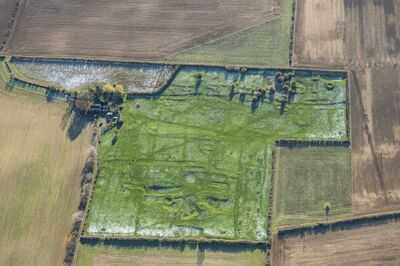
A deserted village with a dark past has become a popular spot for ramblers.
Among the 2,000 or so deserted medieval villages in England, Gainsthorpe in Lincolnshire is one of the most striking and best preserved. Though long rid of the people who lived there, elements of the village, including houses, barns and streets, survive as a remarkable group of earthworks in an unploughed field.
Coming across Gainsthorpe, or Gamelstorp as it was listed in the Domesday Book of 1086, offers a portal into a bygone time.
"I have looked over the gate into the field and felt as though I were looking into some sort of lost world," writes Jim Snee, of Heritage Lincolnshire.The village was likely at its peak in the 13th century, when it stretched across 19 fields and was centered around a chapel, a windmill, and a bridge. In the following century, the thriving little community began to fall apart.
"Archaeologists talk about the disastrous events of the 14th century that broke the social bonds that kept villages like Gainsthorpe alive," writes Mr Snee. "Famine and plague left a reduced and weakened population that could not produce enough food or pay the rents. Landlords moved people out and reused the land for grazing sheep, securing an income, but losing the community. Local legend, on the other hand, has a much more prosaic explanation."
According to a tale that now stretches back hundreds of years, Gainesthorpe was not just a village "but a nest of robbers".
One fateful night, people from the surrounding village, who had grown tired of the distardly ways, rose up against Gainsthorpe and burned it to the ground. Although contemporaneous records no longer exist, The Diary of Abraham de la Pryme from 1859 offers a little more detail.
It notes that Tom Sturr, who was courting a girl at Staniwells Farm nearby, saw robbers advancing as he made his way across the fields, prompting him to hide. From his vantage point, he saw the plunderers murder a rich captive merchant from Hibaldstow and heard their plans. The robbers spotted him and let him go on the promise that he would not tell anyone.
Tom was not good for his word. He immediately headed to the nearby villages, raised a militia, and headed to Gainsthorpe. "The robbers had the best of it for a long time, but finally they were driven to a last stand at the church, and the soldiers burnt the church down on them and rased the whole village to the ground," The Diary recalls.
Whether or not the account is true, what remains today is an intriguing and striking place where you can, as Mr Snee puts it, "forget the modern world and think slow thoughts of ages gone by."
It is made up of about 25 buildings, laid out in about 15 crofts, beside the two east-west lanes. Each croft was probably occupied by a family and used as a garden. The stone buildings survive as rectangular grassed-over wall-footings.
A further 20 or so enclosures without houses are probably paddocks for keeping livestock. In the south-west corner of the site, there are traces of a cluster of farm buildings, including a circular dovecote for keeping pigeons and a rectangular pond.
All Trails highlights a number of walking routes that include Gainsthorpe, including a 1.6-km circular trail from Brigg, Lincolnshire. Generally considered an easy route, it takes an average of 22 minutes to complete.
-
NVO Shares Rise On Strong Kickstart For Wegovy Pill In US: Retail Eyes Up To $110 As ‘Fair Value’

-
MP now Naxal-free, PM Modi satisfied: CM Yadav at IPS service meet

-
High-quality clash of global and domestic runners at Mumbai Marathon

-
ABUS Stock On Track For Biggest Intraday Drop In Over 5 Years – What’s The Issue Around Its Patent In Europe?

-
Sukhwant Singh suicide: Harish Rawat says it’s murder, seeks CBI probe