
The NHS waiting list in England has seen its biggest fall in 15 years outside of the pandemic.
Latest NHS monthly data shows the backlog of operations and appointments fell by 86,000 and the waiting list was down to 7.31 million at the end of November. It cements an historic NHS turnaround under Labour after over a decade of the waiting list increasing under previous Tory governments.
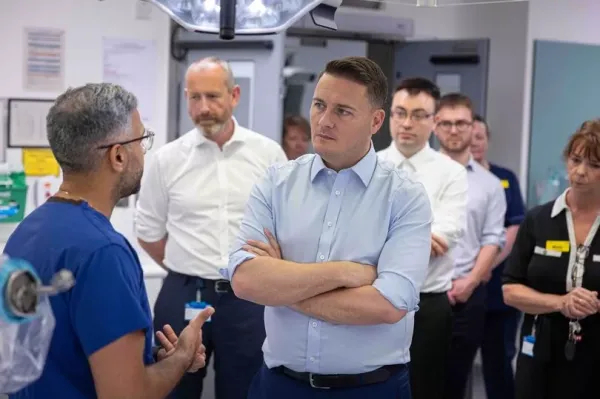
But unions and campaign groups are calling for the Government to go faster at slashing NHS waits by funding more investment in the ailing health service. Health Secretary Wes Streeting said: “For too long, patients were promised change in the NHS but saw little of it. This government is turning promises into change people can actually feel.
“Waiting lists are down by more than 312,000 and more patients are being treated within 18 weeks. November saw the second biggest monthly drop in waiting lists in 15 years. That means faster care, less anxiety for families and people back on their feet and back to work. This is the result of record investment and modernisation, alongside the hard work of NHS staff."
The NHS elective waiting list for England had been on an upward trend for over a decade, passing three million treatments in 2014, four million in 2017, five million in 2021 and seven million in 2022. Labour came to power in July 2024, ending 14 years of Tory rule.
• Dad says Government is ‘playing God’ by refusing test for muscle wasting disease
• Wes Streeting praises Mirror campaign demanding baby test after Jesy Nelson heartbreak
Speaking to Times Radio, Mr Streeting added: “The progress we're reporting today is good for trust in politics and restoring some faith that voting can change things, that politics and government can make a difference."
The waiting list fell by 86,517 in November, which is the second highest drop outside of the first three months of the Covid-19 pandemic when there was a significant drop in the number of people referred onto the waiting list as people avoided presenting to the NHS.
Mr Streeting said the Government had increased NHS evening and weekend appointments, expanded tests at community venues closer to home, and set up specialist surgical hubs to get through more operations. AI notetaking tools have also been credited with saving doctors’ time.
However the data shows that problems in A&Es remain as there were 554,018 over 12-hour trolley waits in 2025, the highest number since current records began.
It comes a day after the Mirror reported a warning from the Royal College of Nursing (RCN) that the “corridor care” crisis on emergency wards is as bad as ever.
Tim Gardner, director at the Health Foundation thinktank, said: “This is a grim milestone and a sign of just how bad things have got in our emergency services. What we are seeing now is largely the result of a decade of underinvestment, compounded by the pandemic.”
The number of people waiting more than 12 hours in A&Es from a decision to admit to actually being admitted - so-called "corridor care" - stood at 50,775 in December 2025, up slightly from 50,648 in November.
In response the Society for Acute Medicine demanded “urgent action to expand bed capacity, stabilise staffing and restore flow through hospitals ”. President Dr Vicky Price said: “The clinical consequences of this are well established. For every 72 patients waiting eight to twelve hours for admission, one excess death occurs. That evidence has been clear for years, yet we are further than ever from a solution.
“Patients receiving corridor care are typically older, frail and living with multiple long-term conditions, often alongside mental health needs. These are people least able to withstand long waits in unsafe, overcrowded environments.
• A&E ‘torture’ as NHS corridor care leaves patients waiting days to be admitted
• Britain's top nurse quit NHS over shameful corridor care - 'we can't look after patients properly'
“These figures describe a system stretched beyond safe limits and the extent of corridor care now being delivered is the predictable result of years of failure to invest in beds, workforce and social care.”
The number waiting in A&E at least four hours from the decision to admit to admission also rose, standing at 137,763 last month, up from 133,799 in November.
Sarah Scobie, deputy director at the Nuffield Trust, said: "While A&E performance may look typical for the season when comparing it with recent years, we must not forget that before the pandemic, these dreadfully long waits would have been unthinkable.
“Back in December 2019, just 2,356 patients waited longer than 12 hours on a trolley until a proper bed became available, but in December 2025 it was 50,775 patients."
Some 73.8% of patients in England were seen within four hours in A&Es last month, down from 74.2% in November. The Government and NHS England have set a target of March 2026 for 78% of patients attending A&E to be admitted, discharged or transferred within four hours.
Mr Streeting added: “Winter pressures remain high and there’s far more to do. We’ll keep backing NHS staff to make sure patients get the care they need, when they need it.”
-
Machado says Venezuela is at ‘threshold of freedom’

-
Man seriously injured in 'fall from height' at Rochester Castle in Kent

-
Noida Weather LATEST Update: Schools Remain Closed on January 17 as Cold and Fog Persist

-
Households with solar panels hit with £100 HMRC fines this January

-
"India-Italy partnership will be more enhanced by conclusion of FTA": Italian Ambassador Antonio Bartoli