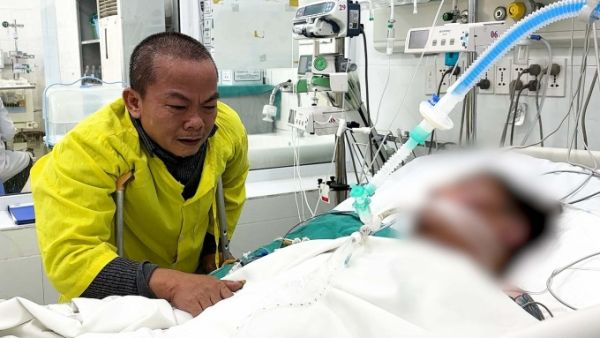
In the intensive care unit of Viet Duc Hospital in Hanoi, white lights illuminate the motionless body of the 25-year-old man covered with a white sheet.
Tubes, wires and the steady beeping sounds from medical equipment surround him. Leaning on crutches, the father steps closer to the hospital bed and holds his son’s hand, still warm but no longer responsive.
He breaks down, sobbing, his voice choking as he says: “Wake up and come home with Dad. You’ve been sleeping for seven days.”
Doctors give him a final moment to say goodbye. The father, in his early 50s, lost one leg more than 30 years ago. He has a wife and three children, with the patient being his eldest son.
For years the father relied on him as the family’s breadwinner, providing for parents in poor health and two younger siblings. A traffic accident in late December left him in a coma, and he was diagnosed with brain death three times.
After being informed of the diagnosis, the father signed the consent form to donate his son’s organs. The document bears only the son’s name and age, not the father’s.
The family said organ donation was the young man’s wish while alive, as he hoped to “help others by donating tissues and organs for medicine.”
|
The father breaks down in tears as he bids farewell to his comatose son in Viet Duc Hospital, Hanoi. Photo by Read/Loc Chung |
In the final moments the father recalls his son’s unfinished promise to “take care of his parents until old age.” He then releases his son’s hand.
Doctors removes the breathing tube, and the monitoring equipment falls silent. The medical team bow their heads in a moment of silence before beginning surgery to retrieve the heart, liver and two kidneys for transplantation to critically ill patients.
The transplants, performed in early Jan. 2026, were all successful, giving four patients a new chance at life. The family’s loss marked the end of one life but created opportunities for others.
Doctors say all four recipients are currently recovering well, with the transplanted organs functioning stably in their new bodies.
The father bids farewell to his comatose son in Viet Duc Hospital, Hanoi. Video by Read/Loc Chung
The young man was the first brain-dead organ donor of 2026 at Viet Duc Hospital and the 26th case since 2025. “This represents a major shift in public awareness about organ donation to save lives,” Associate Professor Duong Duc Hung, director of Viet Duc Hospital, says.
Vietnam leads Southeast Asia in the number of organ transplants and is the only country in the region to achieve more than 1,000 organ donation and transplantation cases every year since 2022.
Earlier the numbers were low because many Vietnamese hold the belief that their loved ones should be allowed to cross over to the other side in one piece, and organ donation is too far remote of an idea from what’s become tradition in their thousands-of-years-old culture.
But organs from brain-dead donors are in short supply while demand is high.
In 2024-2025, the Ministry of Health said the number of brain-dead organ donations nearly doubled compared with all previous years combined. It said the increase is driven by stronger public outreach, the establishment of organ donation advocacy teams at hospitals, and more open attitudes among patients’ families.
The father says: “My son may no longer be with us but if his organs can save others, then he still exists somewhere in this world.”
-
Urgent Call for Evacuation of Kashmiri Students from Iran Amidst Unrest

-
Oliver Glasner confirms surprise Crystal Palace exit to put Man Utd on red alert

-
In Bihar's Nalanda, 60 beneficiaries honoured for proactiveness in harnessing solar power

-
Inside true crime fans' next 'harrowing' obsession Kidnapped: Elizabeth Smart

-
Luke Litter makes major change in match as Gerwyn Price ends stunning winning streak