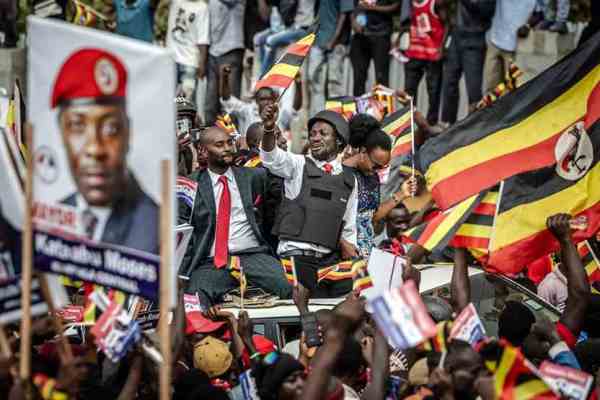
Uganda Election: Uganda witnessed heightened political tension following its recent general election as conflicting claims emerged over the status of opposition leader Bobi Wine, allegations of electoral fraud, and reports of deadly violence in parts of the country. While authorities denied that the opposition leader was detained, his party insisted that he had been forcibly taken by security forces, adding to uncertainty during a sensitive political moment.
Dispute Over Alleged Detention of the Opposition Leader
Soon after voting concluded, Uganda’s main opposition party claimed that its leader had been arrested by soldiers late at night. According to party officials, a military helicopter reportedly landed at his residence in the capital city and he was taken away to an undisclosed location. These claims quickly spread across local and international media, raising concerns about political freedoms and the treatment of opposition figures after the election.
Police authorities, however, strongly rejected these allegations. At a televised press briefing, the national police spokesperson stated that the opposition leader was at his residence and was not under arrest. Officials maintained that he was free to move and that reports of his detention were inaccurate. Despite these assurances, representatives of the opposition party reiterated that he was under what they described as effective house confinement, even if not formally arrested.
Allegations of Electoral Irregularities and Public Unrest
The opposition leader publicly accused authorities of widespread vote manipulation during the election process. These claims were amplified by the fact that voting took place under a nationwide internet shutdown, a move critics said limited transparency and restricted the flow of information. The opposition called on supporters to remain vigilant and protest peacefully against what they described as a flawed electoral process.
Supporters and observers viewed the election as a major political test for the long-serving president, who has ruled the country for decades. The outcome was closely watched both domestically and internationally, particularly because neighboring countries have experienced political unrest following disputed elections in recent years.
Election Results and Political Context
According to provisional figures released by the electoral commission, the incumbent president secured a decisive lead with nearly three-quarters of the total votes counted. The opposition candidate followed with less than one-quarter of the vote, based on results from more than ninety percent of polling stations. These figures suggested a landslide victory for the sitting president, reinforcing his long-standing dominance in national politics.
Despite the tense campaign environment, voting itself was largely peaceful on election day. However, international observers and human rights groups noted that the campaign period had been marked by clashes at opposition events, restrictions on political gatherings, and reports of intimidation. The United Nations described the overall atmosphere as one of repression, raising questions about the fairness of the political playing field.
Deadly Violence Reported After Polls Closed
Although election day passed without major incidents, violence reportedly erupted in the early hours following the vote in a town southwest of the capital. Conflicting accounts emerged regarding the cause and location of the incident, making it difficult to establish a clear sequence of events.
Local police officials claimed that groups of armed opposition supporters attacked a police station and a vote tallying center using machetes. According to police statements, security forces responded in self-defense after being confronted by large numbers of attackers. Authorities said that several people were arrested during the incident.
Conflicting Testimonies From Local Leaders
A local member of parliament from the affected area provided a sharply different account. He alleged that the victims were inside his private residence, where they had gathered to await the announcement of parliamentary election results. According to his statement, security forces entered his home during the night and opened fire, killing multiple people who were unarmed and celebrating what they believed was an electoral victory.
He described the incident as a massacre, stating that security personnel forced their way into the house and began shooting without provocation. He also disputed police claims that the deaths occurred during clashes between officers and opposition supporters outside.
Police representatives later said they were not aware of any incident occurring inside the lawmaker’s residence and maintained that their initial account was accurate. Due to limited access and contradictory testimonies, independent verification of the events proved difficult.
Ongoing Uncertainty and National Implications
The combination of disputed arrest claims, allegations of election fraud, and reports of post-election violence has left Uganda in a state of political uncertainty. Observers warn that how authorities handle opposition concerns and security responses in the coming days could have long-term implications for national stability, democratic credibility, and public trust in institutions.
As the final election results are confirmed, attention remains focused on whether dialogue, legal challenges, or further protests will shape the country’s immediate political future.
-
The Health Benefits of Ghee: A Nutritional Powerhouse

-
Kendall Jenner's Pashmina shawl is a masterclass in quiet winter luxury

-
Charming Surrey country pub named one of UK's best and is just 30 minutes from London

-
YouTube now allows more controversial content to earn full revenue

-
India has world's lowest data costs, highest data usage: Scindia