
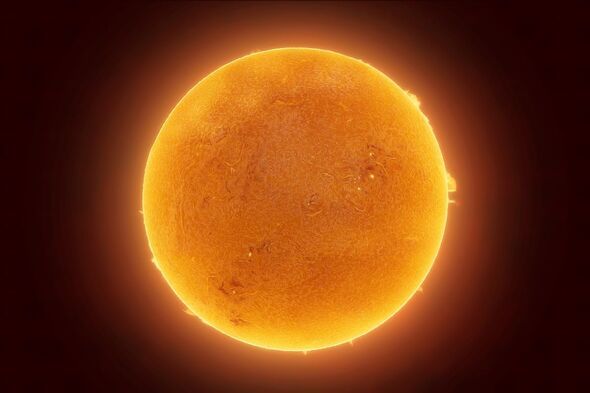
The UK has been warned to expect a "severe" solar storm after the Sun blasted a powerful X-class solar flare in Earth's direction.
The Met Office said geomagnetic activity is likely to increase with the arrival of an Earth-directed coronal mass ejection (CME) on Tuesday.
A CME is a massive burst of plasma and magnetic fields from the Sun's corona, the outermost part of its atmosphere. When Earth-directed, CMEs trigger geomagnetic storms by interacting with our magnetosphere, causing auroras, satellite disruptions, and potential power grid issues. The Met Office indicated in its Monday alert that a strong G3 category storm is likely, with a chance of a severe G4 storm.
The categories rate geomagnetic storms on a scale from G1 (minor) to G5 (extreme), describing how intense they are and what technological impacts they may have on Earth.
Severe storms can cause spacecraft to experience surface charging and tracking problems, and drag may increase on low Earth orbit satellites, with corrections potentially needed for orientation issues.
Radio frequencies and GPS satellite navigation can become degraded for hours, while impressive aurorae may be seen across the whole of the UK.
Taking to X, Stefen Burns, a geophysicist, said: "This 1.9 X-flare that just exploded on the Sun IS INSANE. A huge coronal mass ejection has been launched out towards Earth at high-velocity, we'll have a BIG solar storm impact in 2-3 days, expect G3 geomagnetic storming minimum (early forecast liable to revision with more data)."
Stefen's predictions mean that the solar storm could be seen by Wednesday.
Jim NR Dale, a meteorologist with the British Weather Services, told Metro that there is a lot of cloud over the UK tonight, "so it'll be difficult to see" the streams of red, blue and green.
Forecasts for solar storms are largely guesswork until the waves of particles reach two spacecraft, the NASA Advanced Composition Explorer and the Deep Space Climate Observator.
Both, however, are about one million miles away from Earth, giving the planet about an hour's warning.
-
Ajay Devgn finally reacts to biggest mystery: ‘Who is the Lion of The 50?’

-
Modi undermining MGNREGA, favouring corporates, says Rahul Gandhi
-
HDFC Bank to disburse Rs 20 crore to social impact startups

-
After Hania, Sajal, another Pakistani actress’ wedding on cards

-
Budget 2026 Expectations: EV Players Seek Tax Relief & Infrastructure Funding