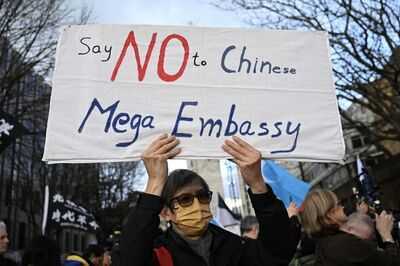
MI5 and GCHQ cannot "eliminate each and every potential risk" linked to the new Chinese embassy, ministers have been told. Sir Ken McCallum, the Director General of MI5, and the Director of GCHQ, Anne Keast-Butler, said it would be "irrational" because of some of the other threats foreign spies pose.
And they said a "package of mitigations deals acceptably with a wide range of sensitive national security issues, including cabling". But these will be under regular review, the security chiefs said, adding that China agreeing to "consolidate" seven diplomatic sites into one "should bring clear security advantages".
Sir Ken and Ms Keast-Butler said: "For the Royal Mint Court site, as with any foreign embassy on UK soil, it is not realistic to expect to be able wholly to eliminate each and every potential risk. (And even if this were a practicable goal, it would be irrational to drive 'embassy-generated risk' down to zero when numerous other threat vectors are so central to the national security risks we face in the present era.)
"However, the collective work across UK intelligence agencies and HMG departments to formulate a package of national security mitigations for the site has been, in our view, expert, professional and proportionate.
"As detailed in classified briefings given to the Intelligence and Security Committee of Parliament, the package of mitigations deals acceptably with a wide range of sensitive national security issues, including cabling.
"These mitigations will be subject to regular review through a cross-government process, led at senior level in the Home Office. Further, it is worth reiterating the new embassy will replace seven different diplomatically-accredited sites across London which China currently operates; this consolidation should bring clear security advantages."
A letter from the Ministry of Housing, Communities and Local Government published on Tuesday morning said the Communities Secretary had granted both planning permission and listed building consent for the site at Royal Mint Court, near the Tower of London.
The Government said "no bodies with responsibility for national security, including HO and FCDO, have raised concerns or objected to the proposal on the basis of the proximity of the cables or other underground infrastructure".
And leading China hawk Sir Iain Duncan-Smith said the Government's approval of China's new embassy in London "ignores the appalling brutality of the Chinese Communist Party".
The senior Conservative MP, co-chair of Inter-Parliamentary Alliance on China, said: "This is a terrible decision that ignores the appalling brutality of the Chinese Communist Party as it practices forced labour at home and spies on the UK and uses cyber attacks to damage our national security.
"By ignoring repeated security warnings, a legal opinion that this decision may be unlawful, unresolved concerns over redacted rooms, and China's refusal to allow the hard perimeter needed to protect historic ruins, the Government has handed Beijing a major strategic foothold in the heart of London."
Shadow Security Minister Alicia Kearns said: "The Government claims they can mitigate the threats of the Embassy to our people and our interests, including the financial cables.
"No one can tell me what capabilities the CPC will develop and that we will be able to mitigate them. Even if we can, at what financial cost?
"Is the British Taxpayer footing the bill?
"How much additional budget will have to be allocated for decades to come to mitigate future technological capabilities?
"How can one part of the Government say they've mitigated the unredacted plans when Steve Reed says he made the decision off the redacted ones?"
The planning inspector said "there is limited evidence" to support national security concerns.
Inspector Claire Searson said in her report: "Planning law and national and development plan policies, and for its signatories, the Vienna Convention which is founded on reciprocity, are nation-neutral.
"It is not possible to discriminate against a use on the basis of the anticipated user. Otherwise that could give rise to an untenable situation of the embassy of one nation being permitted but another nation's embassy being refused."
The report also said: "Any ethical or similar objection to the provision of an embassy for a specific country cannot be a material planning consideration. It would not be lawful to refuse permission simply because it would be for a Chinese Embassy (my emphasis). The same would hold for any other specific country seeking an embassy use through the planning system."
Later, the report said: "In respect of objections related to national security concerns levelled at the specific occupants at the site, there is limited evidence to back up such claims. Should these be found to be true, they would be dealt with through other means, via other legal processes and by various agencies, as per the Vienna Conventions. That is not something which could be controlled through the planning system."
-
Arsenal eye 'next Eduardo' as Borussia Dortmund hold secret transfer talks for teenage gem

-
Award-winning agency behind Aston Martin and Porsche adverts plunges into administration

-
Bengal SIR: Deadline for hearings and publication of final voters' list may be extended

-
Met Office names 9 UK areas at risk of snow before Saturday

-
J&K anti-graft body arrests 4 govt officials for accepting bribe