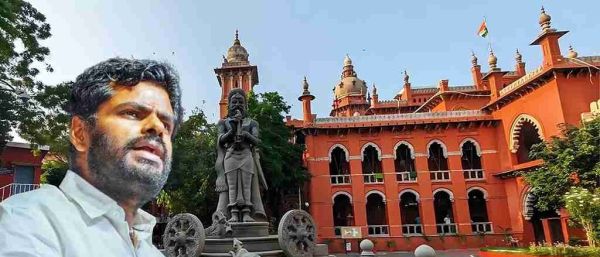
Madras High Court: The recent decision by the Madurai Bench of the Madras High Court has drawn significant political and legal attention across Tamil Nadu and beyond. The court quashed a criminal case registered against BJP national office-bearer Amit Malviya, a move that has been welcomed by the state BJP leadership and interpreted as a critical observation on the use of criminal law in politically sensitive matters.

Political Reaction from Tamil Nadu BJP Leadership
Reacting to the verdict, Tamil Nadu BJP president K. Annamalai described the court’s order as a strong reminder that criminal law should not be misused to target political opponents. According to him, the judgment reinforces the importance of safeguarding democratic discourse and freedom of expression, particularly in matters involving political criticism and public debate.
Annamalai stated that invoking criminal provisions for social media posts can have a chilling effect on free speech and that courts must act as a constitutional safeguard against such excesses. His remarks underline the broader political context in which the case unfolded, marked by heightened tensions between ruling and opposition parties in Tamil Nadu.
Background of the FIR and Allegations
The case originated from a First Information Report registered by the Trichy City Crime Branch following a complaint filed by advocate Dinakaran, who serves as a district organiser of the DMK Advocates’ Wing. The complaint alleged that a social media post shared by Amit Malviya had the potential to promote communal disharmony and disturb public order.
The FIR invoked Sections 153 and 153A of the Indian Penal Code, which relate to acts that promote enmity between different groups and are considered prejudicial to communal harmony. These provisions are often debated in legal circles for their scope and application, especially in cases involving political speech.
Origin of the Controversial Speech
The controversy can be traced back to a speech delivered in 2023 by Tamil Nadu Minister Udhayanidhi Stalin at the Sanatana Abolition Conference, an event organised by the Tamil Nadu Progressive Writers and Artists Association. Speaking as a special guest, the minister drew a distinction between ideas that should be opposed and those that, in his view, needed to be eradicated from society.
During his address, Udhayanidhi Stalin compared what he described as social evils to diseases such as dengue, malaria, and coronavirus. He stated that just as such diseases are eradicated rather than merely opposed, certain ideologies should also be eradicated. He further remarked that the title of the conference was therefore appropriate.
Social Media Amplification and Legal Challenge
A video clip of this speech was later shared by Amit Malviya on the social media platform X. In his accompanying commentary, Malviya claimed that the minister had compared Sanatan to deadly diseases and had effectively called for its eradication. He further alleged that such remarks amounted to a call for genocide against a section of India’s population.
Following the registration of the case, Malviya approached the Madurai Bench of the Madras High Court seeking to quash the FIR. He argued that sharing a publicly available video clip along with political commentary did not constitute a criminal offence and that the case was an example of selective and politically motivated prosecution.
High Court’s Reasoning and Final Order
After examining the submissions and available material, Justice Srimathi of the Madurai Bench allowed the petition. The court ordered that the criminal proceedings initiated against Amit Malviya be quashed, effectively bringing the case to a close. The order, dated January 20, emphasized that criminal law should not be stretched beyond its intended purpose, particularly in the realm of political expression.
Legal observers view the judgment as an important reaffirmation of constitutional principles related to free speech and personal liberty. The verdict is also expected to influence how similar cases involving social media posts and political commentary are handled in the future.
-
Telangana ACB raids Additional Collector’s properties in DA case
-
Elon Musk triggers RyanAir to launch ‘Big Idiot’ seat sale

-
Indore water contamination: HC orders safekeep of original pipeline tender
-
Rupee declines 76 paise to settle at record low of 91.73 against USD

-
Asin back in spotlight: All about her husband and his net worth