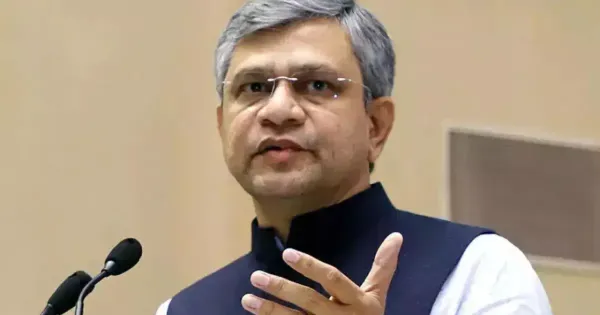
Davos: Union Minister Ashwini Vaishnav on Wednesday said the Indian economy will continue to grow at 6-8 per cent in real terms and 10-13 per cent at current prices over the next five years on the back of softening inflation and strong economic growth. Addressing the ‘Bet on India – Bank on the Future’ session organized on the sidelines of the annual meeting of the World Economic Forum (WEF) here, Vaishnav stressed the importance of simplification of permission processes.
He said the average time taken to set up a telecom tower has reduced from 270 days to seven days and 89 per cent of permissions are now being given promptly. Emphasizing the need to bridge the gap between policy objectives and ground implementation, Vaishnav said that as a political leader, it is important to ensure that the bureaucracy works in accordance with political decisions.
He also mentioned the need for effective communication of challenges across industries and cited the example of standardization of data localization standards in the US and Europe. Speaking on the occasion, Rajiv Memani, President, Confederation of Indian Industry (CII) and Regional Managing Partner, EY Africa-India Region, said that India is among the lowest ranked in terms of per capita income which shows that it needs to increase at least five times by 2047.
Referring to India’s trade strategy, he said that trade agreements with regions like West Asia, Asia-Pacific region and Britain are becoming increasingly important. Apart from this, he also mentioned major reforms like GST rate cut and implementation of new labor laws. CII Director General Chandrajit Banerjee said, “At a time when the global economy is going through uncertainty and rapid technological changes, India has emerged as a market with scale, stability and long-term opportunities.”
The roundtable also included representatives from sectors such as global finance and banking, insurance and reinsurance, technology and digital platforms, industrial automation, transportation and mobility, telecommunications, cyber security, medical technology, life sciences, food and beverage, chemicals and consumer goods, clean energy solutions and cross-border payments.
-
Jay Shah-Led ICC Vote To Replace Bangladesh At ICC T20 World Cup 2026 In Crisis Meeting; Scotland Likely Replacement

-
Delhi High Court Rejects PIL Seeking Ban On Bangladesh In International Cricket

-
Vivo X200T To Launch In India On January 27: What To Expect

-
Marty Supreme Review: Timothée Chalamet Spins Up A Whirlwind Of Ping-Pong Pandemonium

-
PPF: Those investing in PPF in their children's names should be cautious! One mistake could wipe out all your interest earnings..