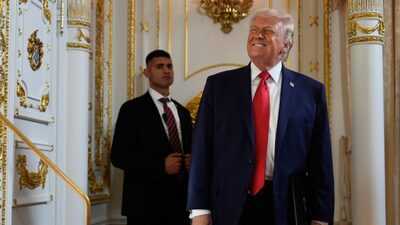
President Trump uses his World Economic Forum platform to defend American policies, push economic nationalism, and outline global strategic priorities.
At the 2026 World Economic Forum in Davos, Switzerland, President Donald Trump delivered a major address that reflected his administration’s evolving posture on global economic leadership, national security priorities, trade policy, and diplomatic relationships. Speaking to world leaders, business executives, and international stakeholders, Trump emphasised themes of U.S. strength, self-interest, and strategic ambition. His remarks underscored continuing tensions between the United States and traditional allies, outlined controversial foreign policy goals, and sought to position his governance approach within the forum’s discourse on economic cooperation and global stability. The address struck a markedly different tone from previous administrations, combining assertions of American exceptionalism with direct critiques of multilateral institutions and foreign partners, all while promoting what he described as a pragmatic vision for worldwide economic growth and security.
Trump’s Economic Message and American Policy Priorities at Davos
When President Trump took the stage at the World Economic Forum, he sought to frame the United States as a dominant engine for global recovery and growth. His address started with a familiar narrative emphasising domestic economic gains, portraying America as a place where innovation flourishes, investment returns are maximised, and job creation continues to strengthen. In outlining this message, Trump argued that policies focused on lowering taxes, reducing regulation and prioritising American labour had revitalised the U.S. economy, encouraging both international and domestic investment.
A central element of Trump’s message was economic nationalism: the idea that countries must first secure prosperity for their own citizens before engaging meaningfully with global partners. He asserted that this inward focus would ultimately create a stronger platform for international cooperation, countering critics who see such policies as isolating or contrary to global unity. Trump’s portrayal of economic strategy included an ambitious offer to foreign businesses: a call to manufacture in the United States under favourable tax conditions, which he claimed would “produce benefits for the most people in the most fundamental ways.”
Trump’s remarks at Davos touched not only on commerce but on the broader doctrine he has championed throughout his presidency, which he encapsulated in a mixture of themes around sovereignty, competitiveness and American leadership. While he insisted that the U.S. remains committed to constructive engagement, his emphasis was unmistakably on ensuring that engagement proceeded from a position of strength, not obligation. According to Trump, countries that partnered with the United States stood to share in the benefits of American economic dynamism, but smaller or weaker economies would need to find their own paths to growth if they could not adapt to the new global market realities he depicted.
Trade policy and industrial investment were key components of the address. Trump criticised what he described as outdated trade agreements that, in his view, disadvantaged the United States and diluted its competitive edge. Instead, he pointed to a series of renegotiated or reoriented deals that he claimed denied unfair advantages to competitors while providing American workers and industries room to expand. This framing of trade — as a tool that must be wielded strictly in America’s interest — resonated with some audiences, particularly in countries where similar economic debates are underway, but unsettled others who favour more integrated global markets.
Trump’s discourse on energy policy further underscored his administration’s focus on national self-reliance. In his view, the United States’ position as a leading producer of oil, gas and innovative energy technology was not merely an economic success but a strategic advantage. He asserted that energy independence shielded Americans from geopolitical risks and provided leverage in negotiations with other powers. Trump also suggested that this abundance of energy resources could benefit allies, positioning American exports as both economically and politically stabilising for partner nations facing energy volatility.
Importantly, Trump’s address did not shy away from the use of economic leverage as a tool of diplomacy. With global trade tensions rising, he referenced the United States’ readiness to impose tariffs or other measures if he perceived that its interests were being ignored or undermined. This message — that economic policy and national security were inseparable — reinforced his broader theme that nations must protect their own prosperity before contributing to collective global frameworks.
Foreign Policy, Strategic Ambitions and Controversial Global Initiatives
While economics dominated the opening of Trump’s remarks, his address at the World Economic Forum also ventured deeply into foreign policy, presenting a set of agendas that have become defining features of his leadership. Central among them was his administration’s stance on geopolitical security and national defence.
One of the most striking elements of Trump’s strategic narrative was his insistence on the importance of securing territories of strategic value, especially in the Arctic. Without mentioning specific negotiation details, he framed this as essential for national and world security, reiterating that strategic positioning would ensure the United States and its allies remained protected in an increasingly contested global landscape. This stance carries implications beyond economics and into the realms of military deployment, alliance dynamics, and long-term defence planning.
Trump also addressed his vision for peace initiatives, which have been framed around U.S. leadership even when operating outside traditional multilateral frameworks. Part of this vision includes creating new mechanisms for conflict resolution and reconstruction in crisis regions. While his remarks in Davos did not elaborate minute details, they aligned with prior statements from U.S. officials who have sought alternative institutional structures for peacebuilding that diverge from century-old institutions, emphasising flexibility and direct leadership by participating nations.
However, Trump’s remarks also intensified criticism among some global leaders and think tanks. European counterparts, in particular, responded with concern to what they viewed as a more unilateral posture on issues such as territorial negotiations, trade retaliation and defence commitments. Allies underscored that cooperation must function within agreed frameworks and respect sovereign boundaries, warning against approaches that could undermine established alliances or unsettle global stability.
This tension was evident in parallel reactions at the forum, where voices from the European Union and other blocs emphasised multilateralism and the importance of collective decision-making, especially in areas of security and economic governance. These responses reflect broader debates about the balance between national interest and international cooperation, especially in an era marked by shifting power balances and emerging geopolitical rivalries.
Part of Trump’s address also focused on trade and alliances beyond the West. He highlighted the importance of engaging with emerging economies and ensuring that policies accounted for the aspirations of nations outside traditional Western alliances. This message was positioned as inclusive in rhetoric, although its practical implications were closely tied to negotiations that prioritise American leverage.
Another significant theme was national security in the context of global economic competition. Here, Trump made clear that security considerations are interwoven with economic ones, particularly when technological supremacy and supply-chain resilience are at stake. In his view, leadership in sectors such as artificial intelligence, energy technology and strategic infrastructure would define the next era of global power relations.
Throughout the address, Trump projected a confident vision of American leadership that mixes assertive national interest with an invitation to other nations to engage on terms that, in his view, are fair and mutually beneficial. His remarks were emblematic of a foreign policy approach that emphasises sovereignty, strategic advantage, and economic prowess as the pillars of global engagement.
Criticism from analysts and world officials noted that certain stances could strain long-standing alliances, particularly when trade and security positions appeared to conflict with collaborative frameworks. Some observers argued that such approaches might foster division rather than unity among global powers, while others acknowledged that realigning global economic and security priorities may be necessary in a rapidly changing international environment.
In sum, Trump’s address at the 2026 World Economic Forum encapsulated a worldview anchored in American strength, economic nationalism, strategic assertiveness, and a redefinition of global cooperation. Whether advocates or critics, participants and observers took away that the United States under Trump seeks to shape global discourse not through traditional multilateralism alone, but through a blend of national confidence, competitive economic policy, and bold geopolitical ambitions.
The post Trump’s 2026 World Economic Forum Address Signals U.S. Priorities and Controversial Global Policies | cliQ Latest appeared first on CliQ INDIA.
-
'It was brutal': BTS fans in UAE battle queues, scramble for tickets ahead of World Tour

-
Husband admits drugging and sexually abusing wife over 13 years as victim sits in court

-
Couples' choice 2026: Europe's most romantic city for Valentine's Day revealed

-
4 Powerful Adi Shankaracharya Teachings for Inner Awakening

-
4 Powerful Business Lessons from Zomato CEO Deepinder Goyal
