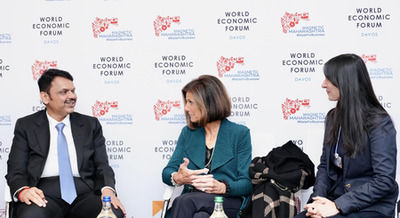
Davos, Jan 21 (IANS) Maharashtra has scripted a historic success story by implementing Asia’s largest decentralised solar power program, Chief Minister Devendra Fadnavis announced on Wednesday.
Speaking at the World Economic Forum (WEF) annual meeting, the Chief Minister stated that the state is on track to generate 16 gigawatts (GW) of solar power by the end of this year.
The Chief Minister was speaking at a session titled "Scaling Solar Energy Where It Matters," organised by the International Solar Alliance at the India Pavilion.
The event was attended by Union Minister for New and Renewable Energy, Pralhad Joshi, along with other global dignitaries.
During his address, CM Fadnavis detailed how Maharashtra has overhauled its energy sector in less than a decade. He highlighted the significant impact on the agricultural sector.
“Agricultural pump owners constitute 10% of the state’s consumers but use 30 per cent of its electricity. The cost of supply was Rs 8 per unit, while farmers were charged only Re 1. The remaining Rs 7 was covered through state subsidies or "cross-subsidies," which inflated electricity rates for industrial and domestic consumers,” he said.
Following Prime Minister Narendra Modi’s vision, the state launched Asia’s largest decentralised solar scheme. By shifting the entire agricultural load to solar power and establishing a dedicated company for farmer supply, the state is making every agricultural feeder independent.
“The cost of supplying power to farmers has dropped from Rs 8 to less than Rs 3 per unit. This transition is not only helping farmers but also reducing the financial burden on industries and households," the Chief Minister noted.
He said that Maharashtra is also a frontrunner in the PM Surya Ghar Yojana, with approximately 4 GW of rooftop solar capacity expected to be commissioned. This initiative allows households to generate their own electricity and feed the surplus back into the grid. Furthermore, the state’s "Solar Pump on Demand" scheme has seen massive adoption.
“Maharashtra currently accounts for 60 per cent of all solar pumps installed across India. The number of installations is expected to cross 1 million shortly,” said the Chief Minister.
“The shift to solar is yielding massive dividends for the state’s economy and the environment: Financial Savings: While electricity tariffs previously rose by 9 per cent annually, they are now trending downward. The state expects to save $10 billion in power purchase costs over the next five years. The reduction in carbon emissions resulting from this program is equivalent to planting 3 billion trees,” said CM Fadnavis.
“By 2032, the state aims to generate an additional 45 GW, with 70 per cent coming from solar. Renewable energy, which stood at 13 per cent four years ago, is projected to reach 52 per cent by 2030,” he said.
To maintain a stable national and state grid, the Chief Minister emphasised the role of Battery Storage and Pumped Storage Projects (PSP). Leveraging the unique geography of the Western Ghats, the state has already initiated PSPs with a capacity of 80,000 MW, with plans to scale up to 100,000 MW soon.
--IANS
sj/dan
-
Campaigners given fresh hope as they call for child abusers to be treated like sex fiends

-
Sabarimala gold loss: Accused 'jointly looted' Lord Ayyappa's property, says Kerala HC

-
Liam Rosenior makes tough Cole Palmer decision as Chelsea wonderkids involved vs Pafos

-
Prince Harry and Meghan Markle should learn one lesson from Diana before UK return

-
Infrastructure boom and refurbishment drive tools demand in UAE and GCC