Highlights
- Tech for Digital Nomads enables reliable remote work anywhere using powerful gadgets, secure software, and travel-friendly productivity tools.
- Smart Connectivity, Power & Security – From eSIMs and mobile hotspots to VPNs and portable power banks, this tech stack ensures secure, always-on remote work.
- Human-Centric Remote Work Setup – Tools designed to reduce burnout, improve ergonomics, and support sustainable work-life balance for long-term digital nomads.
The idea of work has changed more in the last decade than in the previous fifty years. In 2025, work is no longer tied to a fixed location; it travels with people. Cafés replace cubicles, airport lounges double as offices, and time zones blur into flexible schedules. At the centre of this shift is the digital nomad, professionals who rely on technology to work productively from anywhere.
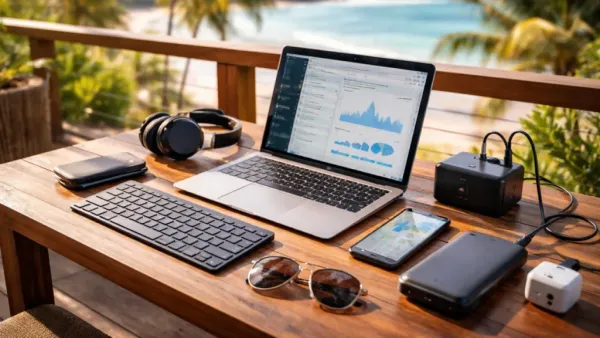
But remote freedom is not effortless. Behind every Instagram-worthy beach workspace lies a carefully curated stack of gadgets and software designed to solve practical problems: unstable internet, power shortages, security risks, and the simple physical strain of working on the move.
This feature article explores the essential tech that makes remote work viable for digital nomadsfocusing on portability, connectivity, security, and power management, while keeping the human realities of long-term mobility firmly in view.
The nomad’s core principle: reliability over novelty
For digital nomads, technology is not about having the newest device. It is about dependability. When work spans borders, the cost of failure rises sharply. A missed meeting due to poor connectivity or a stolen laptop without backups can have consequences far beyond inconvenience.
The most successful nomads build setups that are:
- Lightweight, but not fragile
- Powerful, but energy-efficient
- Secure, without being cumbersome
This balance defines every tech choice.
Laptops: the anchor of mobile work
The laptop remains the single most important tool for any digital nomad. Portability, battery life, and thermal efficiency matter more than raw performance.

Aditya Joshi/Unsplash
Ultralight laptops with all-day battery life have become the default. Machines like Apple’s MacBook Air or compact Windows ultrabooks built on ARM architectures are popular because they run cool, charge quickly, and handle most professional workloads with ease. For developers or designers, slightly heavier laptops with discrete GPUs may be necessary, but weight is always a trade-off.
Nomads tend to favour devices that:
- Last 10–15 hours on battery
- Charge via USB-C (simplifying cable management)
- Remain usable without fans spinning constantly
The goal is not maximum power, but predictable performance anywhere from a hostel to a high-altitude café.
Portable peripherals: small tools, big impact
Ergonomics does not disappear when you travel, but it becomes more important. A foldable laptop stand, paired with a compact wireless keyboard and mouse, dramatically reduces strain during long work sessions. These accessories weigh little but protect posture, wrists, and shoulders over months of mobile work.
Noise-cancelling headphones are another staple. Whether it is the hum of traffic, chatter in a café, or the echo of a shared apartment, good audio isolation improves focus and meeting quality. Many nomads treat these as productivity tools, not luxuries.
Connectivity: the lifeline of remote work
Internet access is the single biggest variable in nomadic life. Smart nomads plan for redundancy.
Mobile hotspots and eSIMs
Portable mobile hotspots and eSIM-enabled smartphones have become essential. Services offering global or regional data plans allow nomads to stay online without relying solely on local Wi-Fi. This is especially critical during video calls or time-sensitive work.
While public Wi-Fi is ubiquitous, it is also unreliable and insecure. Personal connectivity provides control and peace of mind.
Backup strategies
Experienced nomads rarely rely on one connection. A typical setup includes:
- Primary Wi-Fi
- Mobile data as backup
- Offline access to key documents
This layered approach reduces stress and keeps work flowing even when infrastructure falters.

Collaboration and communication
Remote work depends on tools that transcend time zones. Platforms like Slack, Zoom, and Notion remain central because they integrate communication, documentation, and coordination into shared digital spaces.
Asynchronous tools are especially valuable for nomads. Clear documentation and recorded updates reduce the pressure to be online at specific hours, protecting mental health.
File access and backups
Cloud storage is non-negotiable for mobile professionals. Services like Google Drive or Dropbox ensure files are accessible from any device, anywhere.
However, reliance on the cloud alone is risky. Many nomads maintain encrypted local backups on portable SSDs, combining speed with redundancy. The rule is simple: never carry your only copy of important work.
Essential Security: Virtual private networks (VPNs)
VPNs remain a baseline security tool for digital nomads, especially when using public Wi-Fi. A reputable VPN encrypts traffic and reduces the risk of interception, particularly in regions with weak network security standards.
Device protection and authentication
Disk encryption, strong passwords, and biometric locks are essential. Hardware security keys are increasingly popular among nomads handling sensitive data, adding a physical layer of protection against phishing and account compromise.
Security is rarely visible, but when it fails, the consequences are immediate and severe.
Power management: working beyond the socket
Power access varies dramatically across regions. For nomads, managing energy is as important as managing time.
Portable power banks
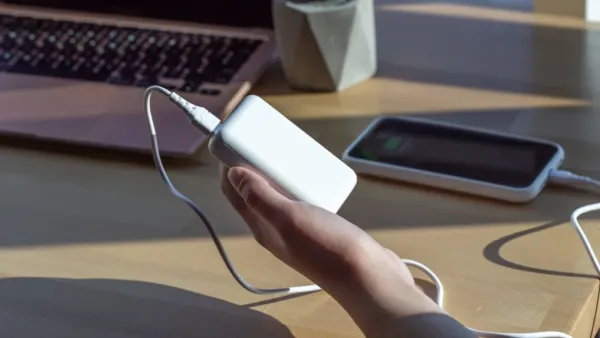
High-capacity power banks capable of charging laptops have become smaller and more affordable. These devices act as insurance, bridging gaps during long travel days, power outages, or crowded cafés with limited outlets.
Universal chargers and adapters
A single, high-wattage USB-C charger that powers multiple devices reduces clutter and simplifies packing. Paired with a universal travel adapter, it ensures compatibility across countries.
Power predictability reduces anxiety, allowing nomads to focus on work rather than logistics.
Human factors: burnout, boundaries, and balance
Technology enables nomadism, but it can also blur boundaries. When work lives everywhere, it risks living all the time.
Successful digital nomads use tech intentionally:
- Scheduling tools to protect downtime
- Focus apps to manage distraction
- Time-zone planners to avoid constant availability
The healthiest setups are not those with the most gadgets, but those that support sustainable routines.
Coworking and hybrid spaces
While tech allows solitary work anywhere, many nomads still seek shared environments. Coworking spaces provide reliable internet, ergonomic furniture, and social connections, which are elements that technology alone cannot replace.

Apps and platforms now help nomads locate trusted coworking spaces globally, adding predictability to unfamiliar cities.
Cost vs. value: investing wisely
Nomad tech can be expensive, but value lies in longevity and reliability. Cheap gadgets that fail mid-trip cost more in stress and replacement than premium tools that endure years of travel.
Most seasoned nomads prioritise:
- Fewer devices, better quality
- Multi-purpose tools
- Ecosystems that work together
Minimalism, in this context, is not aesthetic, but it is functional.
Conclusion
Tech for digital nomads works best when it fades into the background. The ideal setup does not draw attention to itself; it simply works, on a train, in a café, during a layover, or from a rented room halfway across the world.

The future of remote work is not about exotic gadgets or radical software. It is about refining tools that respect mobility, security, and human limits. When chosen thoughtfully, technology becomes a quiet partner which is supporting work without dominating life. For digital nomads in 2025, freedom is not just about location. It is about building systems that make work reliable, humane, and sustainable, wherever the road leads.
-
8th Pay Commission DA update: How much hike can central government employees expect?

-
Charlotte Tilbury 'blurring' foundation ideal for mature skin is under £40

-
Are calcium and vitamin D alone enough? AIIMS explains the real reason behind bone weakening after menopause..

-
Pune Pedals off the Grand Cycling Tour

-
Magic noodles to Potli noodles: Hyderabad's Chinese Thali goes viral