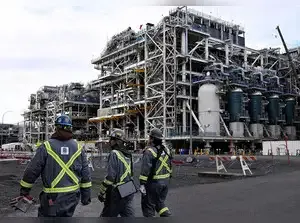
Shell and Mitsubishi weigh partial stake sales in $40B LNG Canada project amid expansion plans
Two of the biggest foreign investors in Canada’s flagship liquefied natural gas project are quietly weighing exit options, underscoring shifting strategies in the global energy industry as markets brace for a potential LNG glut.
Oil major Shell and Japan’s Mitsubishi Corp. are exploring the possible sale of significant portions of their stakes in the $40-billion LNG Canada facility, according to sources familiar with the discussions, even as the project’s owners consider a major expansion that could double its export capacity.
The deliberations are unfolding as the project’s partners assess a possible expansion of the massive liquefied natural gas facility, following a recent transaction in which fellow stakeholder Petronas successfully sold down part of its interest.
Shell, the 40 percent owner, has tapped Rothschild & Co. to test buyer interest and could sell up to 30 percent of the project, sources said. Shell has indicated it is open to a range of options that separately address its stake in the operating Phase 1 and the higher-risk proposed Phase 2.
Mitsubishi, which holds a 15 percent stake, has hired RBC Capital Markets to assess its options, though sources said discussions are preliminary and any sale process would likely begin later this year, with no details on how much could be sold.
Sources cautioned that potential sales by Shell or Mitsubishi are not guaranteed.
In December, MidOcean, backed by EIG and Saudi Aramco, bought a portion of the Petronas venture that held a 25 percent stake, while PetroChina owns 15 percent of LNG Canada and Korea Gas Corporation holds 5 percent.
According to CTV News, LNG Canada is the first major North American LNG facility with direct Pacific Coast access and a cost advantage from discounted Canadian gas prices. Those benefits are being weighed against fears of global LNG oversupply, underscored by Energy Transfer’s suspension of its Lake Charles project, while operational issues emerged in December when LNG Canada’s Train 2 unit went offline shortly after startup, sources said.
Phase 1 of LNG Canada is expected to export 14 million metric tons of LNG annually, with Shell planning to retain a 30-year gas supply contract, a source said. As developers often sell down stakes once projects are operational, Shell is pursuing 4-5 percent annual LNG sales growth and is working with partners toward a Phase 2 investment decision that would double capacity.
Oil major Shell and Japan’s Mitsubishi Corp. are exploring the possible sale of significant portions of their stakes in the $40-billion LNG Canada facility, according to sources familiar with the discussions, even as the project’s owners consider a major expansion that could double its export capacity.
The deliberations are unfolding as the project’s partners assess a possible expansion of the massive liquefied natural gas facility, following a recent transaction in which fellow stakeholder Petronas successfully sold down part of its interest.
Shell, the 40 percent owner, has tapped Rothschild & Co. to test buyer interest and could sell up to 30 percent of the project, sources said. Shell has indicated it is open to a range of options that separately address its stake in the operating Phase 1 and the higher-risk proposed Phase 2.
Mitsubishi, which holds a 15 percent stake, has hired RBC Capital Markets to assess its options, though sources said discussions are preliminary and any sale process would likely begin later this year, with no details on how much could be sold.
Sources cautioned that potential sales by Shell or Mitsubishi are not guaranteed.
In December, MidOcean, backed by EIG and Saudi Aramco, bought a portion of the Petronas venture that held a 25 percent stake, while PetroChina owns 15 percent of LNG Canada and Korea Gas Corporation holds 5 percent.
According to CTV News, LNG Canada is the first major North American LNG facility with direct Pacific Coast access and a cost advantage from discounted Canadian gas prices. Those benefits are being weighed against fears of global LNG oversupply, underscored by Energy Transfer’s suspension of its Lake Charles project, while operational issues emerged in December when LNG Canada’s Train 2 unit went offline shortly after startup, sources said.
Phase 1 of LNG Canada is expected to export 14 million metric tons of LNG annually, with Shell planning to retain a 30-year gas supply contract, a source said. As developers often sell down stakes once projects are operational, Shell is pursuing 4-5 percent annual LNG sales growth and is working with partners toward a Phase 2 investment decision that would double capacity.