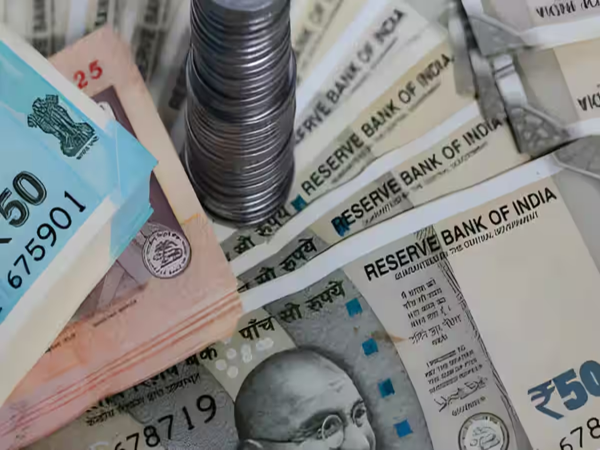
In today's digital age, cash still holds its own charm. But as technology has advanced, counterfeiters have also become more sophisticated. Often, in our haste, we simply look at Mahatma Gandhi's picture on a banknote and put it in our pocket. But did you know that the Reserve Bank of India (RBI) has incorporated not just one or two, but several intricate features into banknotes to make them secure, features that no machine or counterfeit printer can replicate?
Learn about these security features of banknotes
Yes, the RBI changes the design of banknotes from time to time to prevent fraud. Whether it's a small ₹10 note or a large ₹500 note, every note has its own hidden identity. So let's learn about the security features of Indian banknotes that will help you avoid being cheated.
1. Security Thread
The shiny strip in the middle of the banknote is called the 'security thread'. On ₹10, ₹20, and ₹50 notes, this strip is usually completely embedded, but when viewed in light, it appears as a straight line. However, on ₹100 and higher denomination notes, this strip is color-shifting. This means that if you tilt the note slightly, its color will change from green to blue. It also has "India" and "RBI" written on it.
2. Watermark
A picture of Mahatma Gandhi is visible in the white area (watermark window) of the banknote. It has such a light and shade effect that, along with Gandhi's picture, a small 'electrotype' watermark of the note's denomination (like 500 or 100) is also visible. This can be clearly seen only when held against the light.
3. See-Through Register
On the left side of your banknote, there is a small flower-like design or a part of a number. Its specialty is that half of it is on the front of the note, and the other half is exactly on the back. When you hold it up to the light, these two parts combine to form a complete number. In fact, it is printed with such precision that it is impossible to replicate in counterfeit notes.
4. Raised Printing
The RBI has used 'intaglio' printing for the convenience and safety of visually impaired individuals. The notes feature slightly raised printing of Mahatma Gandhi's picture, the Reserve Bank's seal, the Ashoka Pillar emblem, and the Governor's signature. If you run your finger over these areas, you will feel that the printing is raised above the paper.
5. Special Identification Marks
For the visually impaired, there are special shapes on the left side of the note, such as: ₹100: triangle, ₹200: four lines with two circles, ₹500: a circle. By touching these marks, anyone can identify the denomination of the note. Furthermore, the size of these marks has been increased by approximately 50% in the new notes.
6. Color-Shifting Ink
The denomination of the note, usually printed in the center, is printed with special ink. When you hold the note straight, it will appear green, but when tilted, it will appear somewhat blue. This feature is often missing in counterfeit notes because this ink is very expensive and secure.
7. Latent Image
To the right of Mahatma Gandhi's picture, there is a vertical strip. If you hold the note perfectly straight (horizontally) in front of your eyes, you will see the denomination of the note written inside that strip. Otherwise, it just looks like a plain strip.
8. Fluorescence and Micro-lettering
Yes, if you look through a magnifying glass, you will see 'RBI' and the note's value written in very small letters on the note. Also, when placed under ultraviolet (UV) light, the note's number panel and some fibers glow. Remember that this glow is not the same in counterfeit notes. 9. New Numbering Pattern
Not only that, since 2015, the RBI has made some changes to the size of the numbers. Now, the numbers on both panels of the note increase in size from left to right. That is, the first digit is the smallest and the last digit is the largest.
Making and Circulating Counterfeit Notes is a Serious Crime
Under Sections 489A to 489E of the Indian Penal Code (IPC), printing counterfeit notes, circulating them in the market, or knowingly possessing them is a serious crime. This can result in heavy fines and imprisonment.
Identify Real and Fake Notes Yourself
Let us tell you that a banknote is not just a piece of paper; it is also the foundation of the country's economy. So, the next time someone hands you a note, just take 2 seconds and check for yourself whether the note is real or fake.
Disclaimer: This content has been sourced and edited from Zee Business. While we have made modifications for clarity and presentation, the original content belongs to its respective authors and website. We do not claim ownership of the content.
-
Hair will become stronger from the roots with these hair oils.

-
Wire vs Wireless mouse: Which is faster and better for work and gaming? Features, Performance and speed compared | Technology News

-
WPL 2026: Gujarat Giants register an impressive win by defeating UP Warriors in Vadodara. Read

-
Premier League 2025-26: Bergvall joins Tottenham’s injury list; Coach Frank says troubled Spurs ‘going in right direction’

-
‘No Need To Politicise, It Is Very Safe, You Should Visit’: Lalit Modi Urges Bangladesh To Play T20 World Cup Matches In India