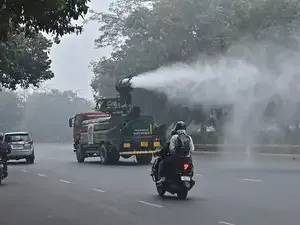
The Commission on Air Quality Management on Thursday revoked the GRAP 3 restrictions in Delhi-NCR following improvement in air quality.
The commission had revoked GRAP 3 on January 2 after the air quality improved but it was reimposed on January 17 when AQI of 368 was recorded.
On Thursday, the Delhi-NCR region saw a slight improvement in the air quality at 332, following which the restrictions were being relaxed.
CAQM said the AQI was likely to remain in the 'moderate' to 'poor' category in the coming days.
Notably, several preventive and control measures under GRAP 1 and 2 continue across the NCR.
GRAP, which is implemented in Delhi-NCR, categorises air quality into four stages -- 'poor' (AQI 201-300), 'very poor' (AQI 301-400), 'severe' (AQI 401-450) and 'severe plus' (AQI above 450).
Unfavourable meteorological conditions, along with vehicular emissions, stubble burning, firecrackers and other local pollution sources often push the air quality in Delhi-NCR to hazardous levels during the winter season.
The commission had revoked GRAP 3 on January 2 after the air quality improved but it was reimposed on January 17 when AQI of 368 was recorded.
On Thursday, the Delhi-NCR region saw a slight improvement in the air quality at 332, following which the restrictions were being relaxed.
CAQM said the AQI was likely to remain in the 'moderate' to 'poor' category in the coming days.
Notably, several preventive and control measures under GRAP 1 and 2 continue across the NCR.
GRAP, which is implemented in Delhi-NCR, categorises air quality into four stages -- 'poor' (AQI 201-300), 'very poor' (AQI 301-400), 'severe' (AQI 401-450) and 'severe plus' (AQI above 450).
Unfavourable meteorological conditions, along with vehicular emissions, stubble burning, firecrackers and other local pollution sources often push the air quality in Delhi-NCR to hazardous levels during the winter season.