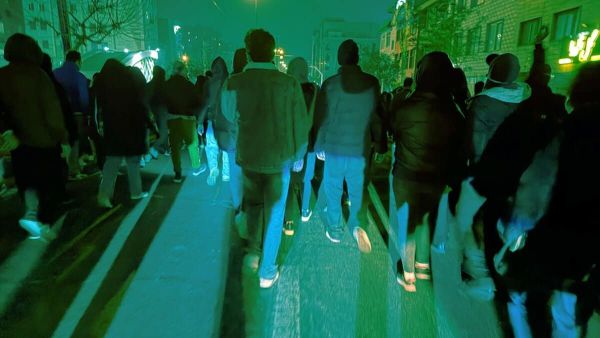
When widespread protest and violence, especially by the youths, led to the overthrow of the parties in power in Sri Lanka, Bangladesh and Nepal in the post-pandemic years, Iran – though single-handedly taking on western enemies – managed to ward off the recent upheaval, but not before paying a heavy price. Contrary to the three South Asian countries, the Islamic Republic had to undergo this massive upsurge after its war with the United States and Israel, as well as the economic blockade and sanctions it had been facing for decades.
What is being ignored by the commentators in general is that, unlike Colombo, Dhaka and Kathmandu, cities in Iran witnessed massive pro-government rallies at the same time. This came as a morale-booster to the government, which ultimately managed to come out successfully. As social media plays a significant role in spreading the message, or even disinformation, Tehran’s accusation that the violence was instigated by forces sitting in the West and Israel carries weight.
No comparison with 1979 revolution
While many experts in the United States and Europe are of the view that the “regime change” is very much in the offing and are busy drawing parallel between today’s Iran and 1979, what they fail to appreciate is that during the massive mobilisation of common masses by Ayatollah Khomeini on the run-up to February 11 revolution 47 years back, not a single person came out on the street in favour of the ruling monarch Raza Shah, notorious for his brutality and lavish lifestyle.

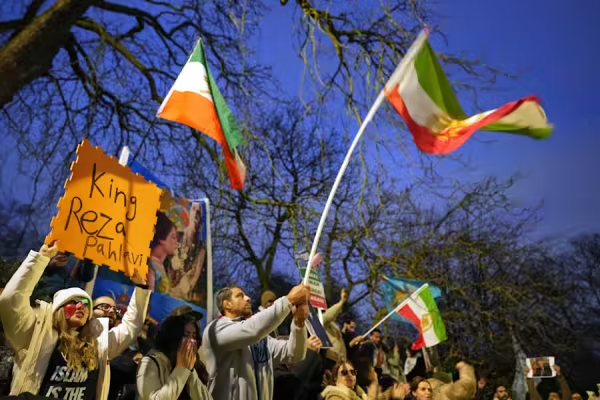
In contrast, this time, lakhs of supporters of the present government took to the streets denouncing the United States and Israel.
Raza Shah, along with his family and wealth, fled to Egypt on January 16, 1979. On February 1, the leader of the revolution, Ayatollah Khomeini, landed in Tehran from 15 years-long exile amidst tumultuous welcome by millions of countrymen and women. On February 11, the regime finally collapsed.
If today, notwithstanding the serious economic crisis, lakhs of people across Iran took to roads in favour of the present establishment, it gives an idea about the groundswell of support it still enjoys. On the other hand, be it for Rajapaksas in Sri Lanka, Sheikh Hasina in Bangladesh and KP Sharma Oli in Nepal, the common people did not turn up to their rescue. No doubt, they were once powerful and popular in their respective country.
Even at the height of 2009, 2017, 2018 and 2022 anti-government protests, millions would pour into the streets to repose faith in the Islamic Republic. Thus, there is more chance of confrontation between two rival blocs.
How different Iran is
Iran is very different from its neighbours, especially the Gulf monarchies where nobody can even imagine of gathering publicly against the government. Though the western media often sketches an image of authoritarian rule in Tehran, yet the fact is that rallies and even strikes against the government are not uncommon here.
Against the general perception, the authorities in Iran tolerate dissent much more. One example is enough to understand the situation. Iranian footballers participating in the opening match against England in November-December 2022 FIFA World Cup in Qatar refused to sing the national anthem to show solidarity towards the protest movement over the death of Mahsa Amini in police custody. Players openly flayed the government on social media on the handling of the situation.
Back in Iran, several people associated with the ruling establishment also criticised the crackdown on those who came out in favour of Mahsa Amini in 2022, and even this time. This is unthinkable in other Arab countries.
Iranians, cutting across the ideological lines, are well educated, mannered and open-minded people. The society is quite vibrant. The country has highly-qualified women workforce as well. The first ever woman in the world to get Fields Medal, considered as Nobel Prize for math in 2014, is an Iranian born American, Maryam Mirzakhani, who incidentally died at the age of 40 in 2017. She graduated from Iran before moving to the US for research.
Since it needs two to quarrel, Iran had, ever since the revolution, witnessed tussle. The Islamic Revolution initially enjoyed the support of secular-nationalist forces, communist party (Tudeh Party) as well as liberal-minded Mujahideen-e-Khalq. But, they fell apart and soon the Islamists prevailed, sparking off large-scale violence leading to the assassinations of its president, prime minister and chief justice in 1981.
However, the war-ravaged country – it was fighting with Iraq – came out from the worst crisis then.
The problem for the opposition is that under the Constitution, there is no provision for the communists or secularists to contest election. So, there is no option for them but to launch protest, which often goes violent. As anti-government movements enjoy material, financial and moral support from West and Israel, and are led by Iranians in exile, they get extraordinary media space.
True, hundreds of people died recently, but what is not highlighted is that a big number of them were the supporters of the government and officials. According to the figures released by the administration, at least 150 security personnel were killed – a couple of them were roasted alive – at the hands of the rampaging mobs, which torched mosques, mazars and other public and private property.
Iran often witnesses debate between hardliners and moderates within the system. Even this time, the government came under attack for its failure to handle the serious economic crisis and subsequent developments.
Though fall of the Islamic Republic is not imminent in the near future, there is no dearth of people within eager to exploit the situation. A section of Iranians feel that their country should not wage a war against Israel and not support Hamas, Hezbollah and Ansarullah or Houthis.
Yet, there is a much larger number of people who still backs the country’s stand against Zionists. The hostility shown by Israel and the United States helped the present establishment consolidate its position. The feeling of Iranian nationalism and the spirit of martyrdom are invoked by the Shia clerics.
The greatest disadvantage with the Opposition is that there is no Ayatollah Khomeini like towering figure to unite and bring down the present set up. By backing the son of late Raza Shah, a downright corrupt tyrant, the United States had done the greatest disservice to the Opposition.
Notwithstanding the failure of the government on several counts, Iranians in general still prefer the present government as nobody today wants to see the return of brutal monarchy, which kept the nation backward and looted the country. The proud people agree that today’s Iran, though facing economic crisis, is scientifically, educationally, militarily and socially much more a developed country on the threshold of becoming a nuclear power. It had made these achievements in the last 47 years notwithstanding all sorts of sanctions and trade boycott. And for this, the masses in general still give credit to those running the nation. A big chunk of population still has faith in those in power.
Iran may in future continue to witness more protests, yet it is a fact that there is an in-built mechanism to tackle them. Till now, these institutions are strong and working. Therefore, those dreaming of “regime change” have no scope to celebrate, at least in the near future.
-
Gold-Silver ETF Crash: ETFs Slide Up to 10% on NSE — Should Investors Panic or See a Buying Opportunity?

-
Subhadra Yojana Payment Update: How Women Can Check ₹5,000 Credit in Their Bank Accounts

-
Budget 2026 Expectations: Equal Tax Treatment for Retirement Plans and a Strong Push for Micro Insurance

-
BSSC Vacancy 2026: Over 3,500 Panchayat Secretary Posts Open in Bihar, Apply Online Before January 31

-
Goa Government Signs MoU With Starlink To Boost Digital Connectivity & Infrastructure