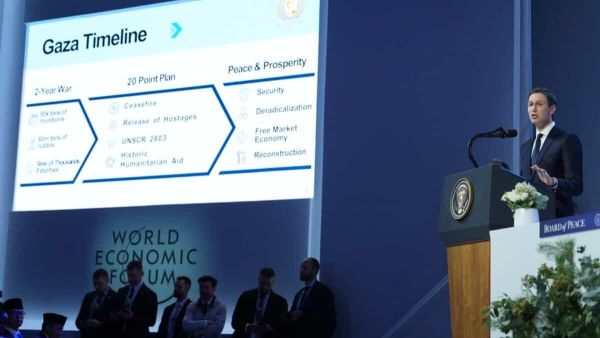
United States President Donald Trump’s son-in-law and Middle East adviser Jared Kushner, a member of the “Gaza Board of Peace,” on Thursday, January 22, unveiled the “Free Market Gaza” vision at the World Economic Forum in Davos, the visuals of which look like a real estate brochure that have since come under severe criticism.
Kushner outlined the plan during the signing of the charter for Trump’s “Board of Peace.” The Free Market Gaza vision requires an investment of USD 25 billion.
Speaking at the event, Kushner said, “Obviously, we are working with Israelis to figure out a way through de-escalation. And the next phase is working with Hamas and demilitarisation.”

Without security, nobody is going to make investments, he added.
A free market economy is defined by limited government control, where product prices are determined by market forces since resources are privately owned.
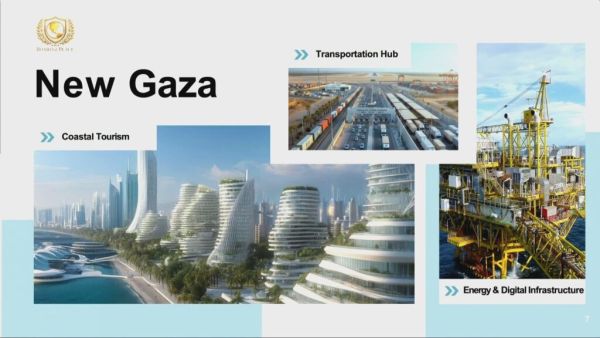
Kushner’s presentation heavily relied on selling the idea of a “developed Gaza,” open for investments to rebuild the war-torn city.
The plan, using free market principles, has various future project ideas, including the construction of an airport, “coastal tourism” and residential neighbourhoods – some things which already existed before the intensification of Israeli military action in Gaza in 2023.
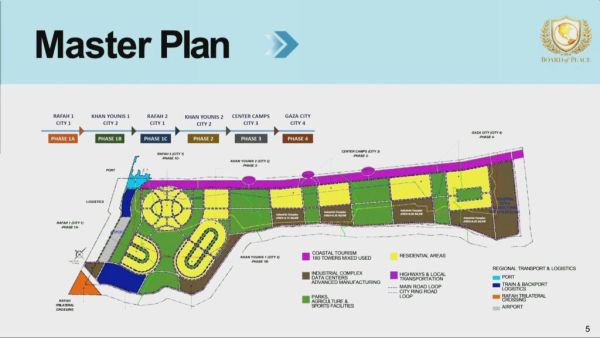
For instance, the Gaza Strip had the Yasser Arafat International Airport near Rafah that opened in 1998 as a symbol of Palestinian sovereignty. The airport ceased operations in 2001 after it was destroyed by the Israel Defense Forces (IDF).
“We want to use free market economy principles. A lot of what President Trump spoke about was what he’s doing in America; we want to bring the same mindset, the same approach to a place like Gaza,” Kushner said in his address.
The approach, he claimed, is to give the people of Gaza the “ability to thrive and have a good life.”
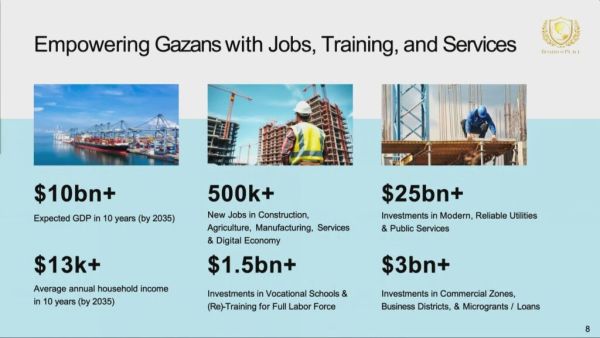
Housing units, residential areas, and a GDP worth USD 10 billion by 2035
Meanwhile, the “Free Market Gaza” is planning to have the central areas become residential neighbourhoods, along with industrial zones, which would include “data centres and advanced manufacturing facilities.”
A further USD 3 billion investment fund was designated for what was described as commercial zones, business districts and grants to stimulate local enterprise.
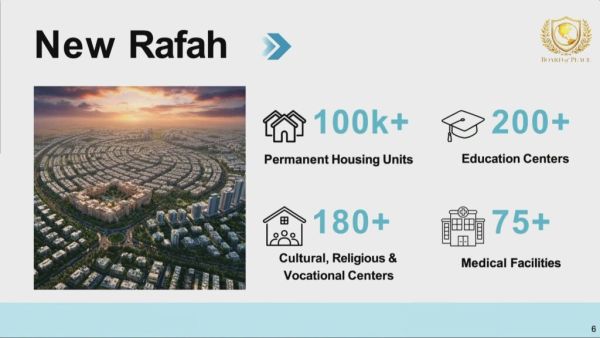
In a slide deck presented by Kushner, titled “New Rafah,” the envoy suggested that 100,000 housing units would be built in the southern city, alongside over 200 educational centres, 75 medical centres and 180 cultural, religious and vocational centres.
In his presentation, Kushner predicted that by 2035, Gaza’s GDP would achieve USD 10 billion, and the annual household income would be above USD 13,000.
“In the Middle East, they build cities like this … in three years,” said Kushner, who helped broker the ceasefire in place since October. “And so stuff like this is very doable, if we make it happen.”
That timeline is at odds with what the United Nations and Palestinians expect will be a very long process to rehabilitate Gaza. Across the territory of roughly 2 million people, former apartment blocks are hills of rubble, unexploded ordnance lurks beneath the wreckage, disease spreads because of sewage-tainted water and city streets look like dirt canyons.
Kushner said rubble-clearing and demolition were already underway there, but did not address whether demining would occur.
Plan will be used to turn Gazans into cheap labour: Critics
Reacting to the “Free Market Gaza,” Palestinian-American writer Susan Abulhawa said that the plan sought to “erase Gaza’s indigenous character, turn what remains of her people into a cheap labour force to manage their ‘industrial zones’ and create an exclusive coastline for ‘tourism’.”
Activist and former Member of the National Assembly of South Africa Andrew Feinstein compared it to building a city on “graves.”
“Imagine the son-in-law of the US President presenting a ‘vision and plan’ for a shiny city with resorts on the ruins of Auschwitz or Theresienstatd where dozens of my mother’s family and tens of thousands of others were slaughtered. And from which he will personally benefit,” he posted on X, calling it repulsive and inhuman.
Kushner’s plan avoids mention of what Palestinians do in the meantime
When unveiling his plan for Gaza’s reconstruction, Kushner did not say how demining would be handled or where Gaza’s residents would live as their areas are being rebuilt. At the moment, most families are sheltering in a stretch of land that includes parts of Gaza City and most of Gaza’s coastline.
Will Israel ever agree to this?
Nomi Bar-Yaacov, an international lawyer and expert in conflict resolution, described the board’s initial concept for redeveloping Gaza as “totally unrealistic” and an indication that Trump views it from a real estate developer’s perspective, not a peacemaker’s.
A project with so many high-rise buildings would never be acceptable to Israel because each would provide a clear view of its military bases near the border, said Bar-Yaacov, who is an associate fellow at the Geneva Centre for Security Policy.
What’s more, Kushner’s presentation said the National Committee for the Administration of Gaza (NCAG) would eventually hand off oversight of Gaza to the Palestinian Authority after it makes reforms. But Israeli Prime Minister Benjamin Netanyahu has adamantly opposed any proposal for postwar Gaza that involves the Palestinian Authority. And even in the West Bank, where it governs, the Palestinian Authority is widely unpopular because of corruption and perceived collaboration with Israel.
(With inputs from Associated Press)
-
Often public expressions of love for me branded as 'drama'; 'pre-planned': PM Modi
-
England rugby captain Maro Itoje makes heartbreaking announcement - 'Most painful loss'

-
Fruits that should never be consumed at Night

-
Designing Buildings for the Decades Ahead: Sahil Vora Introduces a Smarter Approach to Real Estate

-
EuroKids Marks 25 Years of Shaping India's Early Learning Journey, Launches 'Sahi Shuruaat' Movement