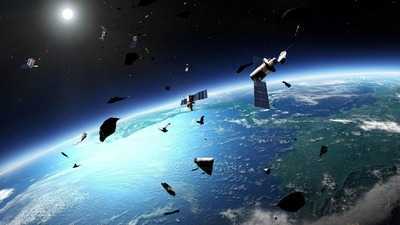
Sonic booms may help track falling space junk
23 Jan 2026
As space exploration continues to expand, so does the problem of space debris.
Old satellites and spacecraft parts re-enter Earth's atmosphere more than three times a day.
These objects can release harmful substances and potentially collide with buildings, infrastructure, or even people if they reach the surface.
Tracking this falling debris is difficult due to its unpredictable deorbiting at speeds up to 29,000km/h.
Current tracking methods struggle with accurate predictions
Tracking challenges
Current techniques for tracking falling space junk involve radar and optical tracking.
However, these methods often fail to accurately predict the landing zones of most objects, especially when they break up during re-entry into Earth's atmosphere.
This lack of precise location data can delay or even prevent the recovery of dangerous toxic space residue.
New method uses sonic booms to track space junk
Innovative approach
Now, researchers from Johns Hopkins University and Imperial College London have proposed a new way to spot space junk during reentry.
The method relies on seismometers, the instruments that usually detect earthquakes in the ground.
It looks for data indicating a sonic boom - the shock wave created when an object exceeds the speed of sound - which falling debris generates as it tumbles through Earth's atmosphere.
Researchers draw on Mars mission experience
Past experience
Benjamin Fernando, a postdoctoral research fellow at Johns Hopkins, said that space debris reentering the atmosphere produces sonic booms just like natural meteoroids or supersonic aircraft do.
He drew from his work on NASA's InSight mission where they tried to use meteoroids as seismic sources on Mars with a single seismometer.
The team applied techniques developed for studying natural meteoroids on Earth and Mars to study space debris on Earth.
Test conducted using China's Shenzhou-15 spacecraft
Method validation
To validate their method, the researchers used the uncontrolled re-entry of China's Shenzhou-15 spacecraft.
As it burned up through Earth's atmosphere, the sonic booms it produced reached the ground and created vibrations that seismometers picked up but didn't look like earthquakes.
The study reconstructed the object's path in the sky using data from 125 such instruments.
Researchers aim to integrate this method into civil monitoring
Future prospects
The researchers hope to integrate this method into a civil monitoring pipeline.
"Say you're worried that something has fallen out of the sky over California or over London - you'd have a tool, based on open source data, which can help you locate where that's happened and potentially inform recovery efforts," Fernando said.
The sonic booms would be detected automatically, allowing people to track falling debris within seconds or minutes from the start of re-entry.
-
Rush Hour: High Court allows bike taxis in Karnataka, rupee falls to 91.9 per US dollar and more

-
'You are not living in alien world', HC slams officials on air pollution issue, warns of pay halt

-
Rising temperatures heighten risk of forest fire: Minister Khandre directs precautions

-
Thousands could be missing out on NHS scheme that saves over £100

-
National C'ships: Top runners in fray as AFI selects national team for Asian Cross-Country